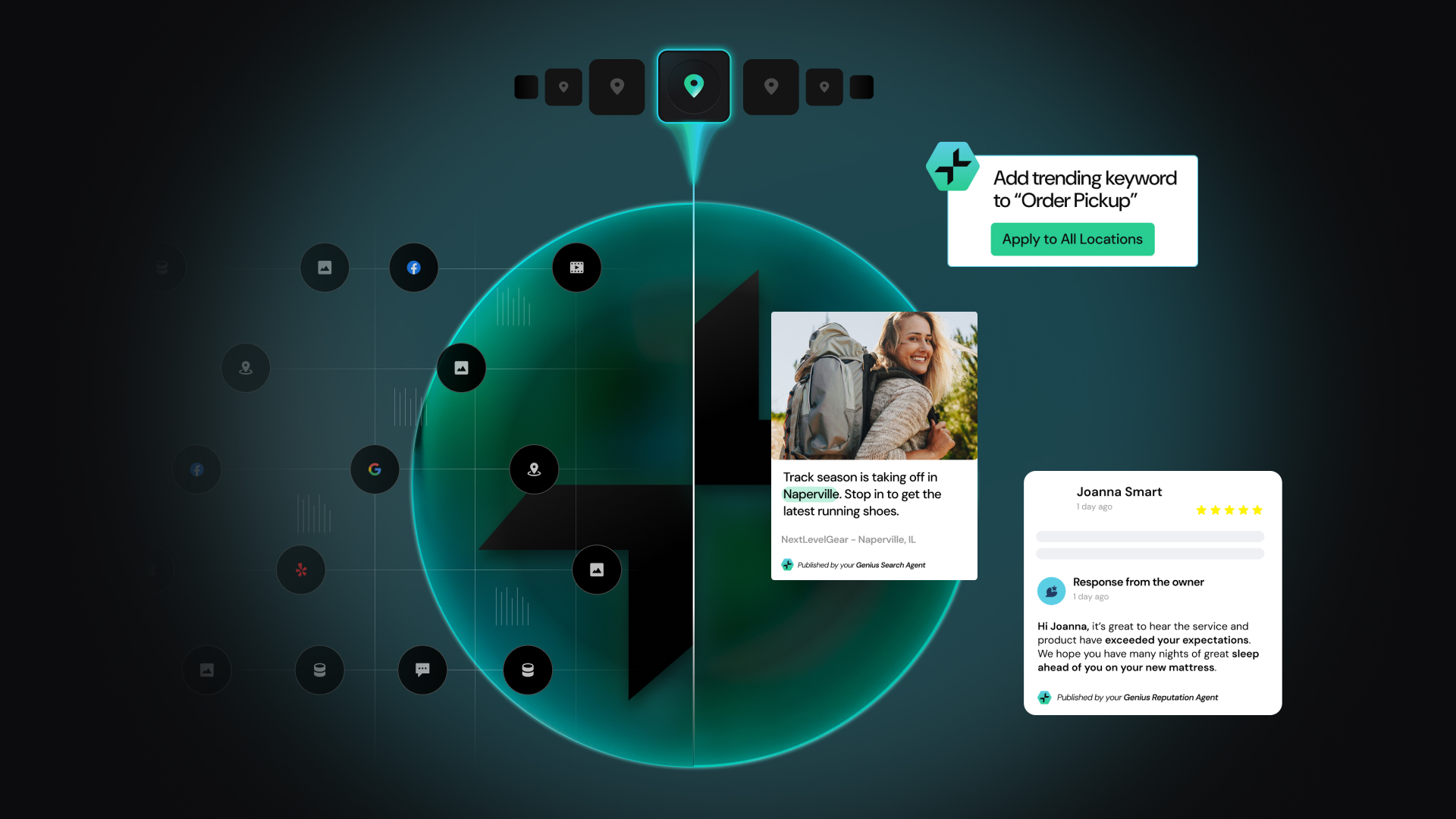
How Enterprise Brands Respond to Thousands of Reviews a Week Without Losing Brand Voice
Share


At a smaller footprint, review response feels manageable because the volume is predictable and ownership is clear. Missed replies are visible before they become exposure.
As the footprint expands into the hundreds across Google, Yelp, Facebook, Apple Maps, and industry directories, response volume accelerates faster than most coordination models evolve. The ability to respond consistently, safely, and on time becomes less certain, even when the intent to do so remains.
Reviews rarely arrive evenly. A service issue in one region can generate a cluster of 1-star reviews across multiple locations, while other platforms quietly age without anyone noticing. Meanwhile, distributed contributors respond under pressure, and one reply that misses legal or brand standards can create more exposure than the original complaint.
At enterprise scale, review response stops behaving like a queue and begins functioning as execution infrastructure. Many organizations continue operating it as if the underlying complexity never changed.
This article explains what breaks first when review volume outpaces capacity, why tools built for smaller footprints introduce new exposure at scale, and what an enterprise-grade workflow must include to handle review volume without losing brand voice, compliance discipline, or visibility.
How to respond to reviews at scale across hundreds of locations
Enterprise brands don’t struggle with whether to respond. They struggle with how to respond consistently, safely, and on time across hundreds or thousands of locations.
At scale, that means maintaining consistent response times, brand voice, and compliance standards without relying on manual triage or informal coordination.
What review response looks like when volume outpaces capacity
Most enterprise teams don’t lose control of review responses all at once. The strain builds quietly — then a product launch hits, or a regional incident drives a surge, and the queue suddenly becomes three days deep, with no clear path to recovery.
Review volume doesn’t move in straight lines. It tends to cluster around events, incidents, and campaigns. A weather event affects ten locations in one market. A menu change generates complaints across a region. A competitor comparison goes viral, and reviews flood in across platforms simultaneously. Teams built around average volume struggle most during peaks, which is exactly when response quality matters most.
Once the footprint crosses the point where manual management no longer holds, a few patterns tend to emerge.
- Queues begin to age without visibility. A review that required a same-day reply remains unanswered for several days, and the customer has already escalated elsewhere.
- Triage absorbs meaningful capacity. Teams spend hours deciding what requires attention, which platform is slipping, and which location presents the highest risk. That effort rarely appears in performance reporting.
- Coverage becomes uneven by default. Google receives consistent attention, while Yelp and Facebook fall behind depending on bandwidth rather than strategy.
- Confidence erodes across the organization. When leadership asks what is currently unanswered across the footprint, the answer often requires manual investigation rather than immediate clarity.
The deeper issue isn’t volume alone. It is the absence of structured execution once volume increases. Without defined prioritization, drafting standards, and approval controls, response becomes reactive, and risk accumulates gradually across locations.
The four failure modes that surface when the review response breaks at scale
Volume triggers the breakdown, but the damage shows up in distinct ways — each one compounding the next.
1. Response SLAs slip, and the damage builds
A 1-star review about a legitimate service issue appears on Monday. By Thursday, it remains unanswered, visible in search results, and increasingly likely to surface in AI-generated summaries about that location.
SLA targets may exist in policy documents, but without a reliable view into aging reviews across platforms and locations, teams don’t see the breakdown until it appears in a reputation report or a customer escalation. At that point, the work shifts from response to containment.
The timing gap carries more weight now. AI-driven discovery tools factor engagement patterns and sentiment trends into which locations get surfaced. A pattern of unanswered negative reviews across multiple locations becomes a visibility issue, not just a customer experience problem.
2. Brand voice fragments across locations
When volume pressures teams to move quickly, consistency often slips first. One location sounds thoughtful and specific, while another reads rushed. A franchise partner responds to a wait-time complaint in language that feels dismissive, and the issue resurfaces when a customer quotes it publicly.
Maintaining brand voice across a distributed footprint is difficult even in calm periods. Regional norms differ. Platform expectations vary. When contributors draft under pressure without guardrails built into the system they’re using, those differences expand.
High-visibility reviews — those with extended threads, strong engagement, or media attention — may carry responses that don’t reflect how the brand intends to present itself. Corrections take time, and the original response has already shaped perception.
3. Legal and compliance exposure accumulates quietly
In regulated industries such as financial services, healthcare, and senior living, review responses require discipline. Referencing a specific transaction, acknowledging a private interaction, or committing to a resolution in writing can create liability beyond the original complaint.
Responses written under time pressure — or generated by tools that lack industry guardrails — miss those boundaries. The exposure often isn’t obvious at the time of publication. The response is live, searchable, and part of the public record before anyone flags the issue. Removing or revising it rarely erases the initial impact.
4. Negative reviews stop getting the attention that protects the reputation
Overwhelmed teams adapt. Reviews receive brief replies to maintain response rate metrics. Templated language appears repeatedly across locations. Customers notice the repetition, and in some cases they call it out publicly.
Backlogs change behavior over time. Complex complaints that require context and careful language start to feel like liabilities rather than opportunities to repair trust. Sentiment trends decline gradually until the pattern becomes visible in reporting, and it becomes more difficult to reverse.
Why tools that work at 50 locations stop working at 500
SMB review tools assume limited volume and centralized oversight. That model holds at a lower scale. Once a brand manages hundreds of locations across multiple platforms with distributed contributors, the operating assumptions change, and coordination gaps widen.
The breakdown rarely happens overnight. Confidence declines first — in the data, in the queue, in the reporting.
Several structural gaps surface consistently as volume grows:
- Shared inboxes become bottlenecks: What once coordinated a small team becomes a queue no one fully owns. Reviews get viewed without a clear follow-up.
- Platform-by-platform dashboards create blind spots: Switching between Google Business Profile, Yelp, Facebook, and industry directories to build a full picture is slow and incomplete. Activity on one platform remains invisible while someone works in another.
- Approval workflows don’t scale: When the same person drafts and publishes responses, governance depends entirely on individual judgment. That model exposes the brand during incidents, audits, or franchise disputes.
- Reporting doesn’t scale with the footprint: Response rate by location, average reply time by region, sentiment shifts across platforms — the data exists, but assembling it into something reliable requires sustained manual effort.
The inflection point usually arrives once the footprint exceeds the threshold where informal coordination can keep pace with volume. Beyond that point, gaps multiply faster than workarounds can contain them. Teams begin operating with uncertainty about what is aging, what is exposed, and where risk is accumulating.
As footprints expand into the hundreds, the review response stops behaving like a contained operational task. It requires structured coordination, shared visibility, and governance that holds across the entire footprint.
Adding headcount rarely solves the underlying issue. Volume continues to grow, while manual process layers introduce new friction. The same failure modes reappear at higher exposure levels.
What an enterprise review response workflow actually requires
Responding to reviews at scale requires a coordinated workflow that manages high-volume reviews without fragmenting voice or missing risk signals. That means centralized visibility, intelligent prioritization, AI-assisted drafting aligned to brand standards, and governance embedded directly into the response process.
What is enterprise review response management?
Enterprise review response management is the structured process of monitoring, prioritizing, drafting, approving, and publishing review responses across a distributed footprint while maintaining centralized visibility and governance.
Responding to reviews at scale is an execution problem, but solving it requires more than speed. The workflow must support visibility, governance, and brand consistency so teams can manage high-volume reviews without creating new exposure in the process.
A centralized visibility layer across all locations and platforms
The starting point for managing high-volume reviews is knowing what’s actually happening across the full footprint. That means a unified view of incoming review volume, how long reviews have been sitting without a response, and where SLA targets are being missed — across Google, Yelp, Facebook, Apple Maps, and any industry-specific platforms relevant to the brand.
Sentiment tracking at the location, region, and platform level turns that visibility into something actionable. When a cluster of negative reviews is building around a specific issue at locations in one market, teams should be able to see that pattern emerging before it becomes a reputation event, not after.
Intelligent prioritization based on risk and sentiment
Centralized visibility is only useful if it helps teams focus on what matters most. A 1-star review alleging a safety issue at a high-traffic location shouldn’t be treated the same as a 4-star review with a minor complaint about wait times. Effective review response management means the highest-risk reviews surface first, automatically.
Keyword triggers that flag sensitive language — references to illness, injury, legal action, or regulated topics — give teams a way to route those reviews through a more careful process before a response goes out. Locations with recurring negative sentiment patterns become visible quickly, which allows teams to address the underlying issue rather than responding to an endless stream of individual complaints.
AI-drafted responses trained on brand voice
Many enterprise teams have experimented with AI-generated responses and found that the drafts require significant editing before they are usable. The issue is rarely AI drafting itself. It is that the tools generating those drafts were not trained on how the brand actually communicates.
Automated responses create real efficiency when they reflect the brand accurately, including tone, persona, level of formality, and any boundaries required in regulated industries. A well-structured draft provides a strong starting point tailored to the type of review being addressed, whether that is a detailed service complaint, a simple 5-star note, or a sensitive issue requiring careful language.
Drafts should be generated with brand guardrails built in and then routed through the appropriate review and approval path rather than auto-published. The workflow determines who reviews it, who approves it, and when it goes live.
Configurable approval workflows
The brand voice failure modes described earlier — tone fragmentation, compliance violations, off-script franchise responses — don’t happen because individuals are careless. They happen because no approval structure catches problems before they’re published. A heartfelt 5-star review from a loyal customer doesn’t require the same oversight as a 1-star complaint that references a specific staff member by name or alleges a product failure.
Role-based permissions enable teams to build approval paths that align with the risk level of the response. High-sensitivity reviews route to the right person before anything goes live. Lower-risk responses move through a streamlined path that keeps volume manageable without creating governance gaps.
Guardrails embedded in the response system
Brand and compliance standards that live only in a style guide or in the institutional knowledge of a few senior team members don’t scale. Those standards must be embedded directly into the environment where responses are drafted and published.
Sensitive language should trigger review before a response is posted. Industry-specific restrictions should apply consistently, regardless of who is managing the queue that day. A clear audit trail should document what was published, when, and by whom so compliance reviews and escalations rely on records rather than reconstruction.
How this workflow plays out in practice
The capabilities described above aren’t abstract. They address specific situations enterprise teams encounter regularly — situations where the gap between a well-designed workflow and an improvised one becomes apparent quickly.
Seasonal or promotional volume spikes
A national retail brand runs a holiday promotion across 600 locations, and review volume triples over three weeks. Sentiment varies by market. Some locations execute well, while others struggle with inventory or wait times, and that difference is reflected clearly in the reviews.
The team can’t expand headcount to absorb a short-term surge. Instead, they need a way to maintain response quality and SLA performance across the footprint without requiring every response to receive senior-level attention. Brand-trained drafts provide a starting point aligned to tone standards and review context, allowing teams to preserve voice consistency even as volume increases.
A high-risk negative review
A customer posts a detailed 1-star review at a financial services location, referencing a specific transaction and a named employee, and implying the situation is being taken further. The review is public, indexed within hours, and sitting on a profile that hundreds of prospective customers will visit this month.
The system flags it immediately based on sentiment score and keyword triggers. A draft is generated that acknowledges the customer’s concern, expresses genuine interest in resolving the issue, and avoids language that would constitute an acknowledgment of fault or a commitment that creates downstream liability. The response routes to the appropriate person for review before anything is published. It goes live within SLA. The interaction is documented with a full audit trail — who approved it, when, and what was published — which matters if the situation escalates further.
That sequence happens because the workflow was designed for it, not improvised at the moment.
Franchise or regional partner participation
Franchise operators have a legitimate interest in responding to reviews about their locations. They know the customers, the context, and often want to handle the conversation directly. The challenge is that brand governance standards, compliance requirements, and tone expectations don’t change because the person drafting the response is a franchisee rather than a corporate team member.
Role-based permissions allow local operators to participate in the response workflow within clearly defined boundaries. They can draft and, in some cases, publish responses for their locations — but the guardrails travel with them. Sensitive reviews, flagged language, or anything that crosses a risk threshold are routed upward automatically for review before they go live. The brand gets consistent representation across the footprint without requiring corporate oversight of every individual response. Franchise partners get the autonomy they want without the governance gaps that autonomy typically creates.
Why review response quality impacts AI search visibility
Review response quality shapes the public record that AI systems interpret. Engagement patterns — whether reviews receive timely, substantive replies — influence how credibility is assessed at the location level.
Response behavior has always influenced local search ranking. What has changed is how AI systems synthesize engagement signals. Large language models evaluate response frequency, depth, and consistency as indicators of active management.
Unanswered negative reviews weaken that signal. Profiles that demonstrate timely acknowledgment and steady engagement present a stronger credibility profile than those where complaints remain visible without response.
SOCi’s AI Visibility Report found that brand locations appear in LLM-generated recommendations at an average rate of 17.6%, compared to 23.6% visibility in Google’s traditional local 3-Pack. That difference reflects how engagement consistency influences whether a location is surfaced in generative results.
Across a large footprint, response inconsistency compounds. Isolated gaps may be recoverable. Distributed inconsistency becomes a measurable authority signal that affects discovery.
Consistent, on-brand execution strengthens sentiment and authority signals over time. Review response, when governed properly, becomes part of the brand’s visible operating discipline.
Key considerations for enterprise leaders evaluating review response at scale
If the current review response approach is straining under volume, the right question isn’t whether to change it. It’s what a better system actually needs to do. These questions are worth working through honestly before evaluating any solution.
Can you see review volume, response rate, and SLA status for every location in a single view? If pulling that picture together requires manual reporting or platform-by-platform investigation, the approach is already creating blind spots that will surface at the worst possible time.
Can high-risk reviews be prioritized automatically? If triage is handled manually, response quality during volume spikes depends entirely on individual judgment under pressure — and that’s exactly how compliance violations and off-brand responses get published.
Do AI-drafted responses actually reflect the brand, or do they require significant rewriting before they’re usable? Drafts that need heavy editing before every use aren’t saving time. They’re shifting work from one person to another while creating a false sense of automation.
Do compliance guardrails live inside the drafting and approval process? If brand standards and industry restrictions exist in a separate document that team members consult on their own, those guardrails aren’t governing anything. They’re advisory. Advisory isn’t sufficient when a response gets indexed before anyone catches the problem.
Can franchise or regional partners participate in review responses without creating brand governance gaps? If the answer is currently “we give them guidance and hope for the best,” that’s a real exposure — particularly in regulated industries or during high-visibility incidents.
Is the reporting trustworthy enough to defend performance to leadership? Response rate, average time to reply, and sentiment trends by region — if those numbers require manual assembly or carry significant uncertainty, the system isn’t providing the visibility that operational accountability requires.
The case for rethinking review response at enterprise scale
As footprints expand, review volume increases, platforms multiply, and customer expectations for response time rise. Approaches built for smaller footprints struggle to handle that growth and introduce SLA failures, tone drift, compliance exposure, and visibility gaps that accumulate over time.
Brands that adapt treat review response as a governed operating function rather than periodic cleanup. That means centralized visibility, intelligent prioritization, brand-trained drafts, and governance embedded directly in the workflow.
When those elements operate together, review response becomes a consistent sentiment and authority signal across every location and platform. Brands that build systems to respond to reviews at scale shift what was once reactive cleanup into structured, defensible infrastructure.
SOCi supports this operating model with unified visibility across platforms, brand-trained drafting, and governance controls that scale across distributed teams. For enterprise brands managing hundreds or thousands of locations, that structure makes review response consistent, defensible, and measurable.
Frequently asked questions about responding to reviews at scale
How do enterprise brands manage high-volume reviews?
Enterprise brands manage high-volume reviews through centralized visibility across platforms, automated prioritization based on risk and sentiment, AI-drafted responses trained on brand standards, and approval workflows aligned to compliance requirements.
Why does review response impact AI search visibility?
AI search systems evaluate response frequency, sentiment patterns, and engagement quality when assessing credibility at the location level. Consistent, timely responses strengthen authority signals, while unanswered or inconsistent replies weaken them.
What breaks first when review volume increases?
Response SLAs typically slip first, followed by tone inconsistency and compliance risk. Without centralized visibility, teams often don’t realize the breakdown until negative sentiment patterns become visible in reporting or search results.
Related Articles