Winning the Next Era of Local Visibility: Key Takeaways from Our Google Webinar
Share


If you’ve noticed that Google Search looks and feels different lately, you’re not imagining it. AI isn’t coming to local search; it’s already here, and it’s moving fast. SOCi recently hosted a webinar with Lisa Landsman, Head of Global Partnerships at Google Search, to unpack exactly what’s changing, what it means for multi-location brands, and how to stay visible in a world where AI is increasingly deciding which businesses get found.
Here are the most important takeaways from that conversation and the actions every local marketer should be taking today.
AI Is Transforming Search at Unprecedented Speed
Fresh off Google I/O, Lisa shared a stat that speaks to the scale of Google’s role in the information economy: one billion facts are uploaded to Google Search every single minute. Google’s access to up-to-date information gives it a big advantage in the AI race, especially for use cases like local search that require data to be accurate and actionable.
The numbers on AI adoption back up how quickly search behavior is shifting:
- AI Overviews have undergone massive growth since launching and are now seen by 2.5 billion monthly active users.
- Gemini, the model that powers AI in Google Search, has also seen usage of its native app grow to 900 million monthly active users.
- AI Mode queries have more than doubled every quarter since launch; the dedicated AI interface for search now has 1 billion monthly users.
Google’s goal has always been to reduce search refinements, the repeated attempts people make when they can’t find what they’re looking for. AI is delivering on that promise, and the result is a more satisfied user who engages more deeply with results.
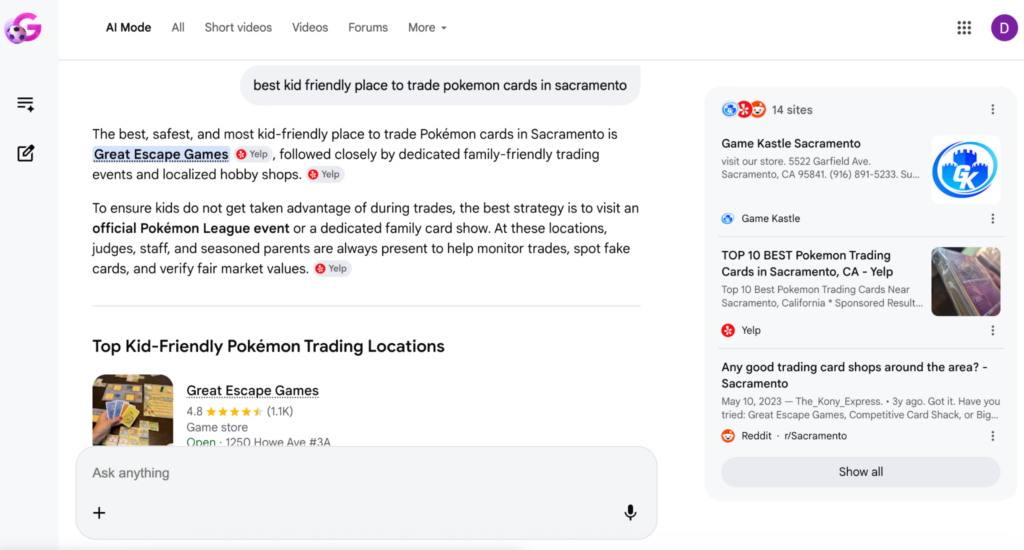
Users are increasingly turning to Google’s AI features, such as AI Mode in Search, for local recommendations
People Are Asking Longer, More Specific Questions, and That Changes Everything
The average search query used to be around four words. Today, with AI-powered search, it’s closer to 23 words on average. People are no longer typing “restaurant near me.” They’re asking things like:
- “Things to do in Nashville this weekend with friends – we’re big foodies who love live music and exploring off the beaten path”
- “Vegan food, cozy vibe, table for four at 7 PM tonight near Midtown East”
- “My phone is dying – where can I charge it without waiting in a long line for coffee?”
- “Is there a public tennis court with lights where I can play tonight?”
These aren’t just longer queries. They’re more specific, which means far fewer businesses will qualify as the right answer. If your Google Business Profile doesn’t communicate your hours, amenities, menu, atmosphere, and services to match that level of specificity, you’ll be invisible to that searcher.
The flip side? A consumer who reaches the end of that AI-powered search journey and finds you as the answer is highly qualified and very likely to transact.
AI Mode, Ask Maps, and the Features Reshaping Local Discovery
Two features deserve particular attention from local marketers right now.
AI Mode
Google’s AI Mode now integrates seamlessly with AI Overviews, so rather than sending users to a separate tab for deeper exploration, Google anticipates when someone wants a richer conversation and surfaces that experience inline. It’s conversational, it’s interactive, and it’s where more and more consumers are spending their search time.
Ask Maps
One of the most exciting recent launches is Ask Maps, now live inside the Google Maps app and in Maps on desktop. Ask Maps brings AI-powered, conversational search directly into the Maps experience — the place where local purchase decisions happen.
Ask Maps doesn’t just return a list of results. It understands nuanced queries, personalizes results based on what it knows about you (your saved locations, your past reviews, your habits), and surfaces contextual “know before you go” information like parking availability, accessibility features, and the details that make each option uniquely suited to your needs. It can also help you take actions like booking reservations and saving places for later, indicating the beginning of a shift toward agentic search experiences.
For local brands, this is the new arena for local discovery.
The AI Visibility Gap Is Real, and It’s an Opportunity
SOCi’s Local Visibility Index benchmarks how well brands show up in local search. The most recent data reveals a meaningful gap:
- 36% of target brands appeared for their key terms in Google’s local 3-pack (traditional search)
- Only 11% of those same brands appeared when Gemini was asked to recommend a business of that type
That gap exists because AI results are more selective. There’s no page two. There might not even be three results; Gemini may surface just one recommendation. The brands filling that 11% slot are the ones who have given Google everything it needs to confidently recommend them.
That’s a problem for brands that are behind, but a significant opportunity for brands who share accurate, consistent, detailed store-level data in their online profiles and properties.
Your Google Business Profile Is Still Your Most Powerful Local Signal
All roads in local AI search, especially in a Google context, lead back to your Google Business Profile (GBP). Google Maps is the primary source for local answers in Google’s Knowledge Graph, and GBP is the part of Maps business owners can control and influence. Your website and local landing pages, as well as Yelp and social platforms, all play supporting roles. But GBP is the foundation.
In the webinar, Google’s Lisa Landsman organized the key optimization areas into three buckets:
1. Master the Basics
- Name, address, phone number: These must be correct, consistent, and current.
- Business categories: Don’t overlook secondary categories. A wings restaurant that also functions as a sports bar needs both categories to surface for sports bar searches.
- Hours: Make sure to include holiday hours. Incorrect hours are one of the most damaging (and avoidable) profile issues.
- Attributes: Indicate accessibility, amenities, payment methods, and any other relevant attribute for your business.
2. Tell Your Story
- Menus and services: Build these out with titles, descriptions, and pricing. A spa that doesn’t list hot stone massage won’t show up when someone searches for it.
- Photos and videos: Businesses with photos are more likely to receive direction requests and website clicks. Show the experience, not just the logo. What does the patio actually look like? What’s the vibe?
- Google Posts: These are free, underutilized, and increasingly powerful. Posts can showcase events, offers, and updates. Google’s “What’s Happening” feature (currently live for food, drink, and leisure businesses) surfaces timely event post content prominently in Google profiles.
- Social media links: Connect your Instagram and Facebook to your GBP. Google pulls this content into search results across multiple surfaces, and SOCi’s case study with a national paint-and-sip franchise demonstrated a 9% increase in Google Search impressions and a 10% increase in web clicks and phone calls simply by adding social media links to their business profiles. Social feed content is also eligible for the “What’s Happening” feature.
3. Engage Your Community Through Reviews
Reviews are being pulled into AI results, local panels, and decision-making journeys everywhere. They’re increasingly visible, which makes how you handle them more important than ever.
A few key principles:
- Respond to every review, positive or negative. A thoughtful response to a negative review can actually increase trust with prospective customers who see it.
- Ask for reviews: This is allowed and encouraged on Google. You just can’t pressure, incentivize, or script them. “If you had a great experience, we’d love a review” is perfectly appropriate.
- Don’t fake it: Google uses Gemini to catch suspicious review activity faster than ever. The risk is not worth it.
Five Things to Do Outside Your GBP
Lisa also shared the broader signals Google uses when triangulating information about your business:
- Unique, valuable content: Text, images, and video on your website and other channels that tells your story
- Technical accessibility: Make sure Google can crawl your site; use structured data
- Showcase your unique value: There’s a reason your business stands out from the competition. Make that reason findable.
- Consistency across platforms: If your hours say one thing on Yelp and another on your website, Google may show the wrong information or none at all.
- Reviews everywhere: Not just on Google. The more authentic peer-to-peer content that exists about your business, the richer the AI recommendations for your business will become.
Your AI Visibility Action Plan: Where to Start
If you’re leaving this article with one thing, let it be this: the brands that show up in AI results are the ones that give AI everything it needs to be confident in recommending them.
Here’s a practical starting point:
- Audit your GBP completeness. For your business category, every relevant field should be filled in. No empty menus. No missing service descriptions. No placeholder photos.
- Add your social media links to your business profiles — and post consistently so that content flows into search results.
- Respond to reviews within 24-48 hours, including negative reviews.
- Add photos and short videos that answer the questions a first-time visitor would have.
- Use Google Posts to keep your profile timely and event-driven.
- Check for consistency across your website, Yelp, social bios, and other directories.
The bar is rising. But for multi-location brands willing to invest in profile completeness and content freshness, the opportunity to capture a meaningful share of AI-driven local discovery has never been greater.
Questions & Answers
Finally, we had several questions from webinar participants that we weren’t able to answer during the session. Below is a sampling of those questions with answers from SOCi and Google. Some questions are edited for length and clarity.
Question: Is AskMaps available to all users globally? Or is it only launching in the U.S. for now?
Ask Maps is currently available to users in the U.S., India, Canada, Australia, and the U.K.
Question: Have any attributes or other opportunities become more relevant in the restaurant industry that we should take into account?
Especially with the launch of the “What’s Happening” feature, discussed above, posts have become one of the most valuable and underutilized opportunities for restaurants. Posts essentially act as free ad space for the business. In addition to posts and menus, attributes that communicate details about parking, seating, menu options, dine-in and takeout options, amenities, and so on can help to inform consumers and AI bots about your business. Check back frequently because attribute options are regularly updated.
Question: The fake reviews policies are great, but I’m looking for a way to report conflict of interest when the reviewer is a former employee and I don’t see that. I also didn’t see any options for reporting incentivized reviews.
These options are updated from time to time, and not all options you might want to utilize may be available. If that’s the case, you should choose the option for flagging the review that best fits the situation. Note too that options differ somewhat by interface. In the Google Maps app, you can go to the profile of a business, scroll to the bottom where you will see a horizontal row of buttons like “Ask,” “Call,” “Save,” etc., scroll right and click on “… More,” and choose “Report business conduct.” Using this feature you will be able to report a business for “Offering something in exchange for reviews” or “Pressuring people to leave reviews.”
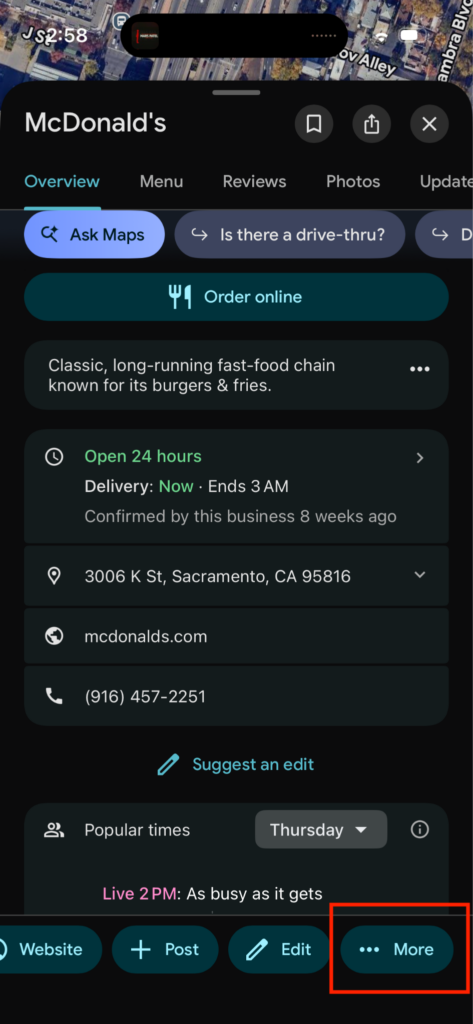
Scroll all the way to the right and tap the “… More” button at the bottom of any business profile in Google Maps to report a concern about incentivised reviews.
Question: There was a rumor floating around on Reddit/X that Google Business Profiles can be negatively impacted when customer reviews mention a technician’s name. Is there any truth to that, or is it a misconception? I’ve always viewed technician name mentions as a positive signal.
As we mentioned in the webinar, it’s fine if a reviewer organically mentions the name of a staff member, but businesses should not specifically ask them to do so.
Related Articles