AI Visibility: How Brands Get Recommended by ChatGPT, Gemini, and Perplexity
Share


Summary
AI visibility measures how often a business appears in recommendations generated by AI platforms such as ChatGPT, Gemini, and Perplexity. SOCi’s 2026 Local Visibility Index introduces a framework for measuring AI visibility for multi-location brands using a “% Recommended” metric that tracks how frequently brands appear in AI-generated local recommendations. The research shows that AI platforms recommend brands far less often than traditional search engines, creating a new visibility challenge for multi-location businesses.
AI is a new gateway for discovering local businesses. Instead of scrolling through search results, users increasingly ask platforms like ChatGPT, Gemini, and Perplexity to recommend places nearby. This shift introduces a new challenge for brands: understanding and improving AI visibility.
What is AI Visibility?
AI visibility refers to how often a business appears in AI-generated recommendations from platforms like ChatGPT, Gemini, and Perplexity when users ask for products, services, or local businesses. Unlike traditional search, it measures recommendation frequency rather than ranked position.
Why AI Search Optimization Is Harder Than Traditional Search
We found that AI platforms including ChatGPT, Gemini, and Perplexity are much more selective than traditional search engines when choosing which local businesses to recommend in SOCi’s 2026 Local Visibility Index (LVI), the first study to measure AI visibility for multi-location brands. The 2026 Local Visibility Index analyzed thousands of business locations across multiple industries to measure how often brands appear in AI-generated recommendations.
Key Findings from the 2026 Local Visibility Index
- Gemini recommended brands 11% of the time
- Brands appeared 36% of the time in Google’s 3-Pack
- ChatGPT recommendations averaged 4.3★ ratings
- Brand locations appeared in AI recommendations 6.5% of the time
These results pose a challenge for multi-location brands, which appear far less frequently in AI recommendations than local SMBs.
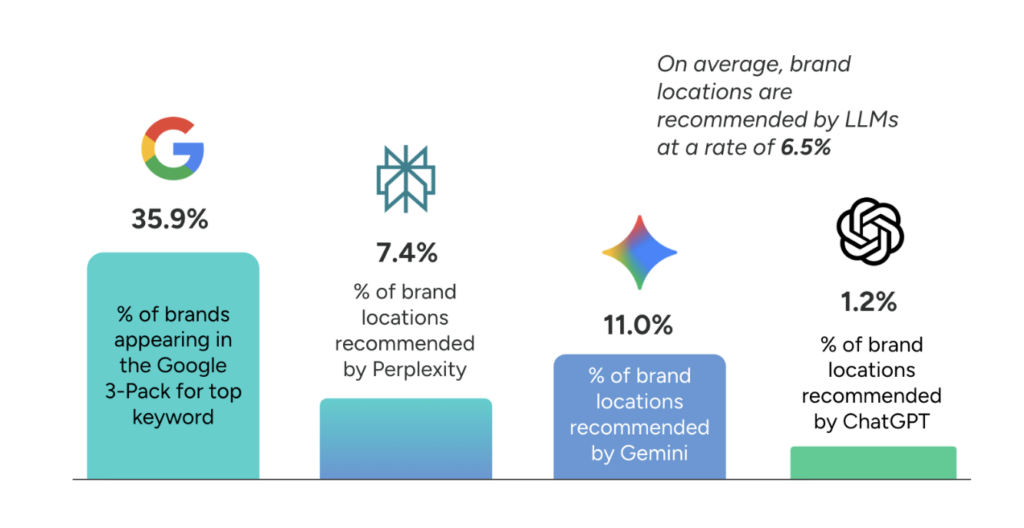
Source: SOCi’s 2026 Local Visibility Index
AI Recommendations Are Probabilistic, Not Ranked
For many years, search marketers have relied on rank tracking to track online visibility for websites and local businesses. This was never a perfect solution, because personalization, including the physical location of the user, has a huge influence on rank position. However, if you repeat the same query under the same circumstances over time, rank position provides an indicator of relative growth or decline; and in recent years, grid-based ranking reports that check for rank position across a set geographical area have made rank tracking even more precise and useful.
But rank tracking is pointless in an AI context. As Rand Fishkin made clear in a recent study, asking an AI tool the same question 100 times is likely to present 100 different answers, and if those answers include a list of options (such as when recommending local businesses), different businesses may appear or disappear from lists of differing lengths with no apparent rhyme or reason.
This is because AI tools are probabilistic rather than deterministic. Even when the same question is asked repeatedly, the model may generate different answers each time.
These findings raise an important question: if AI recommendations are probabilistic, how can visibility be measured at all?
To answer that, we developed a new methodology as part of the 2026 LVI.
How the Local Visibility Index Measures AI Visibility
Understanding How AI Platforms Generate Recommendations
Several basic facts about AI platforms informed our approach:
- Users typically ask longer, more conversational, and more nuanced questions than they do in traditional search.
- AI results can differ significantly for different users or for the same query asked at different times.
- Personalization may influence which businesses appear in AI-generated recommendations.
Because of these dynamics, measuring visibility in AI environments requires a different approach than traditional rank tracking.
Designing a Repeatable Measurement Framework
To account for this variability, we developed a methodology that could be applied consistently across thousands of business locations.
Rather than trying to devise a comprehensive list of more specific questions people might ask about local businesses across multiple industries, we used a standardized prompt: “Can you recommend businesses of X type in Y market?” This question acts as a stand-in for the many ways users might ask for local business recommendations. If a brand does not appear for this core query, it is unlikely to surface in more specific variations.
We repeated this prompt for every audited location of each brand in the study, generating a statistically meaningful sample of responses across the brand’s footprint. The average brand included in the Local Visibility Index was represented by approximately 67 locations.
For each query, we asked the AI platform to recommend 10 businesses, but our analysis focused only on whether the target brand appeared within the first five results. Because AI responses vary in length and order, we did not track rank position. Instead, a location was flagged as “likely to be recommended” if it appeared anywhere in the top five recommendations.
The Core Metric: % Recommended
To quantify AI visibility, we developed a metric called % Recommended.
% Recommended measures how often a brand appears in recommendations generated by AI platforms like ChatGPT, Gemini, and Perplexity across multiple queries and locations.
While no single metric can perfectly capture visibility in probabilistic AI systems, % Recommended provides a consistent way to track how frequently a brand surfaces in AI recommendations and how that performance compares with others in the same industry.
Over time, this metric offers a directional view of how a brand’s local visibility is evolving across AI platforms.
Why Multi-Location Brands Struggle in AI Results
AI systems do not evaluate locations, channels, or tactics in isolation. They evaluate the entire digital footprint of a brand when deciding whether it is safe to recommend.
Multi-location brands operate at a scale and complexity that AI systems struggle to interpret consistently.
Early patterns show LLMs often favor single-location businesses because their data, reputation, and activity signals are simpler and more unified. Local SMBs have the advantage because they have stronger local relevance, more focused review signals, and clearer geographic context.
AI pulls signals from every location, platform, and review that forms one opinion of a brand and applies it everywhere. If even a small subset of locations are inconsistent, inactive, or underperforming, AI interprets that as risk and withholds recommendations.
The Five Factors That Influence AI Visibility
AI systems evaluate businesses through a combination of signals that indicate whether a brand is active, trustworthy, and relevant to a user’s request. SOCi’s research suggests five primary forces influence AI visibility for local businesses that we call FACTS.
Freshness
LLMs show a strong recency bias. Fresh activity signals that the business is operating today, engaged with customers, and actively delivering real-world experiences.
Authority
Ratings, reviews, recency, response time, and feedback patterns all become signals used to assess whether the brand is reliable across every location.
Consistency
AI gathers business data from multiple sources like Google Search and Maps, Yelp, Bing, brand websites, and local pages. They do not reconcile discrepancies. Every inconsistency such as mismatched hours, duplicate listings, outdated phone numbers, missing attributes, conflicting naming conventions signals uncertainty.
Trust
AI looks for patterns that suggest a brand consistently delivers on its promises. This includes historical performance, response patterns, and the overall coherence of digital presence.
Semantic Relevance
AI connects businesses to queries based on natural language relevance, not keyword density. For multi-location brands, relevance must be local. Content should reflect the needs, context, and questions of each community you serve.
How Brands Can Improve AI Visibility
Improving AI visibility requires strengthening the signals that large language models use to evaluate businesses. While AI systems do not rank businesses the same way search engines do, they rely on observable patterns across reputation, content, and local presence to determine which brands are safe and useful to recommend.
For multi-location brands, improving AI visibility typically means focusing on five operational areas:
Maintain strong review signals
Ratings, review volume, and response consistency influence whether AI models view a brand as reliable. Brands with higher ratings and recent customer feedback are more likely to appear in AI recommendations.
Respond to customer feedback consistently
Active engagement signals that a business is operating and responsive. Consistent responses also strengthen sentiment signals that AI systems use to evaluate brand trustworthiness.
Ensure accurate local business data
AI platforms pull information from sources like Google Business Profiles, business directories, and brand websites. Inconsistent or outdated information creates uncertainty and can reduce the likelihood of recommendation.
Publish locally relevant content
AI systems connect businesses to queries using natural language patterns. Content that reflects how people actually ask questions about local services improves the chances that a brand will be surfaced in AI-generated answers.
Monitor AI visibility trends over time
Because AI recommendations are probabilistic, brands should focus on frequency rather than rank position. Tracking how often a brand appears in AI recommendations provides a clearer picture of visibility trends.
Measure Your Brand’s AI Visibility
SOCi’s Local Visibility Index measures how often your locations appear in AI-generated recommendations compared to competitors in your market. Request an audit to see how your brand performs across key AI visibility signals and identify opportunities to improve recommendations.
FAQs
Related Articles