How Multi-Location Brands Measure AI Visibility Across Listings, Reviews, and Social Signals
Share


Some locations show up in AI recommendations. Others disappear entirely, and no one can explain why. Listings look correct on one platform but wrong on another. Reviews are strong in some markets and lagging in others. Teams end up chasing inconsistencies instead of understanding where visibility is actually breaking.
AI has changed how customers discover local businesses. Instead of browsing, they’re given a short list of recommendations—sometimes just one. Most locations are never shown at all. There is no second page. A location is either selected or it isn’t.
That shift raises a new question for enterprise brands: what actually determines whether a location gets recommended?
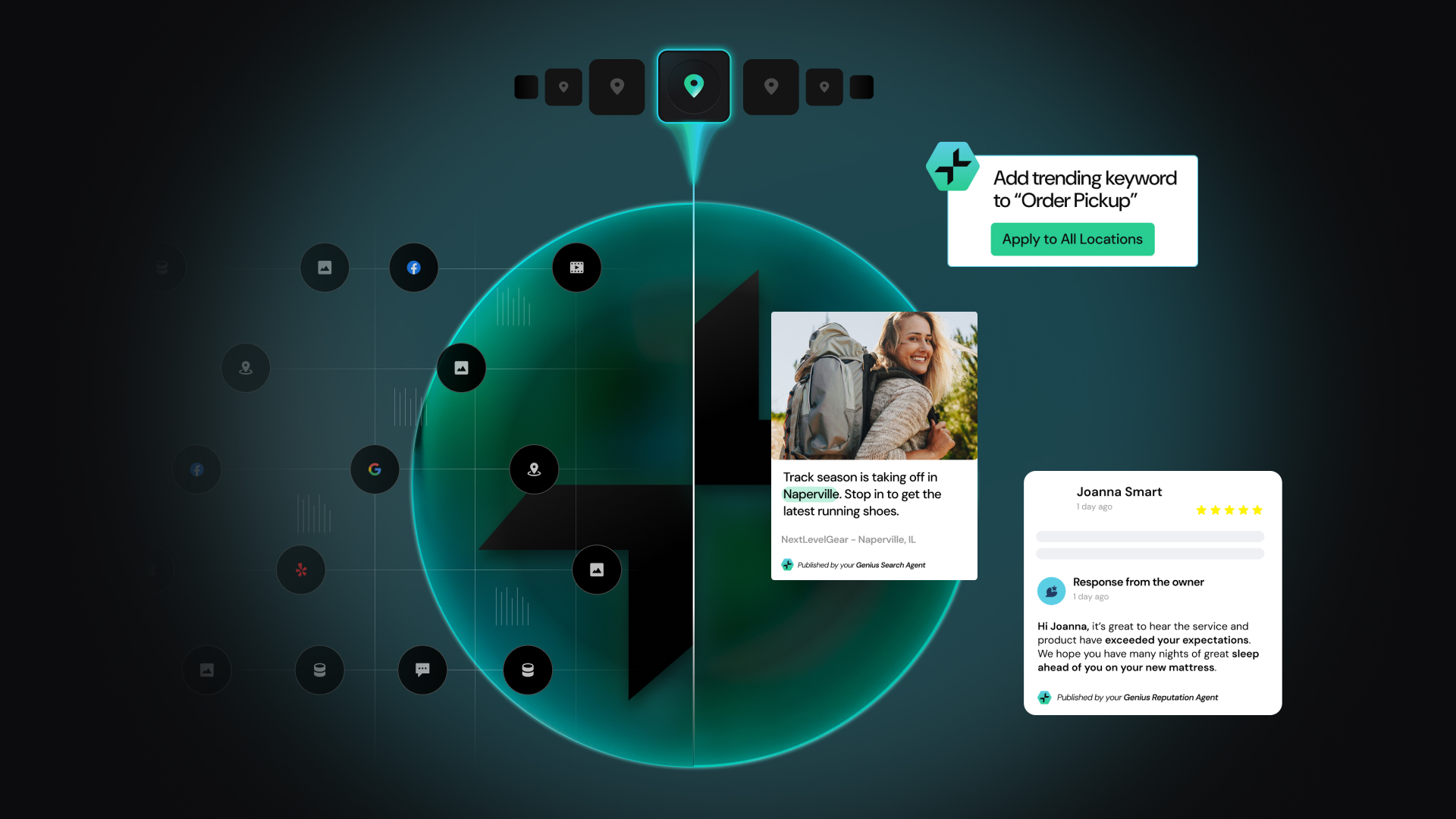
AI visibility is driven by signals that already exist across your local presence—listings accuracy, review sentiment, and engagement across platforms. The difference now is how those signals are evaluated: together, across sources, and with far less margin for error.
This article introduces a practical framework for measuring AI visibility across listings, reviews, and social signals, so you can identify where visibility is breaking, connect signals into something measurable, and evaluate whether your current approach can support AI-driven discovery at scale.
Why AI visibility feels impossible to measure at scale
Most teams can see something is off. Locations that used to perform well start disappearing from AI results, but there’s no clear explanation why. The signals exist, but they’re scattered, inconsistent, and hard to connect to anything actionable.
Visibility feels inconsistent and unpredictable
Locations that rank well in Google don’t always show up in AI results. Performance shifts from market to market without a clear pattern. One location is recommended consistently, while another with similar performance isn’t surfaced at all. That inconsistency makes it difficult to diagnose what’s driving visibility or explain changes to stakeholders.
Teams stop trusting their data
Listings often show different information depending on the platform. Hours are correct in one place and outdated in another. Addresses, phone numbers, or categories don’t always match.
AI reflects those gaps. It can surface incorrect details or skip locations entirely. In some cases, data accuracy drops below ~70% depending on the platform. Over time, teams start questioning whether what they see internally matches what customers and AI systems actually see.
Measurement is fragmented across channels
Listings, reviews, and social are managed in separate systems, each with its own reporting. Teams can see activity in each channel, but not how signals interact or which affect visibility. Connecting effort to outcome becomes manual and slow.
Visibility issues turn into operational fire drills
At scale, small inconsistencies don’t stay small. A rebrand or acquisition can introduce hundreds of mismatched listings overnight. Updates don’t propagate evenly. Customers see the inconsistency immediately—wrong hours, outdated messaging, missing information—and teams react after the damage is already visible.
Why traditional local SEO metrics no longer tell the full story
Traditional local SEO still provides useful signals, but it no longer explains how visibility works in AI. Teams can hit ranking goals and still see locations disappear from recommendations. This is where AI local SEO and generative engine optimization diverge from traditional approaches. Rankings still matter, but AI systems are making a different decision: which locations are credible enough to cite, recommend, or exclude.
Rankings ≠ visibility in AI
Strong Google performance is no longer a reliable indicator of visibility. Many locations that rank well never appear in AI-generated recommendations. In fact, fewer than half of the top-performing brands in traditional local search show up in AI results. Performance looks strong in dashboards, but customers aren’t seeing those locations when it matters.
AI evaluates signals differently
AI pulls from multiple sources at once and looks for consistency across them. A location with strong listings but weak reviews or inconsistent activity sends mixed signals. That lowers confidence, and AI moves on to locations with more complete, aligned signals. The bar is higher across the board. Average ratings, thin content, or inconsistent profiles that once performed adequately are now enough to exclude a location from AI recommendations.
AI is more selective, not more forgiving
AI raises the bar on what qualifies as “good enough.” Reviews illustrate this shift clearly. In traditional search, an average rating can still perform. In AI, that same rating can disqualify a location from being recommended. The same applies to content. Generic descriptions and thin local pages don’t hold up when customers ask specific, detailed questions. If a location can’t clearly match intent, it often doesn’t get surfaced.
The core problem: disconnected signals break AI discovery
What looks like a visibility problem is usually a coordination problem. The signals exist—but they don’t align.
1. Listings, reviews, and social operate as separate systems
Most enterprise teams manage these areas in parallel. Updates go out, but not everywhere at the same time.
After acquisitions or rebrands, inconsistencies compound—duplicate profiles, outdated names, missing categories. Months later, those gaps still surface in search and AI results.
Franchise environments add another layer, with local teams updating profiles and content differently across regions.
2. Inconsistent signals reduce AI confidence
AI systems are trying to answer a simple question: which location can be trusted for this query?
Conflicting data makes it harder to answer. Strong reviews paired with inaccurate hours—or complete listings with low engagement—create uncertainty. That uncertainty lowers the likelihood of being recommended.
What an enterprise AI visibility measurement model requires
Improving AI visibility starts with being able to clearly see what’s happening across locations.
- A single, trusted view of performance: One view of listings accuracy, review sentiment, and engagement across locations—without switching between systems or second-guessing data.
- Signals connected across the platforms AI uses: AI pulls from sources like Google Maps, Yelp, Facebook, and brand websites. Measurement needs to reflect that ecosystem. When signals align across these sources, visibility improves. When they don’t, it drops.
- Clear visibility into where things are breaking: Teams need to see which locations are at risk and why—before issues show up as lost traffic or missed conversions.
- The ability to act quickly across locations: Updates only matter if they show up everywhere. Slow propagation leads to outdated information persisting in AI results.
- A clear link between effort and outcome: Teams need to know whether changes actually improve visibility.
Platforms built for multi-location visibility bring these signals into a single view, making it possible to measure, compare, and act without manual reconciliation.
The three core signal groups that drive AI visibility
AI visibility is the result of multiple signals working together.
1. Entity signals (data accuracy and completeness)
These determine whether AI can trust the basic facts about a location. This includes listings completeness, accuracy of key details, and coverage across directories. Weak or inconsistent data reduces the likelihood of inclusion.
2. Sentiment signals (reviews and reputation)
These reflect customer experience. Ratings, review volume, and response activity all influence trust. Higher-rated, actively managed locations are more likely to be recommended.
3. Engagement and relevance signals (content and activity)
These show whether a location is active and relevant. AI responds to specific, intent-driven queries. Locations with strong, relevant content and consistent activity are easier to match. Thin or outdated content gets ignored.
How to connect signals to AI discovery outcomes
Once signals are visible, the next step is connecting them to outcomes.
Define AI visibility metrics that matter
Focus on metrics tied to inclusion in AI results:
- Recommendation rate
- Presence in AI-generated results
- Coverage across markets
- LLM citation likelihood
These AI discovery metrics help quantify geo visibility for brands across locations.
Map signals to outcomes
Locations with accurate data, strong sentiment, and consistent engagement appear more often in AI results. This is what shapes LLM citation likelihood—AI systems cite locations they can trust based on aligned signals.
Identify leading vs. lagging indicators
Leading indicators include listings accuracy and review response activity. Lagging indicators include AI recommendation presence, traffic, and conversions. Tracking both helps teams act before visibility drops.
Why SMB tools and fragmented workflows break at enterprise scale
What works at a small number of locations breaks as scale increases.
- Visibility breaks quietly, then all at once: Listings drift. Reviews lag. Coverage becomes uneven—until locations stop appearing altogether.
- Cleanup becomes constant: Teams spend more time fixing recurring issues than improving performance.
- Updates move too slowly: Changes propagate inconsistently, leaving outdated information in AI results.
- Teams lose confidence in reporting: Data varies by source, and no system explains what’s actually driving outcomes.
How enterprise brands operationalize AI visibility at scale
Once teams understand what’s driving visibility, the focus shifts to maintaining it consistently across locations.
Connect signals into a single, usable view
Enterprise teams bring listings, reviews, and social signals together so they can evaluate performance without stitching together multiple reports.
This makes it easier to see which locations are performing well and which are starting to fall behind.
Move from identifying issues to resolving them
Most teams already know where problems exist. The challenge is fixing them across hundreds or thousands of locations without creating more manual work.
The difference shows up in how quickly teams can resolve issues across all affected locations, not just identify them.
Maintain consistency across markets over time
Visibility changes as listings update, reviews come in, and local activity shifts.
Teams that perform well keep signals aligned across locations over time, reducing the chance of drift between markets.
Tie visibility to outcomes teams actually care about
Visibility should lead to fewer inconsistencies, fewer escalations, and less reactive cleanup work.
It should also lead to faster updates, more reliable reporting, and more consistent inclusion in AI-driven discovery.
When those outcomes improve, teams spend less time fixing issues and more time improving performance.
In practice, this requires more than reporting. Enterprise teams rely on platforms that connect listings, reviews, and social signals into a unified visibility layer, while also giving them the ability to resolve issues across locations quickly.
AI visibility checklist for enterprise brands
Use this checklist to evaluate whether your current approach supports AI-driven discovery. The goal is not just to ask the right questions, but to understand what strong performance looks like and where risk tends to show up first.
Data accuracy and coverage
Ask:
- Are listings complete and consistent across platforms?
- Can you measure accuracy across all locations?
What good looks like:
- Core business data is consistent across major sources
- Coverage gaps are visible and tracked across markets
- Teams can quickly identify which locations have incomplete or conflicting profiles
Red flags:
- Different hours, phone numbers, or categories appear across platforms
- Coverage is measured in samples, not across the full location base
- Teams find issues only after complaints or performance drops
Reputation strength
Ask:
- Do most locations meet AI sentiment thresholds?
- Are reviews actively managed across markets?
What good looks like:
- Ratings stay above a defined threshold across most locations
- Review volume is healthy enough to support trust
- Response coverage and response speed are tracked consistently
Red flags:
- Large pockets of locations sit at “average” ratings
- Review response is uneven by region or brand segment
- Teams can see ratings, but not whether sentiment is affecting AI visibility
Cross-channel consistency
Ask:
- Are listings, reviews, and social aligned?
- Can you detect inconsistencies quickly?
What good looks like:
- Changes are reflected across core platforms in a consistent window
- Teams can compare locations and markets without stitching together reports
- Social, listings, and reputation signals reinforce the same local story
Red flags:
- Updates appear in one channel and lag in others
- Local content is outdated or generic
- Different platforms present conflicting versions of the same location
Measurement capability
Ask:
- Can you connect signals to AI outcomes?
- Do you know which locations are at risk of invisibility?
What good looks like:
- Teams can track recommendation presence and citation patterns by market
- Leading indicators are tied to lagging outcomes
- Visibility issues can be explained, prioritized, and acted on
Red flags:
- Reporting shows activity, but not whether locations are being cited or recommended
- Teams cannot explain why one location is surfaced and another is not
- AI visibility is reviewed anecdotally instead of measured systematically
Operational speed
Ask:
- Can you connect signals to AI outcomes?
- Do you know which locations are at risk of invisibility?
What good looks like:
- Teams can track recommendation presence and citation patterns by market
- Leading indicators are tied to lagging outcomes
- Visibility issues can be explained, prioritized, and acted on
Red flags:
- Reporting shows activity, but not whether locations are being cited or recommended
- Teams cannot explain why one location is surfaced and another is not
- AI visibility is reviewed anecdotally instead of measured systematically
The shift: from optimizing channels to measuring visibility as a system
AI visibility is not a channel problem. It reflects how listings, reviews, and engagement signals align across platforms and how consistently they’re maintained across locations. Brands that perform well treat visibility as a system. They connect signals, measure them consistently, and act before issues escalate. That shift changes how teams operate. Instead of reacting after problems surface, they can identify where visibility is breaking and act earlier through systems like automated multi-location SEO, social content creation, and review engagement.
Visibility is no longer something you assume from rankings. It’s something you actively measure, maintain, and improve. It also determines whether AI systems consider a location credible enough to cite, recommend, and surface in the moments that influence discovery. Platforms designed for multi-location visibility, like SOCi, make this possible—giving teams a way to measure, manage, and improve AI visibility across every location from a single system.
Related Articles