Google Search Console Has Been Overstating Impressions for Nearly a Year
Share


On April 3rd, Google quietly updated its Data Anomalies in Search Console page with a significant admission: a logging error has been causing Search Console to over-report impressions since May 13, 2025. That’s nearly a year of inflated visibility data that SEO teams, agencies, and marketing departments have been using to inform strategy, report performance, and make business decisions. Google confirmed that a fix is now rolling out over the coming weeks, and that clicks and other metrics were not affected by the error.
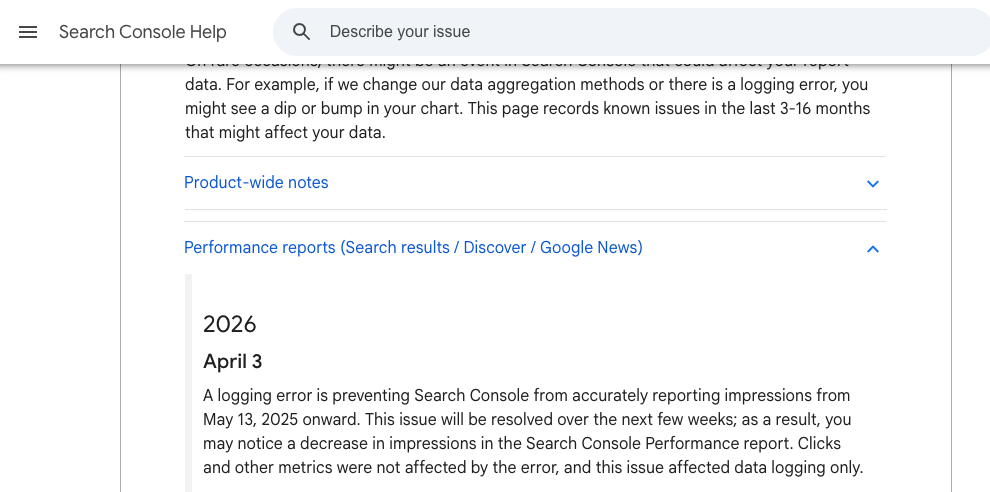
The mechanics of the bug were straightforward, even if the implications are not. A logging error in Google’s reporting infrastructure caused impression counts in the Search Console Performance report to be overstated from May 13, 2025 onward. Importantly, this was not an algorithm update or a change in how Google ranks or surfaces content. It was purely a data recording problem. The real-world search visibility of any given website did not change because of this bug. What changed was how that visibility was being measured and reported, and for anyone leaning heavily on impressions as a key performance indicator, that distinction matters a great deal.
What makes this particularly frustrating is how Google is handling the correction. Rather than backfilling historical data with accurate figures, Google is only applying the fix going forward. That means the inflated impression numbers from May 2025 through April 2026 will remain in Search Console as-is, sitting permanently in your historical data. The practical consequence is significant. Year-over-year impression comparisons will be unreliable for the foreseeable future. Since the tainted window spans roughly May 2025 through now, you won’t have a clean year-over-year comparison on both sides until May 2027. Any reporting that spans that period will be comparing corrected data against inflated data, which will make performance look worse than it actually is.
The timing of this revelation also forces a broader conversation about the role impressions play in modern SEO measurement. We are deep into a zero-click search environment. AI Overviews, featured snippets, and knowledge panels increasingly answer user queries before anyone visits a website, meaning clicks and traffic are in structural decline across many categories. In that context, impressions had become one of the more meaningful signals available for measuring brand visibility and top-of-funnel reach. They were evidence that your content is surfacing in front of people, even if they aren’t clicking through. A year of bad data on that specific metric, at this specific moment in search history, is a genuinely significant problem for anyone trying to make sense of their organic search presence.
For teams currently reporting on organic performance, the immediate priority should be getting ahead of this with stakeholders before the impression drop triggers unnecessary alarm. Annotate the change in Search Console and any connected reporting dashboards, and make clear that declining impression counts in the coming weeks reflect a reporting correction, not a rankings collapse. Longer term, it is worth revisiting how impressions are weighted in your reporting framework. They remain a useful directional signal, but this episode is a good reminder that no single metric should carry too much weight, and that even the data coming directly from Google is not immune to error.
Related Articles