SOCi vs Yext for Multi-Location Brands: Which Fits Your Local Search Strategy

Share


SOCi and Yext often appear on the same shortlist when multi-location brands prioritize local search visibility. Both platforms help teams maintain consistent location information, improve discoverability, and manage presence across large footprints. Both also address AI discoverability in the context of modern search.
The difference is not simply about who has more “local SEO features.” The real distinction comes down to operating fit: how each platform expects organizations to manage location data, who performs the day-to-day work, and how well the model holds up when supporting hundreds (or thousands) of locations with governance needs.
This comparison breaks down those differences — and why they matter when local discoverability depends not just on accurate data, but on continuous location-level execution.
Why SOCi and Yext are often compared
Multi-location teams typically compare SOCi and Yext because both address core local search visibility challenges:
- Keeping listings accurate and consistent across key publishers
- Improving the quality and completeness of location-level information
- Supporting location pages as a discoverability and conversion layer
- Providing reporting that helps teams prioritize what to fix and improve
Where they diverge is the program model: whether the platform is primarily a centralized “source of truth + distribution” system where local managers act on AI-powered recommendations, or an agentic workforce designed to continuously execute location-level optimizations with governance.
The core difference: operating model, not just features
For multi-location brands, local visibility outcomes usually come down to consistent and repeatable local execution:
- Whether categories and attributes are continuously optimized as markets shift
- Whether locations publish timely updates (hours, services, posts, content)
- Whether location variance can be controlled without adding headcount
- Whether the program can keep up with local nuance as the footprint grows
Yext is widely recognized as a digital presence platform centered on a structured “source of truth” (Knowledge Graph) that connects to listings, pages, reviews, and search experiences. For teams that want a centralized system to manage and syndicate brand and location data broadly, this model is compelling. It is important to note, however, that Yext operates as a self-service tool — the platform enables the work, but the execution still depends on a corporate marketing team or individual locations to complete it. Success requires meaningful tool enablement and ongoing adoption.
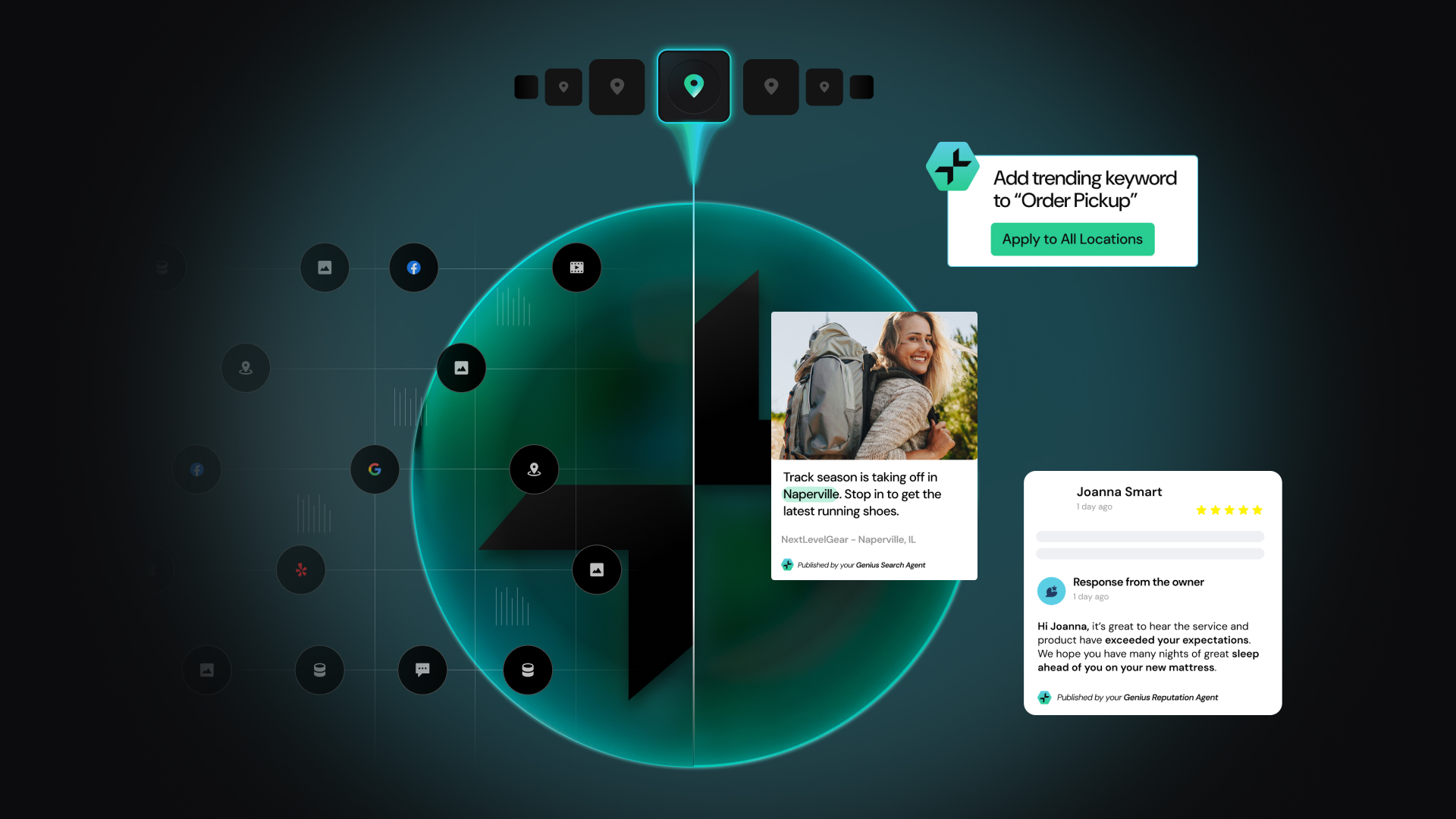
SOCi, on the other hand, was purpose built for multi-location enterprises who want one unified system to not only manage but actively execute the local marketing work required to optimize brand visibility and engagement across all locations and channels — including search, social, reviews, and local pages. With full agentic capabilities, SOCi can be deployed as a self-service platform (similar to Yext) or leveraged as a brand-trained local marketing AI Agent Workforce that executes continuously, with or without human intervention on every task.
How Yext approaches local search visibility
Yext positions its platform around centralized digital knowledge management. It maintains structured facts in the Knowledge Graph, then connects that data to products like Listings and Pages so updates flow across ecosystems.
Where Yext can be a strong fit:
- Structured source of truth for location data, especially for brands with complex attributes
- Syndication across directories and endpoints using the same underlying entity data
- Location pages as a controlled layer for brand and location content and conversion
Important considerations for buyers:
Platform integration: While Yext markets itself as a “Presence Platform,” buyers should be aware that not all capabilities operate as a single, fully unified system. Yext’s social capabilities (from the acquisition of Hearsay Systems) and competitive intelligence features (from the acquisition of Places Scout, now branded Yext Scout) are the result of recent acquisitions and are still in the process of being fully integrated into the core platform. Buyers evaluating Yext as an end-to-end solution should assess whether day-to-day workflows, governance, and reporting feel like a single platform or coordinated components.
AI capabilities: Yext’s AI capabilities are primarily generative and assistive in nature — they can help marketers draft content or generate recommended responses to reviews and other interactions. However, Yext does not currently offer full workflow automation through AI agents or agentic capabilities. AI surfaces insights and assists with content creation, but human action is still required to execute most tasks.
Service model: Yext is designed as a self-service platform built for a corporate or centralized team managing the program. For organizations that require significant hands-on support, implementation guidance, or ongoing managed services, this model may present challenges. Yext is frequently cited on G2 for poor customer service — a recurring theme in user reviews that is worth weighing when evaluating long-term program support needs.
For many organizations, Yext fits well when the priority is data governance and distribution consistency, and when the program is owned by a dedicated centralized team that is comfortable with a self-service model.
How SOCi approaches local search visibility
SOCi is built to execute ongoing location-level visibility optimizations, managed within brand governance guardrails.
SOCi’s local search model emphasizes:
- Continuous execution across locations — not only centralized distribution, but active, ongoing optimization at the location level
- Cross-channel signals informing local search work, so optimization reflects what is actually happening in each market (reviews, engagement trends, and more)
- AI Agents designed to complete work — such as optimizing listings and publishing localized content — rather than only surfacing recommendations that humans must work through
A unified platform by design: Unlike platforms expanded through acquisitions, SOCi was architected as a single, integrated system from the ground up. Search, social, reviews, and local pages operate within one unified platform with shared governance, consistent reporting, and connected workflows — providing a seamless experience across all local marketing channels.
Flexible deployment model: SOCi can be used as a fully self-managed tool for centralized teams, or activated as an AI Agent Workforce that executes local marketing tasks autonomously at scale — within guardrails defined by the brand. This makes SOCi uniquely suited to organizations that want to move beyond managing a tool and toward running a scalable, always-on local marketing operation.
Service and support: SOCi is consistently recognized for strong customer service and support. Beyond standard service, SOCi offers enhanced “Assist Services” for both corporate teams and individual location teams — providing hands-on support where and when it’s needed, without requiring the organization to stand up additional internal resources.
This matters most for brands running hundreds to thousands of locations where the constraint is not knowing what to do, but ensuring the work gets completed consistently within brand and compliance guardrails.
AI in practice: intelligence vs. execution
Both SOCi and Yext connect their platforms to the reality that search is evolving — including the rise of AI-generated answers.
A practical way to evaluate AI in local search is to ask where it operates and what it actually does:
Yext: AI capabilities are primarily generative and assistive. The platform can help teams draft content, suggest responses, and identify gaps — but humans remain responsible for deciding and executing on those outputs. AI accelerates certain tasks but does not remove the need for manual follow-through.
SOCi: AI agents are designed to execute local search optimization workflows across locations, operating within rules defined by the customer. The goal is not just faster analysis — it is reducing the volume of manual work required to achieve consistent optimization at scale, with full agentic automation available for teams that want it.
When evaluating either platform, ask:
- Does AI reduce measurable manual work, or mainly make analysis faster?
- Is it designed for location-level execution or primarily for central team orchestration?
- Does governance slow down updates or enable faster, safer local changes?
- Can the system adapt location-by-location without creating process sprawl?
The operational reality at 500 locations
At 500 locations, local search visibility problems are driven by variance, not just volume:
- Different trending keywords by area
- Different competitors by neighborhood
- Inconsistent freshness (posts, photos, attributes, local content)
- Exceptions that can’t be solved with a single global update
This is why multi-location buyers typically prioritize:
- Central visibility with location-level accountability
- Brand and compliance guardrails that don’t block speed
- A model that continuously improves local presence without adding headcount
Platforms optimized for centralized data management can be effective when the main challenge is maintaining consistency of facts. Platforms optimized for execution tend to matter more when the challenge is continuous optimization across many markets.
When Yext is the better fit
Yext can be a strong fit if you:
- Want a centralized system of record for structured location and brand knowledge, tightly governed and widely distributed
- Run a primarily centralized digital presence program managed by a dedicated internal team or implementation partner
- Prioritize consistency and control of location facts and page experiences as a foundation for visibility
- Are comfortable with a self-service model and have the internal resources to manage tool adoption and ongoing execution
When SOCi is the better fit
- SOCi tends to fit best if you:
- Need ongoing local search optimization execution across hundreds or thousands of locations — not just initial accuracy
- Want a fully unified platform where search, social, reviews, and local pages share a single governance model and reporting layer
- Want local visibility optimization work completed automatically within guardrails — with full agentic capabilities, not just AI-assisted recommendations
- Require strong service and support for your corporate team, your location teams, or both
- Want the flexibility to operate as a self-service tool today and expand to a fully automated AI Agent Workforce as your program matures
Final takeaway: match the platform to how local visibility work gets done
If your local visibility strategy is primarily about centralizing and governing structured location data — and you have a dedicated team equipped to manage ongoing tool adoption and execution — Yext is often aligned with that operating model.
If your strategy requires a unified platform with continuous, location-specific optimization and the option to scale into a fully automated AI Agent Workforce, SOCi is designed for that execution reality. SOCi’s Genius Local Search Agent can continuously execute optimizations across locations within defined governance and approvals, so even a small, centralized team can scale into an always-on execution workforce — without headcount expanding in lockstep with growth.
Related Articles