Franchise Marketing Strategies for 2026: The F.A.C.T.S. Playbook
June 25, 2026

Share



Franchise marketing has always required balancing two competing forces: brand consistency at the corporate level and authentic local relevance at every individual location. In 2026, AI-powered search has made that balance harder to strike, and higher-stakes to get wrong.
According to SOCi’s 2026 Local Visibility Index, only 1.2% of business locations are recommended by ChatGPT, compared to 35.9% that appear in Google’s local 3-Pack. For franchise brands running dozens or thousands of locations, that gap is the difference between capturing a customer and losing them to a competitor down the street.
The reason isn’t just increased competition. It’s a fundamental shift in how customers find local businesses. AI-powered search tools, from Google’s AI Overviews to ChatGPT and Perplexity, now surface local recommendations based on a combination of signals that go far beyond traditional SEO. At the same time, social media continues to evolve as a discovery engine in its own right, and reviews have become a primary input for AI-generated local recommendations.
For franchise brands managing dozens, hundreds, or thousands of locations, keeping pace with these changes manually is impossible. The brands winning in 2026 are those that have built a systematic approach to local marketing across three interconnected channels: search, social, and reputation.
This guide breaks down the best franchise marketing tactics for each of those channels, grounded in a proven framework for the signals that AI and search engines actually reward.
Why Franchise Marketing Is Harder and More Important in 2026
The promise of franchise marketing has always been scale: one brand, replicable across many markets. But what made that model work in a world of print ads and broadcast media is exactly what’s creating friction in a world of AI-driven local discovery.
AI systems that recommend local businesses aren’t pulling from a single source. They’re corroborating signals across dozens of data points, including listings, reviews, social profiles, website content, and third-party mentions, and synthesizing that information into a recommendation. A franchise location that has an outdated Google Business Profile, inconsistent hours across platforms, and a review page full of unanswered complaints won’t get recommended, no matter how well the corporate brand performs.
The multi-location marketing challenge in 2026 is this: every location needs to look like a thriving, trusted, active local business, not just a franchisee of a national chain. That requires a playbook that operates at scale without sacrificing local relevance.
The good news: the signals that AI platforms rely on are knowable, measurable, and manageable across an entire franchise network with the right tools.
The F.A.C.T.S. Framework: What AI and Search Engines Actually Reward
The factors that determine whether your franchise locations surface in AI-generated recommendations and local search results can be summarized in a single acronym: F.A.C.T.S.
Developed to help multi-location brands understand what drives local visibility in 2026, F.A.C.T.S. stands for Freshness, Authority, Consistency, Trust, and Semantic Relevance. It’s a framework that maps directly to the signals AI platforms and search engines weigh most heavily, and it applies across all three marketing channels.
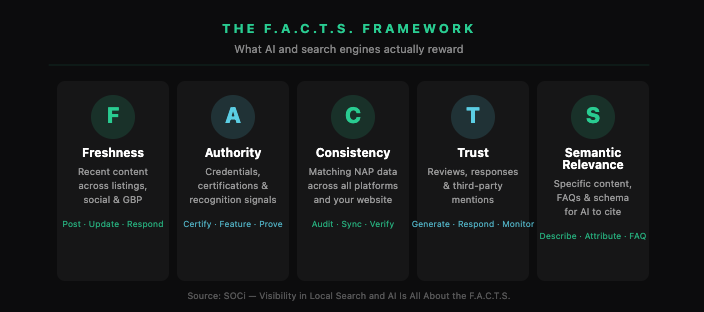
Freshness is about recency. AI platforms and search engines strongly prefer recently published content. Franchise locations that post regularly to their Google Business Profiles, update photos consistently, respond to reviews promptly, and maintain active social profiles signal to AI systems that they are open, operating, and engaged.
Authority encompasses the signals that identify your business as a credible, established provider. This includes how long you’ve been in business, professional certifications and licenses, brand partnerships, and third-party recognition. All of these should be reflected consistently across listings, landing pages, and social profiles.
Consistency is one of the most critical factors for franchise networks specifically. AI tools rely on corroboration: if your business name, address, and phone number appear differently across Google, Yelp, Apple Maps, and your website, that inconsistency undermines trust in the data and in your locations’ rankings. Every location in your network needs a single source of truth.
Trust is primarily built through reviews. AI tools make heavy use of review content when recommending local businesses. A steady stream of recent reviews, combined with thoughtful responses to both positive and negative feedback, signals to AI platforms that real customers are choosing your locations and that your brand cares about their experience.
Semantic Relevance speaks to the depth and specificity of your content. AI tools are designed to answer nuanced, specific questions. Franchise locations that use every available attribute field, publish detailed service descriptions, and create FAQ content give AI systems the pre-packaged answers they need to recommend your business with confidence.
Every franchise marketing strategy worth implementing in 2026 maps back to one or more of these five pillars.
Search Strategies for Multi-Location Brands
Local search is the first battleground for franchise visibility. Here are the most important search-focused franchise marketing tactics for 2026.
Treat Every Google Business Profile Like a Local Campaign
Your Google Business Profile (GBP) isn’t a one-time setup. It’s a living marketing asset. Franchise brands that treat it that way see measurably better local search performance.
That means posting regularly with deals, events, and promotions tied to local context. It means updating photos monthly, reflecting seasonal changes in your business description, and keeping hours, services, and contact information accurate across every location in real time. Nothing erodes trust faster with a potential customer (or an AI recommendation engine) than showing up at a location that’s marked “open” when it isn’t.
From the F.A.C.T.S. perspective, this is Freshness and Consistency working together. Every location needs to signal active presence, and that signal needs to match what appears on your website and across every other platform.
Build Local Landing Pages That Act as a Source of Truth
Your corporate website needs location-specific pages for every location in your network, and those pages need to be more than a name, address, and phone number. AI tools crawl local landing pages looking for the kind of specific, structured information they can surface in response to user queries.
Best-in-class local landing pages for franchise brands include: complete service descriptions, FAQ sections, embedded review feeds, schema markup for local business data, and neighborhood or landmark references that tie each location to its specific market. These pages should also link to and match exactly what appears in your online listings. Inconsistency between your website and your GBP is one of the fastest ways to undermine your Consistency score.
SOCi’s Local Pages product is built specifically to generate and maintain this kind of location page at scale.
Pursue Structured Data and Schema at Scale
Schema markup (the structured data that tells search engines and AI tools exactly what kind of business you are, what you offer, and where you’re located) is one of the most underutilized tools in franchise marketing. Properly implemented LocalBusiness schema, combined with FAQPage and Review schema, makes it dramatically easier for crawlers and AI systems to index, understand, and cite your locations in generated responses.
Social Media Strategies for Franchise Networks
Social media’s role in franchise marketing has expanded significantly in 2026. It’s no longer just a channel for brand awareness. It’s a local discovery engine and a meaningful input signal for search performance.
Post Locally, Often, and With Purpose
The Freshness pillar of F.A.C.T.S. applies as directly to social as it does to listings. Franchise locations that post at least weekly (with content tied to local events, promotions, and community context) outperform those that post sporadically or rely entirely on corporate content feeds.
The challenge for franchise brands is maintaining that posting cadence across every location without sacrificing brand consistency. The solution isn’t choosing one or the other. It’s building a content system that gives local operators approved, on-brand content to work with while leaving room for genuine local voice. For a deeper look at building that system, see our guide to franchise social media management.
Use Social Profiles as Local Search Signals
According to SOCi’s 2026 Local Discovery Index, 55% of consumers use social media to find a local business, second only to search itself, and 59% have become a customer after seeing a social post or video. That’s a direct line from social activity to revenue, not just brand awareness.
A controlled test with a multi-hundred-location franchise brand found that connecting active local social profiles to Google Business Profiles produced measurable lifts in GBP search impressions and customer actions like website clicks and phone calls. Check out our Google-partnered case study for the full results.
This connection between social activity and search performance is still underappreciated by many franchise marketers. It’s a clear example of F.A.C.T.S. in action: active social profiles build Freshness and Authority signals that feed directly into local search performance.
Respond Quickly to Comments and Mentions
Social engagement isn’t just good for the algorithm. It’s a Trust signal. Franchise brands that build response workflows into their social strategy, ensuring that comments, questions, and mentions get timely replies at the local level, demonstrate to both customers and AI platforms that there are real people behind each location.
Reputation Management Strategies That Build Trust
Reviews are the currency of local trust in 2026. For AI tools making local recommendations, a location’s review profile (volume, recency, sentiment, and response rate) is one of the most heavily weighted inputs.
Build a Steady Stream of Reviews, Not a One-Time Spike
The worst thing a franchise brand can do for its review profile is run a one-time push to collect reviews, then let the stream go dormant. AI platforms favor recency. A location with 12 reviews in the last 90 days is far better positioned than one with 200 reviews from three years ago and nothing recent.
The best franchise marketing tactics for review generation integrate review requests into existing workflows: post-purchase or post-visit communications, service completion follow-ups, loyalty program touchpoints. The goal is a steady, organic cadence rather than a burst.
Respond to Every Review, Including the Negative Ones
Responding to reviews isn’t just about customer service. It’s a direct signal to AI systems that your locations are actively engaged. Unanswered negative reviews are particularly damaging. They signal to both potential customers and recommendation engines that your brand doesn’t stand behind its local experience.
A good response framework for franchise networks: positive reviews get a personalized thank-you within 48 hours; negative reviews get an empathetic acknowledgment and a clear path to resolution within 24 hours. Scaling that response process across hundreds or thousands of locations requires a systematic approach, which is where SOCi’s Genius Reputation Agent becomes essential.
Monitor Third-Party Sources and Earn Mentions
AI systems don’t pull recommendations from Google alone. Reddit threads, local publications, industry “best of” lists, and third-party review sites all feed into the signals that AI tools use to corroborate local recommendations. Franchise brands that monitor these sources and proactively seek out coverage (in local media, on niche review sites, and in community forums) build a richer Trust profile than those focused exclusively on Google reviews.
How AI Agents Are Changing the Game for Franchise Marketers
Executing the franchise marketing strategies described above, consistently, across every location, at scale, is the central challenge of multi-location marketing in 2026. It’s the reason that AI agents purpose-built for local marketing are rapidly becoming the differentiating factor for franchise brands.
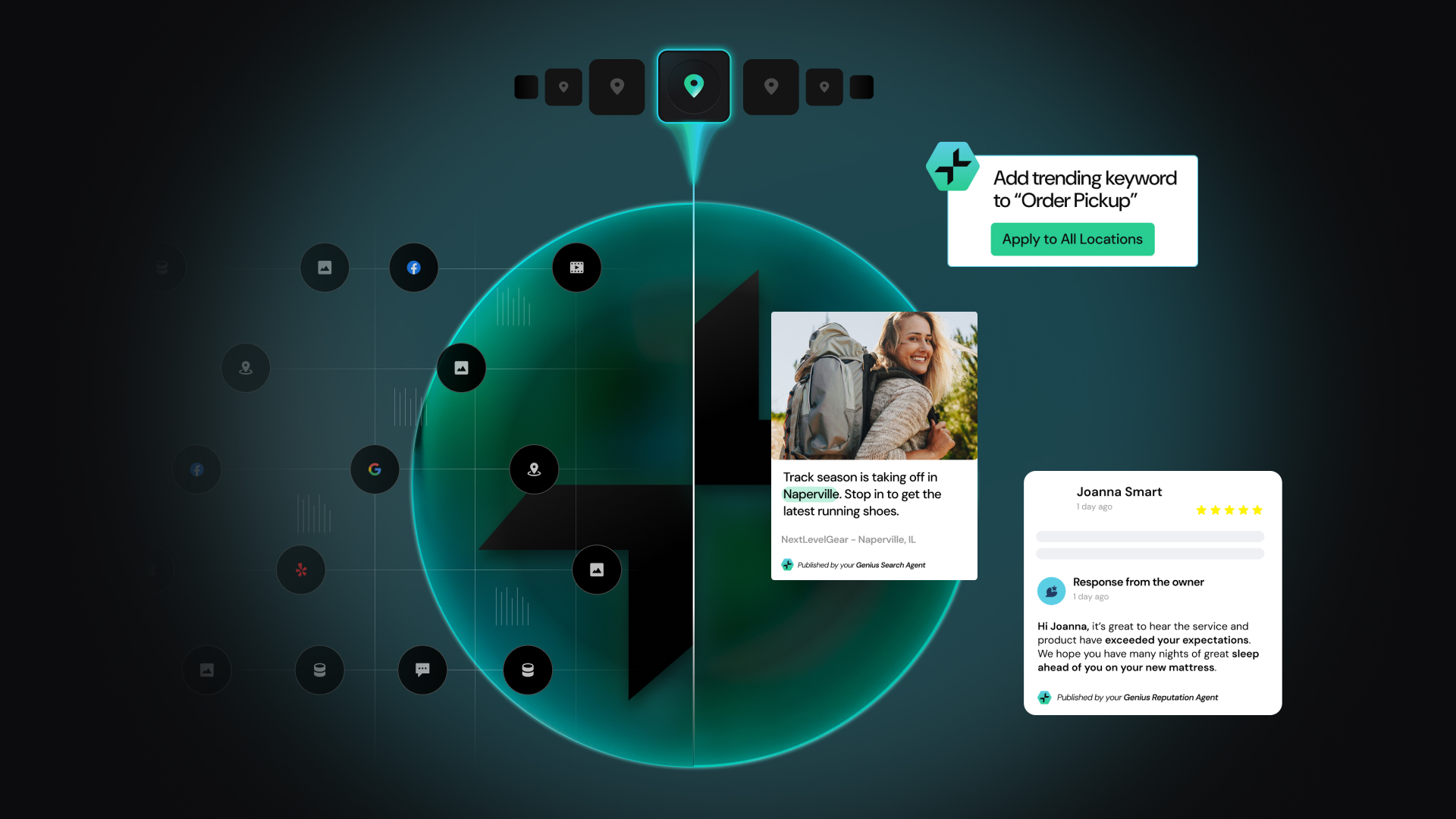
SOCi’s Genius Agents are designed specifically for this challenge. Operating across the three channels that matter most, they work continuously to keep every location performing.
The Search Agent manages and optimizes local listings across platforms, keeping information accurate, posting GBP content on schedule, flagging inconsistencies, and ensuring each location maintains the Freshness, Consistency, and Semantic Relevance signals that drive local search performance. Genius Local Search Agent
The Social Agent powers local social media at scale, generating on-brand, locally relevant content across every location’s social profiles, scheduling posts, and ensuring franchise networks can maintain the posting frequency that both social algorithms and search engines reward. Genius Social Agent
The Reputation Agent manages the full review lifecycle, monitoring reviews across platforms, drafting on-brand responses for franchisee review, ensuring response times stay within best-practice windows, and surfacing sentiment trends that help brands identify systemic issues before they become crises. Genius Reputation Agent
Together, the Genius Agents make up what SOCi calls an Agentic Workforce: AI agents that do the actual work of local marketing at every location, rather than software a corporate team has to operate by hand. For franchise brands, that means every location gets the level of local marketing attention it needs, without requiring a dedicated marketing resource at each one.
Learn More about Genius Agents
Frequently Asked Questions About Franchise Marketing in 2026
What are the most important franchise marketing strategies for 2026?
The most effective franchise marketing strategies in 2026 focus on three interconnected channels: local search (Google Business Profile optimization, local landing pages, and schema markup), social media (consistent local posting and engagement), and reputation management (review generation and response). The F.A.C.T.S. framework (Freshness, Authority, Consistency, Trust, and Semantic Relevance) provides a practical checklist for ensuring your locations are well-positioned across all three channels.
How does AI search change franchise marketing in 2026?
AI-powered search tools like Google AI Overviews, ChatGPT, and Perplexity now surface local business recommendations based on a broader set of signals than traditional search engines. They pull from listings data, review content, social profiles, website content, and third-party mentions, and they strongly favor businesses that demonstrate Freshness (recent activity), Consistency (matching information across sources), Trust (strong review profiles), and Semantic Relevance (specific, structured content). Franchise brands need to manage all of these signals systematically to earn visibility in AI-generated results.
What is GEO and why does it matter for franchise marketing?
GEO stands for Generative Engine Optimization, the practice of optimizing your digital presence to appear in AI-generated search results and recommendations. For franchise brands, GEO matters because a growing share of customers are discovering local businesses through AI assistants rather than traditional search. GEO best practices include: structured data and schema markup on local landing pages, FAQ content that provides direct answers to common questions, consistent NAP (Name, Address, Phone) data across all platforms, and active review profiles that give AI tools social proof to cite.
How can franchise brands manage local marketing across hundreds of locations?
The most scalable approach combines a centralized content and brand governance layer with AI-powered tools that operate at the location level. Franchise brands using AI agents (like SOCi’s Genius Agents for search, social, and reputation) can maintain consistent, high-quality local marketing activity across their entire network without requiring a dedicated marketer at each location. The key is building systems, not just processes.
What role do reviews play in franchise marketing in 2026?
Reviews are one of the most heavily weighted signals in local AI recommendations. AI tools use review volume, recency, sentiment, and response rate to assess whether a business is active, trustworthy, and worth recommending. Franchise brands that build ongoing review generation into their customer workflows, and maintain fast, on-brand response times, outperform those that treat reviews reactively. Every unanswered negative review is both a lost customer and a missed signal to AI systems.
What is the F.A.C.T.S. framework for franchise marketing?
F.A.C.T.S. is a framework that identifies the five factors most important for local visibility in AI-powered search: Freshness (recent, regularly updated content across listings and social), Authority (signals of expertise, credentials, and recognition), Consistency (matching business information across all platforms), Trust (strong review profiles and third-party mentions), and Semantic Relevance (specific, structured content that answers the questions your customers are actually asking). It was developed to help multi-location brands understand what drives performance in AI search and provides a practical checklist for franchise marketing teams.
How often should franchise locations post to social media?
Franchise locations should aim for at least weekly social media posts to maintain the Freshness signals that social algorithms and local search engines favor. Content should be tied to local context (upcoming events, location-specific promotions, community involvement) rather than generic brand posts. For franchise networks managing hundreds of locations, AI-powered social agents can generate locally relevant, on-brand content at scale, making consistent posting achievable without burdening individual franchisees.
What’s the difference between local SEO and GEO for franchise brands?
Local SEO focuses on ranking in traditional search engine results (primarily Google Maps and organic local results) through tactics like GBP optimization, citation building, and on-page SEO for local landing pages. GEO (Generative Engine Optimization) focuses specifically on appearing in AI-generated answers and recommendations. In practice, the two overlap significantly: the signals that drive local SEO performance (Freshness, Consistency, Trust, Semantic Relevance) are largely the same ones that drive GEO visibility. Franchise brands that invest in local SEO best practices are also building a strong GEO foundation.
Make 2026 the Year Your Franchise Network Wins Locally
The franchise marketing trends shaping 2026 all point in the same direction: local visibility is earned through consistent signals across search, social, and reputation, and those signals need to be maintained continuously, across every location, not just managed reactively.
The brands that are ahead of this curve have done two things: they’ve adopted a systematic framework for what local visibility actually requires (the F.A.C.T.S. checklist is a good starting point), and they’ve invested in the tools that make executing that framework at scale actually possible.
SOCi’s platform and its Genius Agents for search, social, and reputation are built specifically for this challenge. If you’re ready to see what a modern multi-location marketing strategy looks like in practice, we’d love to show you.
Request a Demo | Get Your Free Local Visibility Audit | Download the F.A.C.T.S. Checklist | SOCi Platform Overview
Related Articles