Why Yelp AI Search Citations Are Reshaping Local Visibility
August 21, 2026

Share



The Yelp Syndication Network
You may have heard the recent news that Yelp has officially partnered with OpenAI to bring local listings content to ChatGPT, along with related features such as booking a restaurant reservation or requesting a quote from a service provider. This news is probably the strongest public acknowledgment yet on OpenAI’s part that local information is key to the success of ChatGPT as an all-purpose interface.
Yelp AI search citations are no longer a niche curiosity for local marketers. Yelp has officially partnered with OpenAI to bring local listings content into ChatGPT, including features like restaurant reservations and service quotes. It is the strongest public signal yet that OpenAI treats local business data as core to ChatGPT’s future, and it reflects how fragmented local discovery has become: in the last 30 days, 83% of U.S. consumers used search engines, 55% used social media, and 52% used AI tools to find a local business, according to SOCi’s 2026 Local Discovery Index.
Google has spent two decades building the local layer other platforms now have to route around, from local pack rankings to Google Maps. Because OpenAI competes directly with Google, it cannot license Google’s local data. Yelp, a comparatively neutral source with a decade of trusted review content, becomes the practical alternative. This is the same dynamic that drove Bing and Apple to license Yelp reviews, photos, and listing details years before generative AI existed.
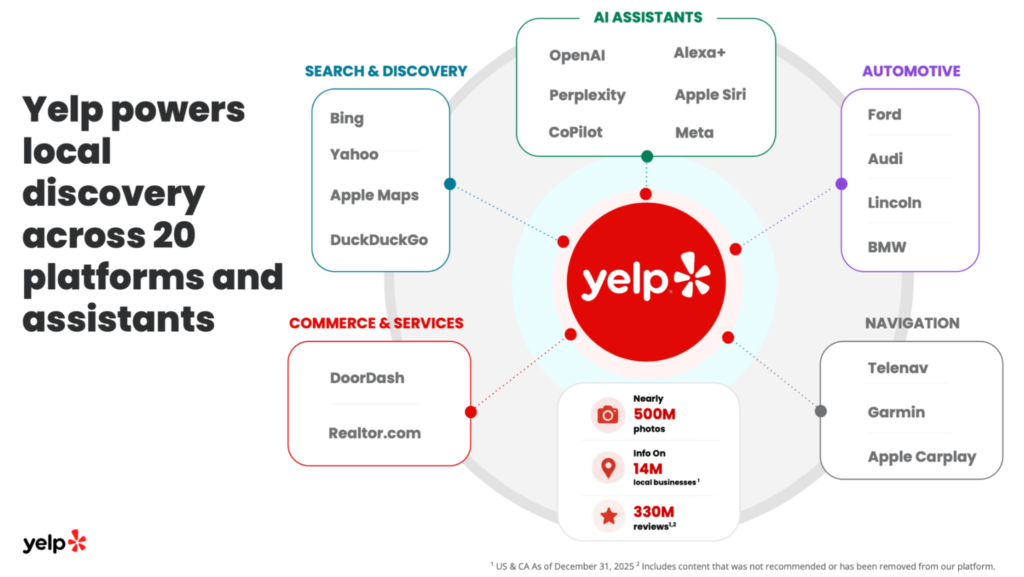
Yelp AI search citations matter because Yelp has become the central node in a distribution network that feeds local business data to six of the top non-Google AI platforms, along with Apple Maps, Bing, Yahoo, and DuckDuckGo.
What Is Driving Yelp’s Growing AI Search Citations?
Many of Yelp’s pre-AI licensing relationships persist today, and OpenAI is far from the only AI company relying on Yelp content. Yelp’s own data, 330 million reviews and 500 million photos covering 14 million businesses, now reaches consumers through automotive navigation systems and vertical apps like DoorDash, in addition to its formal AI partnerships.
Long before the OpenAI partnership was announced, ChatGPT was already surfacing Yelp content in local recommendations, a byproduct of Yelp’s dominance as an indexed site. Google’s own AI Mode and AI Overviews now cite Yelp more than any other third party in local answers.
Some brands dismiss Yelp as restaurant-only. That has always been a mischaracterization, and it is a costlier one now: Yelp’s content reaches consumers across every industry through interfaces with no category bias, from Apple Maps to AI assistants.
Why Yelp’s Review Quality Drives Trust in Local AI Answers
A recent Forbes analysis, “How Yelp Became AI’s Ground Truth,” points to review quality as the real differentiator. Yelp’s algorithm for promoting a review to “recommended” status, the only reviews that count toward a business’s star rating and get syndicated elsewhere, is notably selective. First-time reviewers and one-sided reviewers rarely clear that bar.
Yelp also requires text in every review. Google allows star-only ratings, which inflates volume but dilutes signal. Both platforms fight spam, but Yelp’s inclusion standard is measurably stricter, and that is precisely what makes Yelp’s data attractive to AI platforms building local answers around trusted sources.
What SOCi’s Data Shows About Yelp’s Real Share of AI Search Citations
Yelp’s reach is real, but SOCi’s 2026 Local Visibility Index puts it in proportion. Among the sources AI platforms cite most often for local answers, Google Maps leads at 33%, a mix of niche local sites follows at 26%, and brand-owned websites account for 23%. Yelp sits at 11%, ahead of Facebook’s 8% but behind three sources a brand can influence directly.
AI platforms are far more selective than traditional search, regardless of which source they cite. According to SOCi’s 2026 Local Visibility Index, only 1% of business locations are recommended by ChatGPT and 11% by Gemini, compared to 36% of locations appearing in Google’s local 3-Pack. A high volume of Yelp AI search citations across the web does not guarantee any single location a recommendation. Profile accuracy and review quality, on every platform, still decide who gets named.
How Multi-Location Brands Should Respond to Yelp AI Search Citations
- Claim and complete the Yelp profile with the same discipline as Google. Yelp is a top-five source behind local AI answers industry-wide; an incomplete or unclaimed profile is lost inclusion, not just lost traffic.
- Treat review response as a visibility input, not a support task. SOCi’s Genius Reputation Agent automates review monitoring and response at scale, the exact behavior the Local Visibility Index ties to stronger AI recommendation rates.
- Audit for data accuracy drift across every syndicated platform. One outdated Yelp listing propagates to Apple Maps, Bing, DoorDash, and beyond. SOCi’s Local SEO Audit Checklist covers this exact multi-platform accuracy check.
- Track AI recommendation rate as its own metric. Search rank and AI recommendation rate have decoupled; a location can lead Google and still be invisible on ChatGPT. AI Usage Surges 6X for Local Search covers how fast that gap is widening.
- Automate the fundamentals rather than auditing them manually. SOCi’s Genius Local Search Agent keeps listing data synchronized across Google, Yelp, and the platforms both feed.
Where Yelp Fits in a Multi-Location Brand’s AI Visibility Strategy
Yelp’s global reach outside the U.S. is thinner, so OpenAI and other platforms will eventually face build-or-buy decisions there. But inside the U.S., Yelp functions like Google Maps, Reddit, and Wikipedia: a knowledge graph that generative AI anchors itself to because building an equivalent from scratch is not worth the cost. That makes Yelp AI search citations a fixture of local AI visibility for the foreseeable future, not a passing trend.
Brand marketers who want to be visible across search and AI, now and going forward, need a Yelp strategy that is as disciplined as their Google strategy. See where your locations currently stand against SOCi’s 2026 Local Visibility Index benchmarks, then get your local visibility snapshot in seconds.
Key takeaways:
- Yelp now feeds data to six of the top non-Google AI platforms, plus Apple Maps, Bing, Yahoo, and DoorDash.
- SOCi’s 2026 Local Visibility Index puts Yelp’s AI citation share at 10.5%, behind Google Maps, niche sites, and brand websites.
- AI platforms recommend only 1.2% to 11.0% of locations, versus 35.9% Google 3-Pack presence, so being cited is not the same as being recommended.
- Profile accuracy, review response, and review quality on Yelp now function as AI visibility inputs, not just reputation management.
Related Articles