AI Usage Surges 6X for Local Search, Fragmenting the Digital Ecosystem
September 24, 2026

Share



Summary
New consumer research shows local search behavior now straddles multiple platforms, with consumers traversing a “verification loop” to find actionable information.
For years, local search followed a rough sequence, driven in large part by the dominance of search as a channel and Google as its dominant provider. A consumer searches using keywords, evaluates a set of results, chooses one, and converts.
That model is breaking down. According to SOCi’s 2026 Local Discovery Index, an annual survey of more than 1,000 U.S. consumers now in its third year, people no longer move through a simple linear funnel when they choose a local business. Instead, their behavior resembles a loop: discovering a business on one channel, seeking corroborating info in another, and even using a third channel to make a final decision, often within the same few minutes.
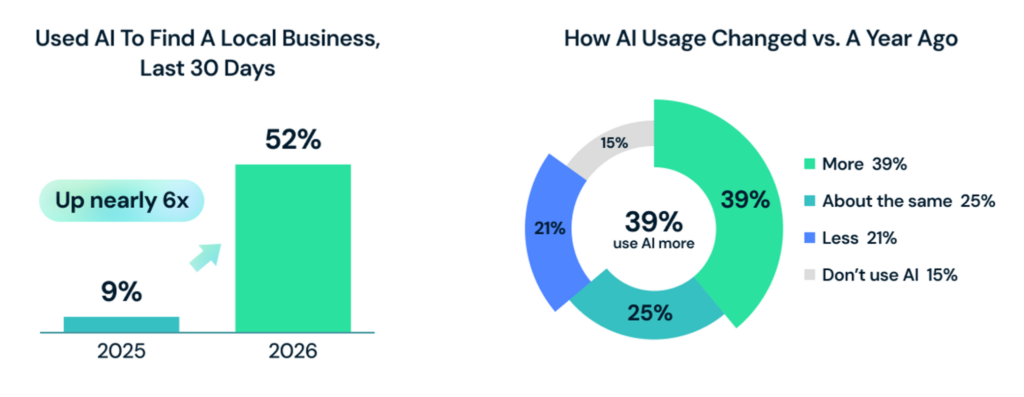
The most dramatic evidence of this newly fragmented landscape is the rise of AI search. The share of consumers who, according to the Local Discovery Index, used an AI tool to find a local business in the last 30 days rose from 9% in 2025 to 52% in 2026, close to a sixfold increase in a single year.
But the data also shows something that should make search marketers take note: usage and trust are moving in opposite directions. The more consumers rely on AI, the more they double-check it using other sources like search and social. This greatly increases the importance of cross-channel brand consistency.
Local Discovery Is a Loop, Not a Funnel
The study’s central finding is essentially a reframing of how the customer journey works. Consumers today discover local businesses across multiple channels (83% use search, 55% use social, 52% use AI), verify before committing (99% read reviews, 43% preview a business on social media), and decide using a combination of signals (72% favor businesses that respond to reviews, 59% have become a customer because of a social post, and 63% have walked away from a business that couldn’t answer a question they needed answered).
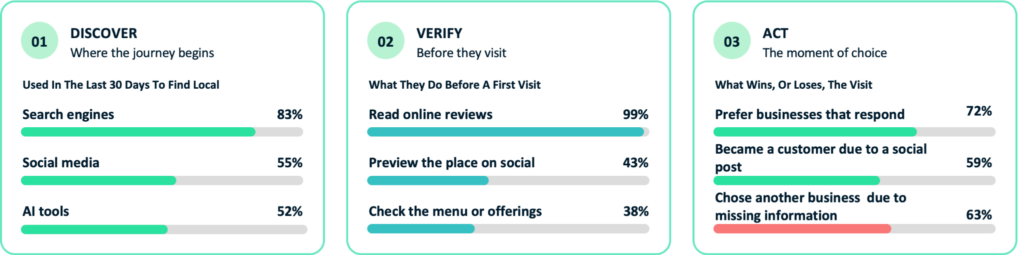
There’s no single entry point for marketers to focus on, and no orderly hand-off between channels to manage. A consumer might encounter a brand in an AI-generated answer, judge it against competitors by examining recent reviews, and ultimately decide based on a video they saw on Instagram, in any order. We call this the verification loop: a nonlinear path by which discovery on one channel gets cross-checked against others before a decision gets made.
The reason the loop exists is simple: no single channel is both complete and trustworthy on its own. AI is fast but sometimes wrong. Reviews are credible when available but rarely contain all the info a consumer needs to make a buying decision. Search is comprehensive but unfiltered. Consumers compensate by triangulating.
It’s worth noting that the more complex the consumer journey, the more challenging it can be for marketers to attribute success to isolated metrics, using models like last touch attribution. A more comprehensive view is needed to see how channels interact and support each other to build consumer confidence.
AI Adoption for Local Search Has Reached a Tipping Point
Three years of data make the AI trend line unusually clear. In 2024, AI search capability had barely reached ChatGPT and almost no consumers used it to find local businesses. By early 2025, roughly 19% had tried an AI search. By 2026, 60% of consumers use AI as a frequent discovery channel, and 52% use it specifically for local business research.
Adoption is not even across the population, which matters for anyone whose marketing strategy includes demographic segmentation. Regular AI use rises from 47% among consumers earning under $50,000 a year to 76% among those earning $100,000 or more. By generation, Millennials are the heaviest users at 63%, ahead of Gen Z (49%) and Gen X (48%), with Baby Boomers far behind at 11%. The consumers most likely to research a local business through AI are, generally speaking, Millennials with money to spend.
Where does that AI usage actually happen? For local search and discovery, consumers interact with AI in two ways: seeking it out directly (57% use ChatGPT, while 51% use Gemini), and encountering it passively inside tools they already use (51% have seen an AI answer at the top of Google results, 35% have clicked into Google’s AI Mode, and roughly a third have encountered AI content on Meta’s platforms or in mapping apps).
Local Consumers Generally Don’t Trust What AI Tells Them
Usage of AI is climbing sharply, but trust is not. Among consumers who use AI tools, 67% say they’ve been given wrong information about a local business at least once, and 30% say that bad information caused a real inconvenience. Only 27% say their trust in AI has grown over the past year, meaning 73% haven’t seen their confidence increase. In fact, 23% of respondents reported that their trust in AI has actually declined since last year.
The trust gap spurs consumers to verify AI results before taking action. When an AI tool recommends a business, 81% of consumers take some kind of verification step before contacting the business directly, checking reviews (33%), checking the business’s social media (20%), searching to confirm details independently (16%), or checking multiple sources (12%). Only 19% go straight from an AI recommendation to contacting the business.
As we can see, winning the AI answer is necessary but not sufficient. A business that appears in an AI-generated response but has thin, outdated reviews or an inactive social presence risks losing the customer at the very next step. AI visibility and reputation aren’t separate problems to manage; they’re stages of the same evaluation process.
Social Platforms Are Functioning as Search Engines
Social platforms have effectively begun functioning as search engines for a meaningful share of consumers. Use of social media to discover local businesses rose from 17% in 2024 to 55% in 2026, and 43% of consumers now use social media specifically to preview what a place is like before visiting. This behavior takes place across multiple platforms. Among social searchers, Facebook (73%) and YouTube (69%) lead, ahead of Instagram (67%) and TikTok (50%), with X, Snapchat, Reddit, and Pinterest all capturing meaningful, if smaller, shares of the market.
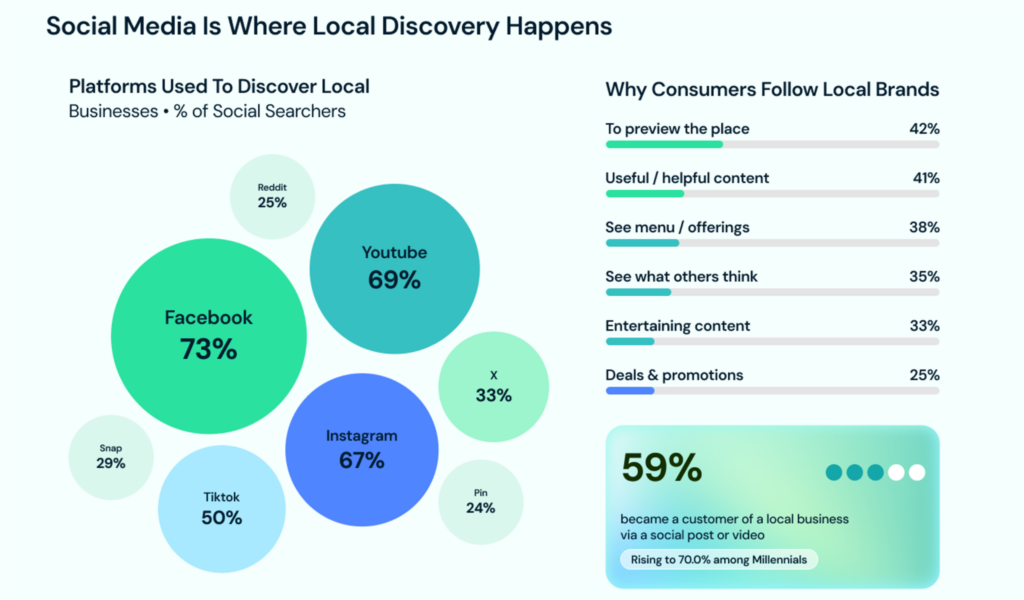
What’s notable is that the leading platforms for local discovery are the older, high-reach ones, not the newest or trendiest. YouTube’s strong second-place finish points to real demand for video footage that showcases the atmosphere of a place or gives a service provider the opportunity to display their expertise. TikTok, providing a similar service, reaches half of social searchers but skews younger; it’s the one platform Gen Z favors over Facebook.
And social media converts local consumers: 59% say a social post or video has directly turned them into a customer of a local business, a number that climbs to 70% among Millennials and holds above half for Gen X (54%) and Gen Z (52%), dropping off only among Baby Boomers (22%). Social discovery at the local level has become a mainstream behavior across most of the spending population.
Reviews Still Gate the Decision; Responses Change Outcomes
If AI tools and social media expanded the discovery ecosystem beyond traditional search, reviews remain the filter that decides who makes the shortlist. This is because reviews are, in effect, the Reddit of local: the single biggest readily available source of peer feedback across a broad range of industries and geographies.
According to the Local Discovery Index, 99% of consumers read reviews before a first visit at least some of the time, and 68% do so always or most of the time. That’s consistent with what the study has found in prior years: reputation isn’t just a ranking signal, it’s closer to a gating factor.
What’s changed is how much consumers reward engagement, not just star count. Seventy-two percent are more likely to choose a business that responds to its reviews, up from 65% in 2025. Sixty-five percent say they’d be more likely to revisit a business after a helpful response to a negative review. And 87% say they’d be more likely to revise a negative review to a positive one if the business responds helpfully. These signals indicate that consumers are likely to reward businesses that are more attentive to their concerns.
This behavior also tracks with income. The share of consumers who read reviews always or most of the time rises from 63% among those earning under $50,000 to 76% among those earning $100,000 or more, and the preference for businesses that respond to reviews rises from 62% to 80% across the same range. Higher-value customers are also the most influenced by reputation signals.
The Journey Looks Different by Industry
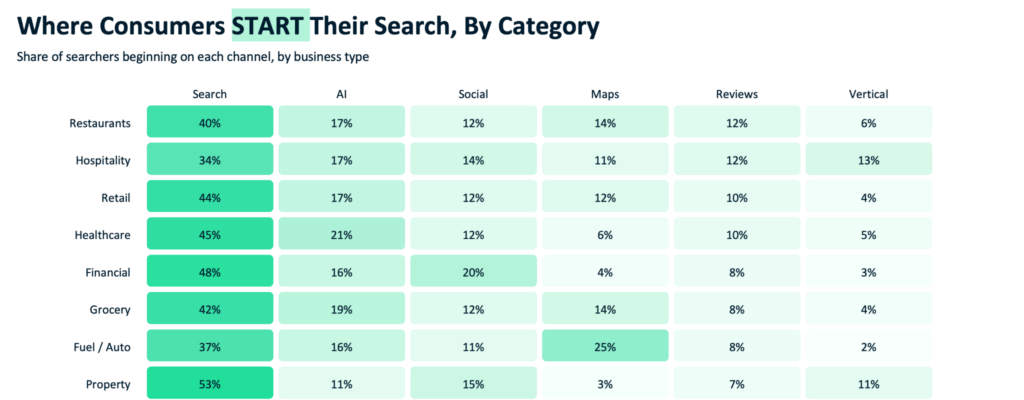
Where consumers start their search, and what ultimately determines their choice, both vary meaningfully by industry.
Search leads as the starting point across every category studied, but the runner-up channel shifts. AI-first journeys are most common in healthcare (21%) and grocery (19%). Social is surprisingly popular as a starting point for financial services (20%). Mapping apps are the most common entry point for fuel and auto searches (25%), which tracks with how those searches tend to be need-driven and location-specific.
Decision factors split by category as well. Reviews and word of mouth lead in five of the eight categories studied, from restaurants (41%) to healthcare (38%). But visual content is the most popular deciding factor for apartment searches (43%), whereas practical details like hours and location matter most for grocery (37%) and fuel (36%). Brand credentials carry the most weight in financial services (34%). A one-size-fits-all local visibility strategy will not properly account for the factors consumers prioritize.
Takeaways for Search Marketers
Fundamentally, it’s important to pay attention signals like these in order to ensure that your marketing strategy corresponds to the behavior and preferences of today’s consumers. No survey can perfectly measure this, but the directional signals in the Local Discovery Index are strong enough to be actionable in the following ways:
- Understand the journey. Today’s consumers loop from search to AI to social; brands must be equally available on all prominent channels.
- Overcome the AI trust gap. Accuracy and consistency requires that you establish signals in search and social that reinforce AI answers.
- Treat social as a local channel. Consumers want local social presence that engages and informs, not just national or regional marketing.
- Reputation is built one local review at a time. Local reviews determine AI visibility and consumer choice; responding improves conversion and mitigates risk.
- Industry context changes the playbook. What decides a healthcare visit isn’t what decides a grocery run or an apartment tour. Category-specific benchmarks are more useful than blended averages.
Methodology
SOCi surveyed more than 1,000 U.S. consumers for the 2026 Local Discovery Index, weighting results to mirror the U.S. population on age (median age 39), gender (a near 50/50 split), and household income (a median of roughly $81,600). Respondents were asked how they discover, evaluate, and choose local businesses across search, social media, AI, maps, and reviews. Figures cited for 2024 and 2025 are drawn from the two prior annual editions of the study, previously published as the Consumer Behavior Index. Figures are rounded to the nearest whole number.

See what the loop looks like for your brand.
SOCi’s agentic workforce runs local search, social, and reputation at every location – so the answer a consumer finds in AI holds up everywhere they go to verify it.
Related Articles