Dynamic Local Pages: How Multi-Location Brands Keep Every Location Page Found in Search and Cited by AI
Share


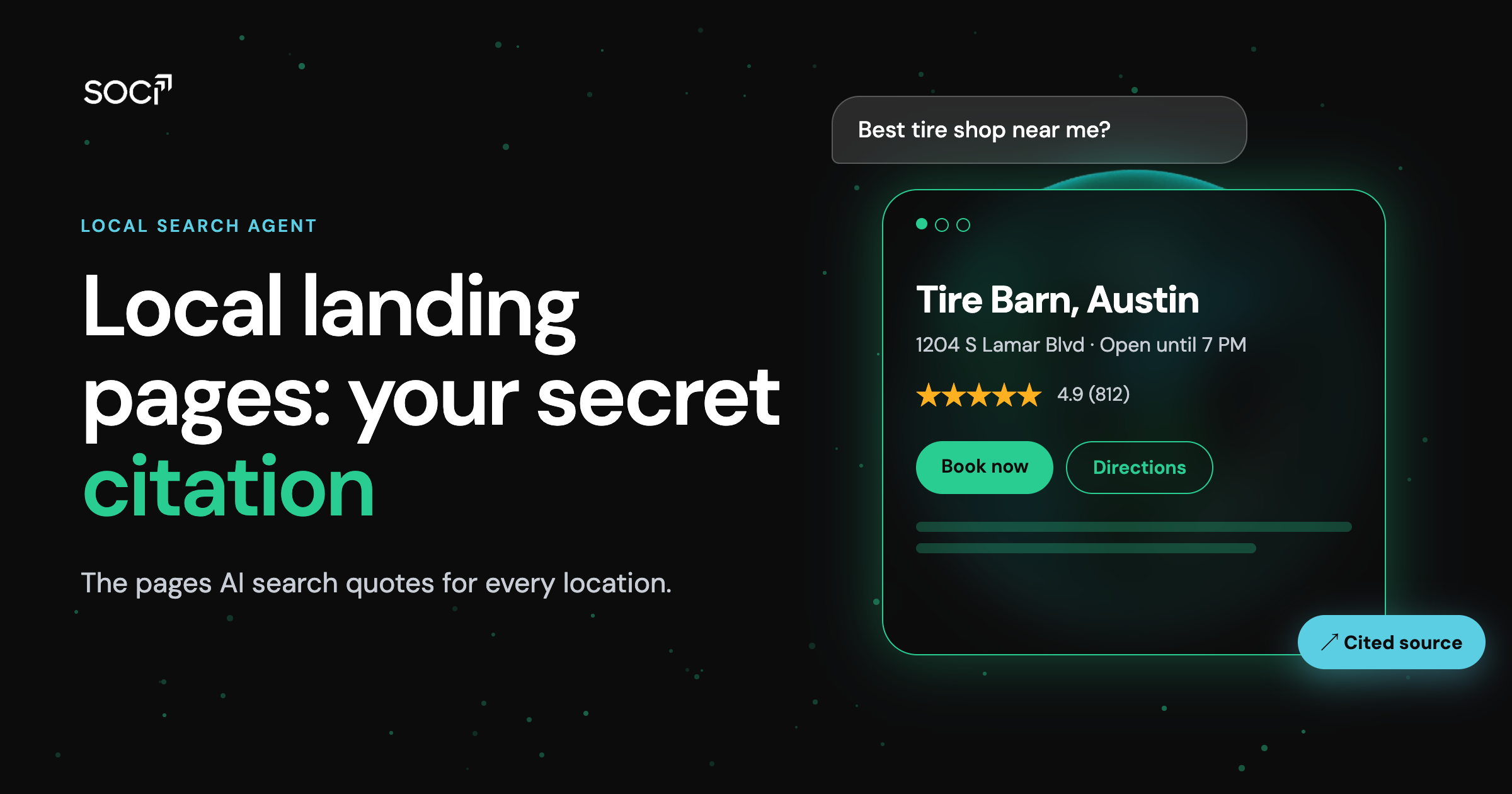
Think of the dynamic local page as the old local landing page, reborn: sharper, faster, and tuned to every neighborhood it serves. Traditional optimization built each location page from a moment-in-time snapshot and rarely, if ever, came back to revisit it. Dynamic local pages refresh every month based on what customers near that location are actually searching for, with every change reviewed and approved by your team.
Most multi-location brands still run on the older model: pages built once, checked for accuracy, and left alone while search keeps changing. That gap matters more every month. Customers now ask Google, ChatGPT and Gemini full questions, and the location page that answers best is the one that gets chosen.
Key takeaways
- The Dynamic Pages Skill refreshes each page monthly using Google Search Console performance, popular queries, search volume data, competitive insights, and local signals like seasonaxlity, local events and each location’s own details. Nothing publishes without your team’s approval.
- Location pages are one of the strongest levers a brand has for local and AI search, yet only 2.7% of local pages rank on page one of Google (Source: Whitespark Ranking Factors, 2026; SOCi’s 2026 Local Visibility Index).
- Pages decay because search demand moves every month and no team is staffed to rewrite hundreds or thousands of pages by hand. That is an arithmetic problem, not an effort problem.
- AI assistants are 3 to 30 times more selective than the Google 3-Pack. There is no page two in an AI answer (SOCi Local Visibility Index, 2026).
- SOCi’s Dynamic Pages Skill, part of the Genius Local Search Agent, reviews every location page monthly and recommends changes only when a real trigger calls for one, ensuring maximum visibility across local and AI search.
The customer you never knew you lost
A customer asks ChatGPT or Google a question your nearby location should be the perfect answer to:
- “Where can I get a family-friendly dinner with outdoor seating in Austin?”
- “Which gyms near me in Denver have beginner-friendly group classes?”
- “Where can I buy running shoes and get fitted near Chicago?”
Your page offers an address, hours and a broad description. Another brand’s page answers the question. The customer chooses them.
Nobody on your team ever knows about this lost customer. There is no abandoned form, missed call or bad review. Just a local customer who found an answer somewhere else.
Losing customers like this is not an awareness problem. The trouble is that most location pages are built once and left behind as local search gets longer, more specific and more conversational.
Why AI search raises the stakes for location pages
52% of U.S. consumers used an AI tool to find or research a local business in the last 30 days, up 6X from 2025 [Source: SOCi’s 2026 Local Discovery Index].
And AI is far more selective than search. SOCi’s 2026 Local Visibility Index analyzed approximately 350,000 locations across 2,751 multi-location brands. The research found that brand locations appear in the Google 3-Pack 35.9% of the time. ChatGPT recommends just 1.2% of brand locations, Gemini 11.0% and Perplexity 7.4%. That makes AI platforms 3 to 30 times more selective than traditional local search.
In AI-driven local discovery, there is no page two. A location is either recommended or invisible.
AI assistants do not invent their recommendations. They synthesize them from sources they can find and trust. The study found that accurate, complete data and differentiated local content, particularly on brand-owned local pages, is what gets a location into the small group AI recommends. Share of local citations by source:
| Source | Share of local citations |
|---|---|
| Google Maps | 32.5% |
| Multiple niche sites | 26.3% |
| Brand websites | 23.1% |
| Yelp | 10.5% |
| 7.6% |
Brand websites are the third-largest source, and the only one on this list a brand fully owns. AI rewards specificity, not sameness. A page that answers why this location is right for this customer, in the words that customer uses, is a page an assistant can cite.
Strength in one channel also no longer carries a brand. In retail, only 45% of the top 20 most visible brands in traditional local search also ranked in the top 20 for AI recommendations [Source: SOCi’s 2026 Local Visibility Index].
None of this changes what a brand should do. It changes what the same work is worth. Keeping location pages fresh and specific was always good SEO. It now also decides whether a location appears in the answer at all.
SEO, AEO, GEO and AIO: why every acronym leads back to your location pages
Local discovery used to mean one place: Google’s results. Now it means several, and each has a name:
- SEO (search engine optimization): ranking in traditional results and the Google 3-Pack.
- AEO (answer engine optimization): becoming the direct answer in AI Overviews, featured snippets and voice assistants.
- GEO (generative engine optimization): being cited and recommended when customers ask ChatGPT, Gemini or Perplexity.
- AIO (AI optimization): the broader practice of making a brand readable and trustworthy to AI systems wherever they appear.
The labels differ, but the inputs overlap. Every one of these engines needs accurate, specific, well-structured information about each location. According to Whitespark’s 2026 Local Search Ranking Factors, local page and link signals drive about 57% of local organic visibility and 37% of AI search visibility, outweighing other factors. [Source: Whitespark 2026 Local Search Ranking Factors]
Your location pages are also one of the few inputs a brand fully controls. Brand websites are one of the top three sources AI platforms use for local queries [Source: SOCi 2026 Local Visibility Index]. Maps listings and review sites matter too, but you cannot rewrite those. You can rewrite your pages.
If location pages feed search engines, answer engines and AI assistants at once, they cannot be a one-time project.
What is a dynamic local page?
A dynamic local page is a local landing page whose content, metadata and FAQs are refreshed every month based on real search signals from that specific location. It is the next step beyond local landing page optimization, which built pages at a point in time and then moved on. Instead of a fixed template with the address swapped in, a dynamic page reflects what people nearby are searching for. The agent recommends each update. Your team approves it before it publishes.
Three things separate it from a traditional location page:
- It listens. Changes are triggered by that location’s own data, like Google Search Console queries, Google Business Profile searches, rankings, clicks and seasonal demand, not a quarterly content calendar.
- It refreshes. Titles, descriptions and localized content are rewritten in the language customers actually use.
- It answers. FAQs are built from the questions people ask before they visit, with schema so search engines and AI assistants can read and cite them.
| Static location page | Dynamic local page | |
|---|---|---|
| Content | Built at a point in time; address swapped into a template | Refreshed monthly from that location’s own search data |
| Metadata | Set at launch | Rewritten where pages are seen but not clicked |
| FAQs | Generic or missing | Built from real searches, with schema |
| Oversight | Manual updates, page by page | Agent recommends; your team approves, grouped by location |
Why static local pages lose value by the month, and why it is a multi-location problem
A well-built local page performs from the day it goes live. The problem is that search demand keeps moving while the page does not. A new phone launches. Back-to-school starts. A restaurant adds late-night hours and people start searching “drive-thru open late” nearby. Yesterday’s metadata is already behind today’s searches, and the page quietly loses traffic it already had. Content decay is estimated to cost pages around 20% of their traffic [Source: CiteRanger May 2026].
For one location, that is manageable. For 500 or 5,000, it is two demands at once:
- Quantity. Every location needs its own titles, descriptions, local content and FAQs. A brand with 1,000 locations is maintaining 1,000 versions of each.
- Accuracy and specificity. Each page has to reflect that location’s real details and how its market searches. A template copied across every location gives search engines and AI assistants no reason to choose one over another.
Add the practical limits: a single location can surface hundreds of keywords, metadata and schema take specialized expertise, and teams rarely know which pages to fix first. Every local SEO lead knows which pages need work. The issue is capacity. It is why only 2.7% of local pages rank on page one of Google [Source: SOCi’s 2026 Local Visibility Index].
Local search is also long-tail. Customers no longer type “coffee near me.” They search for “coffee shop with outdoor seating and oat milk open early near downtown.” Although these longer queries carry lower volume, they carry much higher intent. A static page written for the head term misses every one of them. And when customers cannot find what they need, they leave: 63% say they have walked away from a local business because of missing information [Source: SOCi 2026 Local Discovery Index].
Accuracy was never the finish line. Relevance was.
How the Genius Local Search Agent automates: analyze, update, refresh, answer
Most platforms either help you build location pages or help you find SEO opportunities, then leave the execution to your team. SOCi treats finding the opportunity and doing the work as one job.
ZZZ
The Genius Local Search Agent is the worker. Skills are the jobs it knows how to do. The Dynamic Pages Skill puts an AIO and SEO visibility expert on every location page:
- Analyze. The agent reviews each location’s Google Search Console and Google Business Profile data, plus search volume, competitive insights and local signals like seasonality and events, to find the long-tail queries driving traffic. It ranks opportunities by expected impact, prioritizing queries just off page one (positions 6 to 15) and pages that are seen but not clicked.
- Update. It rewrites meta titles, descriptions and on-page content in the language customers use, so the same rankings earn more clicks.
- Refresh. It writes a localized Content Spotlight for each page from what people search near that location, with internal links to relevant products and services. Seasonal content comes with an expiry date and replacement copy, so pages never promote an event that is over.
- Answer. It builds FAQs from the questions people actually search, like catering options, dietary needs, repairs or eye exams, with schema and JSON-LD built in. Existing FAQs are marked keep, update or remove.
Here is the difference in the copy itself. A static page says: “Visit us for all your mobile needs.” A dynamic page for the same store might say: “Holding onto an older device can mean slower speeds and shorter battery life. At our San Diego store, we make it easy to switch to the latest 5G technology, with competitive trade-in values to lower the cost of your next phone.” Next month, as searches change, the agent recommends a fresh version for your team to approve.
Monthly local content updates, and only when it matters
The agent reviews every location page each month against its latest search data. But a monthly review is not a monthly rewrite. It recommends a change only when a real trigger calls for one: clicks falling, a query climbing just off page one, a page seen but not clicked, or a seasonal shift in what people nearby are asking. If a page is performing, the agent leaves it alone.
| Page element | What the agent does | What you get |
|---|---|---|
| Meta titles and descriptions | Rewrites them where pages are seen but not clicked, using the terms customers search | More clicks from rankings you already have |
| Content Spotlight | Writes localized, long-tail content from each location’s own search data, with internal links and seasonal refreshes | A page that reflects what people nearby want this month |
| FAQs with schema | Builds FAQs from real searches with schema and JSON-LD; flags outdated ones | Answers search engines and AI assistants can read and cite |
See the Dynamic Pages Skill in action.
Your team remains in control by default
Automation at this scale only works if your team trusts every change. The Dynamic Pages Skill is built for that:
- Nothing publishes without approval. Preview how each change will look on the local page before you approve it. Published pages can be edited anytime.
- Every change shows its reasoning. Each recommendation comes with a plain-language explanation and the search data behind it. A change like adding “prepaid phone plans” appears only for stores where people actually search for it.
- One review, every location. Locations with the same signals share one grouped recommendation. Approve once and publish to every location you choose.
- The agent learns. Every edit and dismissal teaches it what your brand wants.
“Every multi-location brand knows its local pages matter. What they’ve never had is the capacity to keep thousands of them current as search keeps changing under their feet,” said Afif Khoury, CEO and Co-Founder of SOCi. “The Dynamic Pages Skill does that work every month, using the brand’s own search data, on every page at every location, and it knows when to leave a high-performing page alone.”
What you need in place before launching
- SOCi Local Pages with a finished template. The skill works on pages built on a consistent template, so the agent can update the same fields across every location.
- A connected Google Search Console. It is the core signal. Connecting Google Business Profile adds coverage from searches on Maps and Search.
- An approval owner. Decide up front who approves grouped recommendations and which locations, if any, to exclude.
The loop, and why it compounds
Searches change. The agent sees it. The page updates. More of the right customers find it, which produces more search data, which makes the next update sharper.
Every location page is either gaining ground or losing it. Managed by hand, most pages are built once and left to decay. Managed by an agent, every page stays current with what customers are asking, in search and in AI answers.
We are still early in this shift. The brands that win the next era of local discovery will be the ones that treat their location pages as living assets…and have the capacity to keep them that way.
Ready to see it? The Dynamic Pages Skill for the Genius Local Search Agent is generally available October 13, 2026. Request a demo or, if you are a SOCi customer, ask your account team.
Frequently asked questions
What is a dynamic local page?
A dynamic local page is a local landing page whose content, metadata and FAQs are refreshed every month based on real search signals from that specific location. It is the modern evolution of local landing page optimization, which built pages at a moment in time but did not return to revisit them. An agent recommends each update, and your team approves it before it publishes.
What do SEO, AEO, GEO and AIO mean for local pages?
SEO is ranking in traditional search results. AEO is becoming the direct answer in tools like AI Overviews. GEO is being cited and recommended by AI assistants like ChatGPT, Gemini and Perplexity. AIO is the broader practice of optimizing for AI systems. All rely on accurate, specific information about each location, and a brand’s own location pages are a primary source.
How is a dynamic local page different from a static one?
A static page is written once and describes the location. A dynamic page is refreshed from that location’s own search data and answers the questions customers are asking. Static pages decay as demand shifts. Dynamic pages keep pace.
Why do local pages matter for AI search?
Whitespark’s 2026 Local Search Ranking Factors found local page and link signals drive about 57% of local organic visibility and 37% of AI search visibility. Pages that answer specific questions in customers’ own words, with structured FAQs, are easier for AI to cite.
What does the Dynamic Pages Skill change on a page?
It optimizes meta titles and descriptions, writes a localized Content Spotlight with internal links and seasonal refreshes, and builds FAQs with schema from real searches. It also flags existing FAQs to keep, update or remove.
How often does the agent update pages?
It reviews every location page monthly. It recommends a change only when a trigger calls for one, such as falling clicks or a query sitting just off page one, and leaves high-performing pages as they are.
Does the agent publish changes without approval?
No. Every change is reviewed and approved before it goes live, with a preview, plain-language reasoning and the data behind it. Locations with the same signals are grouped, so one approval can publish to every location you choose.
How does it handle seasonal content?
Seasonal content, like back-to-school or holiday promotions, is published with an expiry date and replacement copy, so pages never keep promoting an event that has ended.
What do you need in place before launching?
SOCi Local Pages with a finished template, a connected Google Search Console account, and a team member who owns approvals. Connecting Google Business Profile adds more search coverage.
Related Articles