Multi-Location Marketing Automation: What It Requires, Where It Breaks, and How AI Agents Close the Gap

Share


Summary
- Multi-location marketing automation refers to the systems, workflows, and agents that execute consistent local marketing across hundreds or thousands of locations without manual effort at each one.
- Local SEO at scale is not one marketing problem repeated. It is a coordination problem layered on top of thousands of individual ranking environments, each with its own profile, review stream, and competitive set.
- AI agents, specifically SOCi’s Genius Agents, change the equation by executing location-level work autonomously, adapting to local signals, and holding brand governance intact across the full footprint.
- Brands that cannot automate at the location level face compounding ranking decay, uneven customer experience, and measurable revenue loss in local markets they already paid to enter.
- According to SOCi’s 2026 Local Visibility Index, multi-location brands that deploy AI-driven local marketing outperform manually managed location sets in local search visibility by a significant margin.
Enterprise marketing teams are asked to do something the org chart does not support: run a distinct local marketing program in every market where the brand has a footprint. At 200 locations that is difficult. At 2,000 it is arithmetic that never resolves.
Location-specific content, review response, citation accuracy, and Google Business Profile optimization all have to happen at once, in every market, with brand governance intact.
Multi-location marketing automation is supposed to solve that. In practice, most implementations move the work rather than remove it. Corporate gets a dashboard. Field teams get a queue. The location-level execution gap stays exactly where it was.
This post breaks down what real multi-location automation requires, where current approaches break, and what AI agents make operationally possible now.
What Is Multi-Location Marketing Automation?
Multi-location marketing automation is the use of systems and AI-driven workflows to execute, monitor, and optimize local marketing across a distributed footprint without requiring manual effort at each individual location.
The objective is locally relevant, brand-compliant output in every market, at a speed and volume centralized human teams cannot match.
In practice, it spans several operational domains:
- Listings and citation management: Keeping NAP (name, address, phone) data consistent across every directory, map, and platform, and propagating changes across the network the moment they happen.
- Google Business Profile optimization: Publishing location-specific posts, maintaining hours and attributes, and managing photos and Q&A for every profile.
- Reputation management: Monitoring review streams across platforms, generating brand-compliant responses, and surfacing locations with emerging reputation risk.
- Local content publishing: Distributing genuinely localized content to social profiles, local landing pages, and listing platforms at volume.
- Performance monitoring: Tracking local ranking, visibility, and engagement by location so underperformers are identified before the decline compounds.
Every one of these requires location-level specificity. A corporate template pushed to 900 profiles is not automation. It is mass production, and it does not move local search ranking.
Why Local SEO at Scale Is Structurally Harder Than It Looks
Local SEO for a multi-location brand is not regional SEO multiplied. It is an entirely different problem class. A single-location business has one profile, one listing set, one review stream, and one local audience. A brand with 600 locations has 600 versions of each of those, plus a coordination layer that has to keep them aligned while they all change independently.
The structural challenges compound fast.
Data drift never stops. Hours change. Managers turn over. Suites get renumbered. Phone systems get consolidated. Without continuous monitoring, any one of these creates a citation inconsistency that quietly erodes local ranking.
SOCi’s Local Visibility Index shows that inconsistency is one of the primary drivers of inaccurate AI mentions and weak brand visibility in AI platforms. Among the brand locations studied, 98% had a claimed Google profile, but only 80% had claimed Yelp profiles and only 53% were managing Facebook store pages. The downstream result: LLM citation accuracy for local brands sits at roughly 79%.
Review velocity outruns response capacity. A brand with 400 locations averaging 15 reviews per month generates 6,000 reviews monthly. At five minutes per response, that is 500 person-hours a month for review response alone, before anyone writes a single local post. Most enterprise marketing teams are staffed at a fraction of that. Locations that go unanswered show measurable declines in local ranking signals.
Local content cannot be templated away. Google’s local algorithm rewards relevance, recency, and specificity. A post that references “your local [Brand Name]” with no market context delivers no ranking lift. Producing meaningful local content at volume requires systems that draw on location-specific inputs, not systems that swap in a city name.
Governance and relevance pull in opposite directions. Corporate wants message control. Regional and location leaders want room to speak to their market. Without the right execution layer, brands pick one: lock it down and lose local relevance, or open it up and lose consistency. Both choices cost visibility.
Ownership models fragment accountability. Enterprise footprints often mix corporate-owned, franchised, dealer, and partner-operated locations. Each model has different levels of access, different incentives, and different willingness to execute. Automation that assumes uniform cooperation fails on contact with a real portfolio.
Where Traditional Multi-Location Marketing Tools Fall Short
The first generation of multi-location marketing tools solved distribution without solving intelligence. They could push content to every location simultaneously. They could not produce content that was actually distinct at the local level.
The gaps are predictable.
Rules-based automation breaks at the exception. Any system built on if-then logic needs a human the moment reality falls outside the rules. Distributed operations generate exceptions constantly: a location closes for remodel, a competitor opens across the street, a regional weather event changes hours for nine days. Rules-based systems cannot adapt. They queue the exception and wait.
Reporting without action creates false accountability. Plenty of platforms produce detailed dashboards showing which locations are losing local search ranking. The dashboard flags the problem. It does not fix it. A human still has to diagnose, decide, and execute. At 800 locations, that workflow does not scale no matter how good the visualization is.
Integration gaps create data silos. Local marketing requires coordination across Google Business Profile, directories, social platforms, review platforms, and local landing pages. Most point solutions cover one or two. Brands end up with a fragmented stack, no data flow between systems, and no single view of local performance.
Field adoption is treated as a given. Tools that require location managers to log in and complete tasks depend on the least reliable input in the system. Adoption decays. The automation only works where someone remembered to use it.
How AI Agents Change Multi-Location Marketing Automation
AI agents do not just automate tasks. They execute judgment at scale. That distinction matters here, because the challenge was never task volume alone. It is that each task requires context-specific decisions rules-based systems cannot replicate.
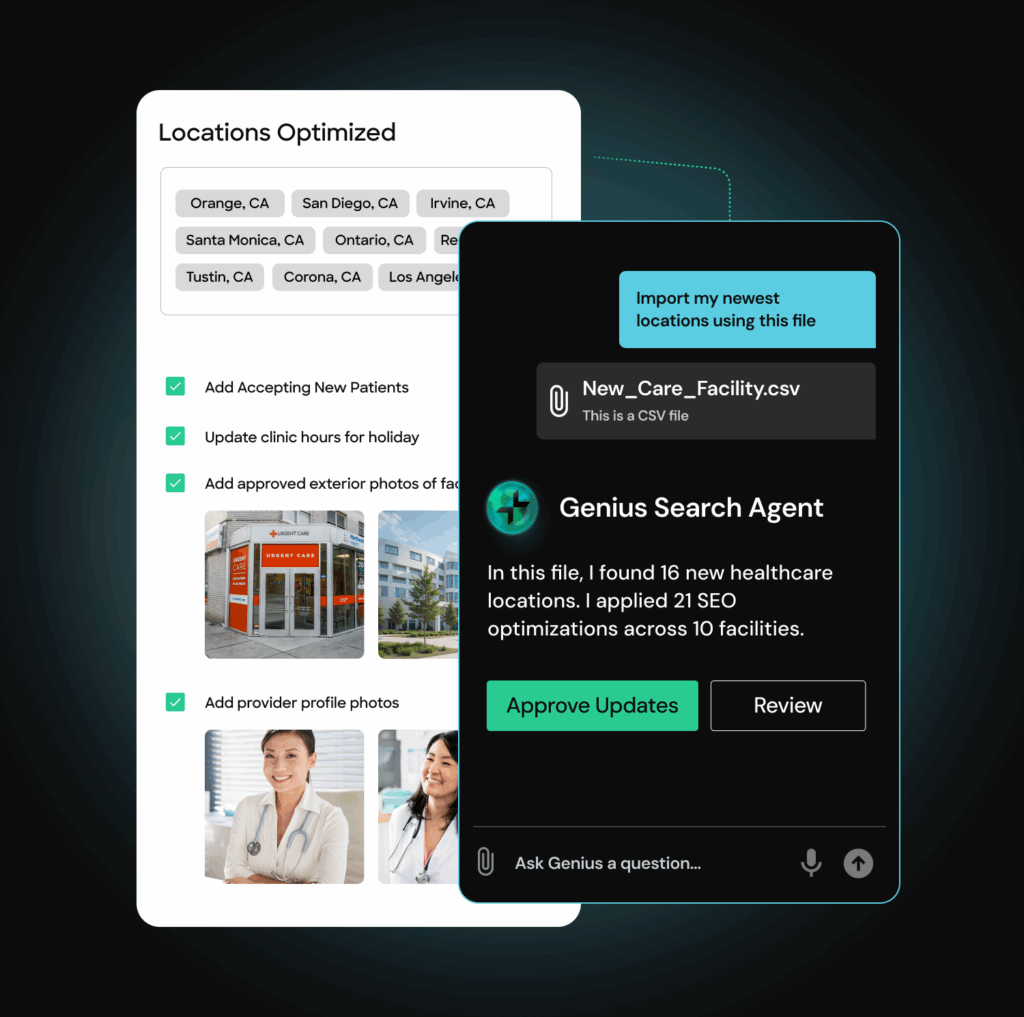
SOCi’s Genius Agents are that shift in practice. Rather than distributing templates and waiting on human review, the Local Search Agent maintains profile accuracy and publishes location-specific updates, the Social Agent produces content calibrated to each market, and the Reputation Agent responds to reviews with brand-compliant language matched to what the reviewer actually said. Human teams set the parameters and review exceptions. The agents do the work.
The operational change shows up in three dimensions.
Genuine local content at volume. Genius Agents generate profile posts, social content, and review responses that reflect real location-level inputs: the neighborhood, the local competitive context, recent customer signals. This is not a template with a city inserted. It is content Google’s algorithm can distinguish as locally relevant, which is what drives measurable improvement in local search ranking.
Continuous monitoring without continuous staffing. Genius Agents watch listing accuracy, review streams, and ranking signals across the full footprint without anyone opening a dashboard. When a listing changes or a location slips, the system acts. Brands get the equivalent of a dedicated local marketer at every location without adding headcount at every location.
Closed-loop performance improvement. Instead of reporting what happened and handing intervention to a human, agents identify underperforming locations, diagnose likely causes from available signals, and execute corrective action inside defined brand parameters. Local SEO becomes an operational output rather than a quarterly project.
What to Evaluate Before Choosing a Multi-Location Marketing Platform
Not every platform delivers on the AI promise. Prioritize four criteria.
- Location-level intelligence, not location-level distribution. Ask exactly how the system generates content for an individual location. If the answer is templates with variable insertion, it is not AI-driven local marketing.
- Google Business Profile depth. GBP is the highest-leverage local SEO surface for most multi-location brands. The platform has to handle posts, attributes, Q&A, photos, and service updates, not just hours and NAP.
- Review response quality. Pull sample responses from a vendor demo. Generic, tone-deaf replies hurt more than silence. Responses need to reflect the specific content of the review, not one approved template applied everywhere.
- Integration with the systems you already run. The platform should connect to your CRM and your existing local landing page infrastructure. Isolated automation creates reconciliation work rather than removing it.
According to SOCi’s Industry Research, brands that manage GBP optimization as an integrated, automated workflow rather than a periodic manual task see a 14% lift in visibility compared to those who do not.
The Multi-Location Marketing Maturity Curve
Most brands sit somewhere on a curve running from fully manual to fully agentic. Moving up a stage is not just technology adoption. It requires operational redesign.
Stage 1: Location-dependent. Each location manages its own listings, reviews, and content. Brand consistency is low. Corporate has no performance visibility.
Stage 2: Centralized distribution. Corporate pushes templates to locations. NAP consistency improves. Local relevance drops. Profile performance is mediocre because the content is generic.
Stage 3: Platform-assisted management. A platform aggregates location data, centralizes review monitoring, and enables bulk updates. Human teams manage exceptions. Performance improves, but it scales with headcount.
Stage 4: Agentic execution. Genius Agents execute location-level work autonomously inside brand parameters. Human teams focus on strategy, exception review, and interpretation. Local search ranking improves as a byproduct of continuous operation.
Stage 4 is where Genius Agents operate. Most enterprise brands are in Stage 2 or 3. The distance between where they are and what is now possible is the opportunity.
Frequently Asked Questions
What is multi-location marketing automation? Multi-location marketing automation is the use of software systems and AI-driven workflows to execute, monitor, and optimize local marketing across a distributed footprint without manual intervention at each location. It covers listings management, Google Business Profile optimization, review response, local content publishing, and performance monitoring.
How do AI agents improve local SEO at scale? AI agents continuously monitor location-level signals, generate locally relevant content for profiles and social platforms, respond to reviews with context-specific language, and correct listing inaccuracies in real time. Unlike rules-based automation, agents adapt to location-specific inputs and execute without proportional increases in staffing.
What makes Google Business Profile management difficult across hundreds of locations? Every location needs its own profile with distinct posts, attributes, hours, photos, and review management. Past roughly 100 locations, keeping all of that current and locally relevant exceeds the capacity of most marketing teams. Stale profiles signal low relevance to Google’s local algorithm, which suppresses local search ranking directly.
How do Genius Agents handle mixed ownership models? Genius Agents operate inside brand-defined parameters at the location level, so corporate-owned, franchised, and partner-operated locations can all receive execution without depending on local staff to log in and complete tasks. Corporate retains visibility and governance across the entire footprint.
What is the Local Visibility Index and why does it matter? The Local Visibility Index is SOCi’s annual research benchmarking local marketing performance across multi-location brands and industries. It reports on profile optimization rates, review response rates, local search visibility, and competitive performance by sector, which gives enterprise marketers the external benchmarks needed to build an internal business case.
Where should a multi-location brand start? Start with Google Business Profile completeness and accuracy across every location. GBP is the primary local ranking signal for branded and near-me search. Verify NAP consistency across major directories next. Then move to review response rate, a confirmed local ranking factor. Automating those three before expanding into content and social produces the fastest measurable gain.
Automate Local Marketing Across Every Location
See how SOCi Genius Agents manage local marketing across every location in your footprint.
Related Articles