The Role of Social Media in the Verification Loop

Share


Social media is now a core part of local discovery. For many consumers, it is where they find a local business, where they check it out, and where they decide to visit.
SOCi’s 2026 Local Discovery Index (LDI) found that 55% of consumers used social media to find local businesses in the last 30 days. That makes social the second most-used channel after search engines (83%), and just ahead of AI tools (52%).
The ranking is only part of the story. The study describes local discovery as a verification loop: consumers discover a business in one place, verify it in another, and decide in a third, often within a few minutes. Social shows up at every stage of that loop, which changes how multi-location brands should plan for it.
This post covers what the data says about social’s role in discovery, verification, and conversion, and what marketers responsible for dozens or thousands of locations can do about it.
What Is the Verification Loop, and Where Does Social Fit?
The verification loop is the nonlinear path a consumer takes to choose a local business. Discovery on one channel gets cross-checked against others before a decision is made.
The LDI explains why the loop exists: no single source is both complete and trusted. AI is fast but fallible. Reviews are credible but scattered. Search is comprehensive but unfiltered. Social is persuasive but unstructured.
That last description matters. Social gives consumers something the other channels do not: a look at what a place is actually like. Photos, video, staff, and community moments show a business in a way a listing or a star rating cannot. But social content is not organized like a business profile, so consumers rarely treat it as the final word. They use it alongside everything else.
The LDI’s three-stage frame shows social has a measurable role at every step:
- Discover: 55% used social media to find local businesses in the last 30 days.
- Verify: 43% preview the place on social before a first visit.
- Decide: 59% have become a customer because of a social post or video.
The pattern also holds over time. Monthly use of social networks (across all uses, not only local search) grew from 40% in 2024 to 73% in 2025 and 78% in 2026.
How Do Consumers Use Social to Discover and Vet Local Businesses?
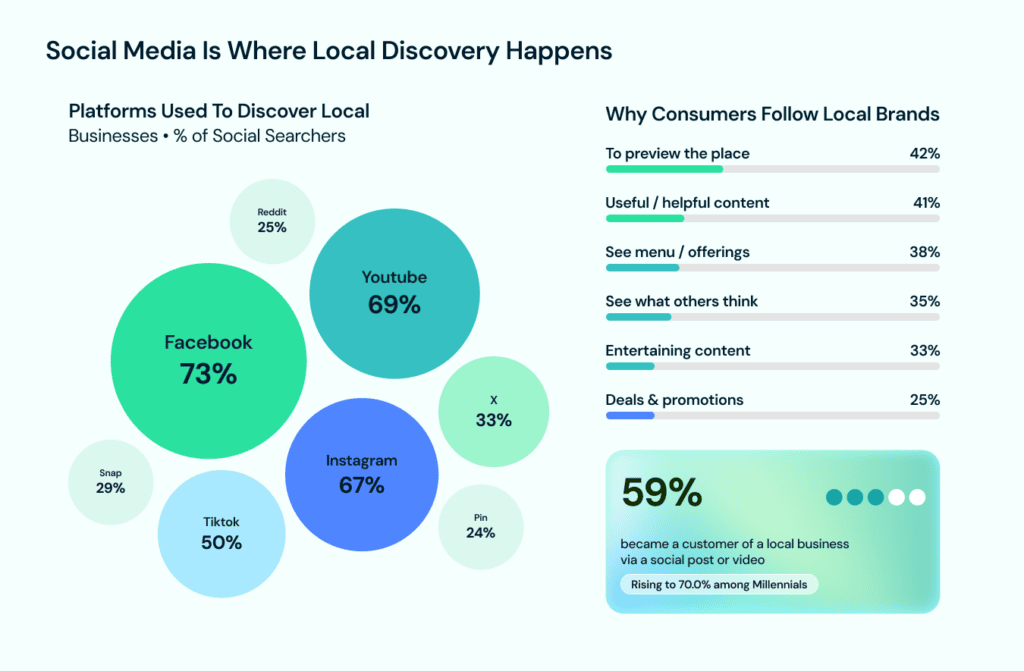
Consumers use more than one app, and the biggest platforms are not the newest ones. Among consumers who use social to find local businesses, Facebook leads at 73%. YouTube follows at 69%, ahead of Instagram (67%) and TikTok (50%). X, Snapchat, Reddit, and Pinterest also reach a notable share of social searchers.
YouTube’s second-place finish points to demand for video that shows what a place is like before consumers commit, from walkthroughs to real customer footage. TikTok reaches half of social searchers but skews younger, and it is the one platform Gen Z favors over Facebook. The right platform depends partly on who a brand is trying to reach.
The reasons consumers follow local brands are mostly about checking, not entertainment. According to the LDI:
- 42% follow a local brand to preview the place.
- 41% follow for useful or helpful content.
- 38% follow to see the menu or offerings.
- 35% follow to see what others think.
Entertaining content (33%) and deals and promotions (25%) rank lower.
Category changes the picture. Visual content is the top decision factor for property, cited by 43% of consumers. In financial services, 20% start their search on social, the highest share of any category in the study. A restaurant, a bank, and a property manager should not run the same social playbook.
Does Social Media Actually Convert Local Customers?
Yes, and not only with younger consumers. 59% of consumers say a social post or video has directly made them a customer of a local business.
That behavior peaks with Millennials at 70%. It holds above half for Gen X (54%) and Gen Z (52%), and drops to 22% among Boomers. Because three of four generations sit above half, social is not a young-consumer niche that can be judged on reach or engagement alone. It produces customers.
The LDI’s read for enterprise brands is that this makes social a local proposition, not just a national one. Localized, store-level content is what moves a consumer from scrolling to visiting. A national brand page cannot do that job for every location.
What Happens After an AI Recommendation?
Social is a common next stop after an AI answer, and that is where the loop becomes visible. AI use for local discovery is growing fast, but trust has not kept pace. Among AI users, 67% say a tool has given them wrong information about a local business at least once. Across all consumers, 73% have not increased their trust in AI over the past year.
So consumers check. After an AI tool recommends a business, 81% take another step before reaching out, and only 19% contact the business directly.
Reviews are the most common next step (33%). Social comes second: 20% look at the business’s social media to learn more. Another 16% verify through search.
This is what “AI is a powerful first impression” means in practice. A location can appear in an AI answer, but if its social presence is missing, stale, or out of step with its listings, the consumer reaches the verification step and the loop breaks.
The 2026 Local Visibility Index (LVI) points to one place that gap shows up. 43.0% of locations include social links on their Google profile. That leaves room to connect the search result to the social proof consumers go looking for.
What Should Multi-Location Brands Do About Social?
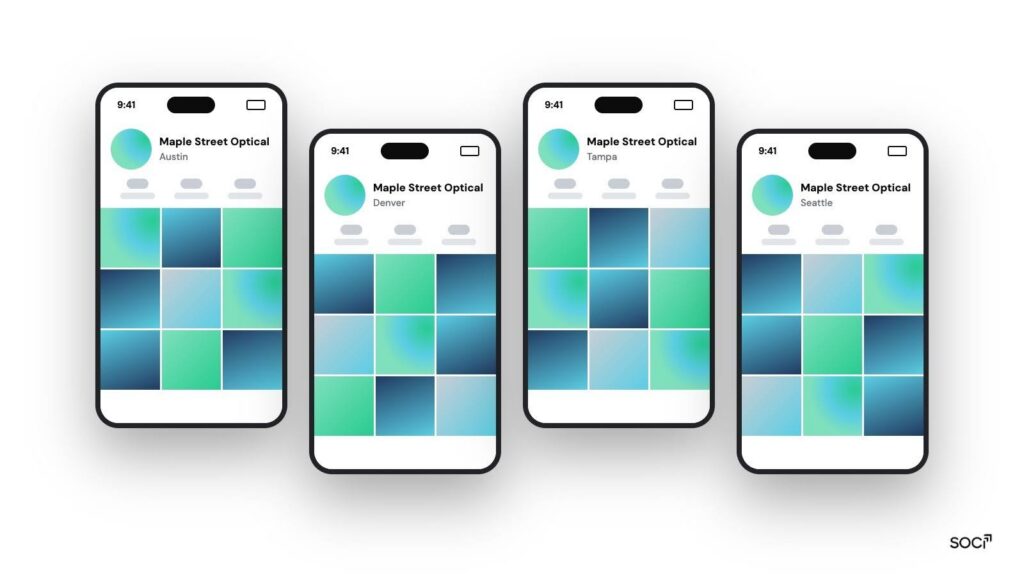
The LDI’s action item is direct: make sure your brand has a social presence at the local level, with a profile on key platforms for every location. Here is how to put that into practice.
- Give every location a social presence. The verification step happens location by location, and a brand page alone does not cover it.
- Post local, not just national. Prioritize real photos, staff, offers, and community moments. The 2026 LVI found that 26.8% of locations use waterfall posting on Facebook, which copies corporate posts to local pages. Localized posting drives better engagement.
- Match platforms to audience and category. Facebook and YouTube have the broadest reach among social searchers, TikTok skews younger, and category shifts what matters (visual content for property, social as a starting point for financial services).
- Focus first on Millennials and Gen X. They convert at the highest rates among the generations studied, at 70% and 54%.
- Keep social consistent with everything else. Hours, offers, and details on social should agree with listings and reviews. A break at any point in the loop sends the customer to a competitor.
- Treat search and social as one system. The Leaders in the 2026 LVI manage social as a credibility signal as well as an engagement channel.
Doing this across hundreds or thousands of locations is an execution problem. SOCi’s Social Agent keeps every location posting locally relevant content at scale.
Conclusion: Social Is Part of the Proof
Social no longer sits outside the path to purchase. In the 2026 LDI, it shows up in discovery, in verification, and in the decision itself. Consumers rarely rely on one source, so a strong social presence matters most when it agrees with everything else they find.
The standard to aim for: be everywhere your customers look, accurate and consistent on all of it, or be effectively nowhere.
See where your locations stand. Download the 2026 Local Discovery Index, or request a Local Visibility Index audit to see how your locations show up across search, social, AI, and reviews.
Related Articles