AI for Local SEO: How Agents Improve Rankings for Multi-Location Brands
Share


Summary
AI is changing how consumers discover local businesses. Search is no longer confined to Google—it now happens through AI agents interpreting user intent, reviews, and local reputation signals across maps, social platforms, and the broader web. For multi-location brands and franchises, AI is now an essential part of Local SEO, redefining what visibility means in a world of conversational and automated discovery.
AI has fundamentally changed how consumers discover local businesses and most multi-location brands aren’t ready for it.
According to SOCi’s 2026 Local Visibility Index, which analyzed more than 350,000 locations across 2,751 multi-location brands, only 1.2% of locations were recommended by ChatGPT, 11% by Gemini, and 7.4% by Perplexity. By comparison, those same brands appeared in Google’s local 3-pack 35.9% of the time. AI local visibility is up to 30 times harder to achieve than traditional local search visibility.
The implication is significant: a brand can be winning in traditional local SEO and still be completely invisible to consumers who ask an AI assistant for a recommendation. Local visibility now requires winning in two different systems simultaneously — and AI agents are the only practical way to do both at scale.
What Is AI for Local SEO?
AI for local SEO is the use of intelligent software agents to manage, optimize, and improve a brand’s local search visibility across both traditional search engines and AI-powered discovery platforms.
For multi-location brands, this means continuously maintaining accurate business data, managing reviews at scale, generating localized content, and ensuring every location sends the right signals to both Google and AI assistants like ChatGPT, Gemini, and Perplexity.
The goal is local visibility — appearing when and where consumers are looking, whether that’s a Google Maps search, a voice query, or an AI-generated recommendation.
Why Traditional Local SEO Is No Longer Enough
Local SEO for multi-location brands in 2026 requires satisfying two distinct discovery systems:
Traditional local search — Google’s local 3-pack and Maps results — ranks businesses based on proximity, relevance, and prominence. This system is well understood and remains critical.
AI-driven local discovery — ChatGPT, Gemini, Perplexity, and voice assistants — synthesizes business data from across the web and recommends a single answer rather than a list of options. This system is newer, far more selective, and operates by different rules.
SOCi’s 2026 LVI found that strong traditional local search performance does not guarantee AI visibility. In retail, only 45% of brands leading in traditional local search also appeared among the most recommended in AI results. That 55% gap represents brands that are visible on Google but invisible to AI assistants — and invisible to the growing share of consumers who use them.
The practical challenge is execution. Automated multi-location SEO keeps listings, local pages, reviews, and AI-facing data accurate without relying on every local manager to make the right update.
What Drives AI Local Visibility
SOCi’s research identifies three factors that consistently determine AI local visibility:
1. Data accuracy and consistency. Business profile information was only 68% accurate on ChatGPT and Perplexity, compared to 100% accuracy on Gemini (which is grounded in Google Maps). Locations recommended by AI assistants maintain accurate, consistent data across platforms. Locations that don’t are frequently excluded.
2. Review quality and volume. Locations recommended by ChatGPT averaged 4.3 stars. In traditional local search, businesses with average ratings can still rank based on proximity and category relevance. In AI-driven results, those same locations are frequently excluded, because AI systems prioritize confidence and risk reduction over breadth. Brands with low ratings and low review response rates — below 5% response rate, near 3.4 stars — were effectively invisible in AI recommendations.
3. Cross-platform engagement signals. AI assistants synthesize data from Google Maps, Yelp, Facebook, and brand websites. Brands that maintain consistent, high-quality visibility across multiple platforms are disproportionately recommended. Single-channel strength is no longer sufficient.
How AI Agents Improve Local Visibility
Maintaining Listing Accuracy Across Every Platform
Accurate business information — name, address, phone number, hours, and category attributes — is the foundation of both traditional local SEO and AI local visibility. For multi-location brands, keeping this data synchronized across dozens of platforms is a constant maintenance problem.
AI agents monitor listings continuously and push corrections in real time. Rather than catching discrepancies in a quarterly audit, issues are resolved before they accumulate into the kind of data inconsistency that causes AI systems to lose confidence in a location.
For brands where business profile accuracy is already at 68% on AI platforms, closing that gap is the single highest-leverage action available.
Scaling Review Management to Maintain AI Visibility Thresholds
Review quality is a hard threshold in AI-driven discovery, not a gradient. Locations below roughly 4.0 stars with low response rates are excluded from AI recommendations, regardless of how well they rank in traditional local search.
For a brand with 200 locations receiving five reviews per day per location, that’s 1,000 daily reviews requiring timely, on-brand responses. Manual response at that volume is not operationally viable.
AI agents analyze incoming review sentiment, flag escalations, and generate brand-aligned responses at scale. This keeps response rates high and ratings strong — maintaining the quality thresholds that AI systems require to recommend a location.
Creating Localized Content That AI Systems Can Cite
AI assistants don’t just look at business profiles. They synthesize content from across a brand’s web presence — location pages, blog posts, FAQs, and Google Business Profile posts — to build a picture of what each location offers and how well it serves its community.
Generic location pages that only swap the city name don’t contribute meaningfully to this picture. AI systems are increasingly capable of identifying templated content and giving it less weight in generated recommendations.
AI agents can generate location-specific content that reflects local search intent, regional services, and local context at scale — producing the kind of substantive, place-specific signals that improve both traditional local visibility and AI local visibility simultaneously.
Automating Structured Data for AI Discoverability
Structured data — specifically LocalBusiness schema with accurate NAP, hours, geo-coordinates, and service data — helps AI systems understand entity relationships across your brand’s location portfolio. It is one of the clearest signals a brand can send to AI assistants about what each location does and where it operates.
Implementing and maintaining this schema across hundreds of location pages manually is both time-consuming and error-prone. AI agents can generate and synchronize schema automatically, ensuring every location sends a strong structured signal to AI systems.
Continuous Performance Monitoring Across Local and AI Channels
Local visibility in 2026 changes faster than periodic audits can track. A location that slips below a key review threshold, a listing that develops a data discrepancy, a competitor that increases posting frequency in a key market — these changes affect visibility in real time.
AI agents monitor performance signals continuously across locations, surface issues before they compound, and implement optimizations automatically. This replaces reactive maintenance with proactive visibility management — the operational model that leading brands in SOCi’s LVI use to maintain their position across both traditional and AI-driven discovery.
The Local Visibility Gap: What the Data Shows
SOCi’s 2026 Local Visibility Index benchmarks reveal clear patterns across industries:
- Retail: Only 45% of top traditional local search brands carried over into AI recommendations. AI favors consistent, trusted signals across platforms — not single-channel strength.
- Financial Services: Brands with profile accuracy issues, ratings near 3.4 stars, and review response rates below 5% were effectively invisible in AI recommendations.
- Restaurants: Visibility is concentrated among a small group of leaders. Brands that exceed category benchmarks in review quality and engagement significantly outperform the field in AI recommendation rates.
The consistent pattern: brands that treat local visibility as ongoing operational discipline — not periodic campaigns — are the ones being selected by AI assistants. Brands that don’t are disappearing from a growing share of consumer discovery.
Building a Local Visibility Strategy for AI Search
Multi-location brands that want to compete in AI-driven local discovery should focus on five areas:
Close the data accuracy gap first. With business profile accuracy at 68% on AI platforms, most brands have significant room to improve before optimizing anything else. A comprehensive listings audit is the highest-leverage starting point.
Treat review management as a visibility threshold, not a reputation tactic. AI systems use review quality as a filter, not a ranking signal. Getting every location above 4.0 stars with active, timely review responses is a prerequisite for AI local visibility.
Build cross-platform consistency. AI assistants synthesize data from Google, Yelp, Facebook, and your own website. Inconsistency across platforms reduces confidence and reduces recommendation frequency. Uniform, accurate data across all major platforms strengthens AI visibility.
Invest in genuine localized content. Every location page, GBP post, and local FAQ contributes to how AI systems represent your brand. Content that reflects real local context — specific services, local events, community context — performs significantly better than templated location pages.
Measure AI visibility alongside traditional metrics. Most local SEO reporting focuses entirely on traditional search rankings. As AI-driven discovery grows, brands need visibility data across ChatGPT, Gemini, and Perplexity to understand their full competitive position.
Why SOCi for AI Local Visibility
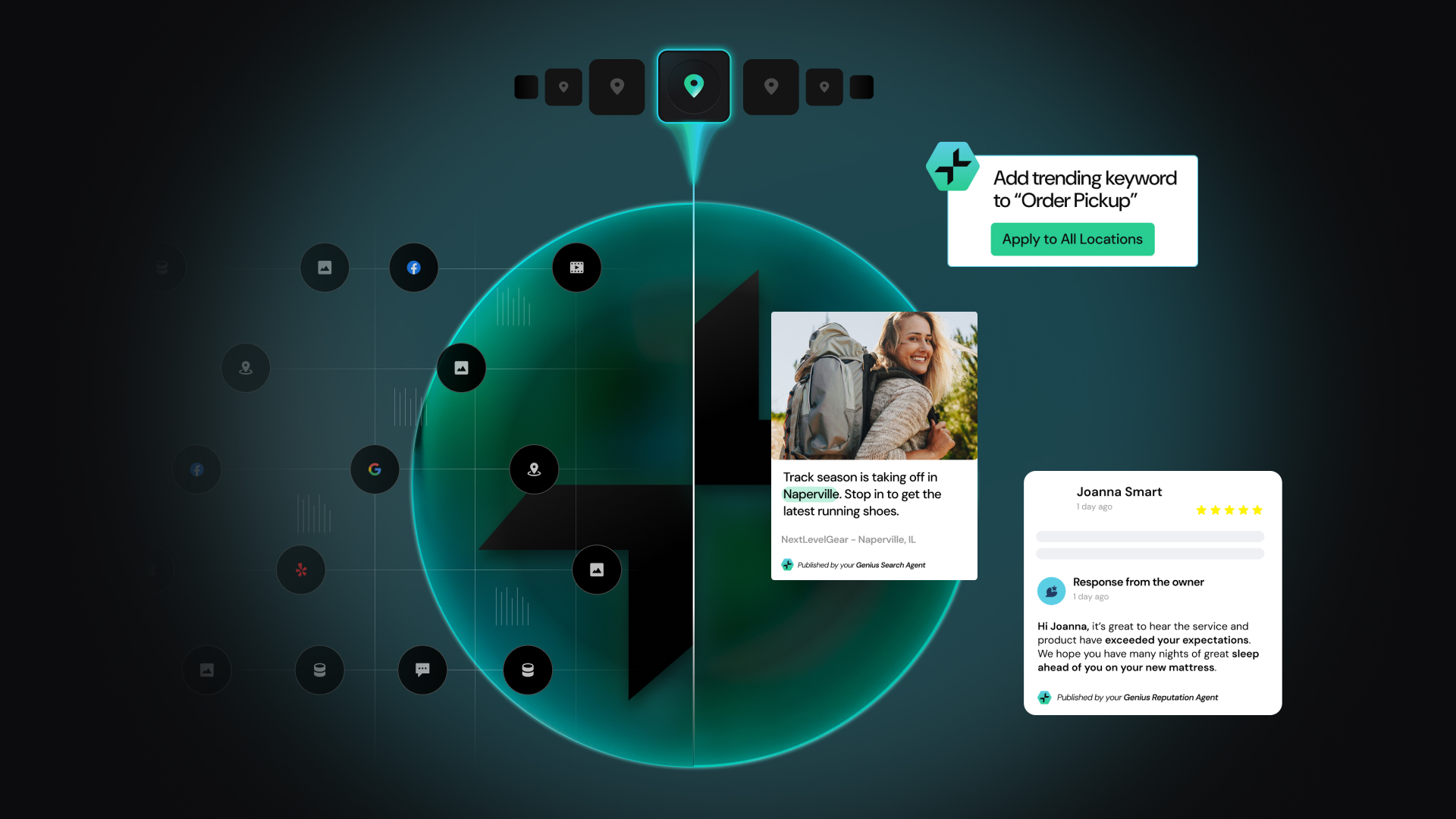
SOCi’s Genius Agents are built specifically for the operational demands of multi-location local visibility — across both traditional local SEO and AI-driven discovery.
Genius Agents continuously maintain listing accuracy, manage reviews at scale, generate localized content, and monitor performance across every location from a single platform. They are guided by SOCi’s unified visibility engine, which tracks performance across Google Search, Google Maps, ChatGPT, Gemini, and Perplexity — giving brands the benchmarking and optimization capability to compete across every channel where local discovery happens.
SOCi’s 2026 Local Visibility Index is the only benchmark that measures both traditional local visibility and AI local visibility at scale. Brands that want to understand where they stand — and what it takes to improve — can benchmark their performance against category leaders using LVI data.
Local visibility today is not about ranking. It’s about being selected. AI agents are the operational infrastructure that makes consistent selection possible — across every location, every platform, and every consumer discovery moment.
See how your brand performs in AI-driven local discovery. Explore the 2026 Local Visibility Index →
Related Articles