Retail Foot Traffic and Local Visibility: What New Data Reveals

Share


Summary
SOCi and Placer.ai compared year-over-year foot traffic against 2026 Local Visibility Index scores for multi-location retailers and found a 0.72 correlation: retailers gaining local visibility across search, social, and AI also gained store visits. Brands with near-complete profile coverage on Google, Yelp, and Facebook were recommended more often in AI answers. Retailers should prioritize accuracy, differentiation, and reputation to convert digital visibility into physical visits.
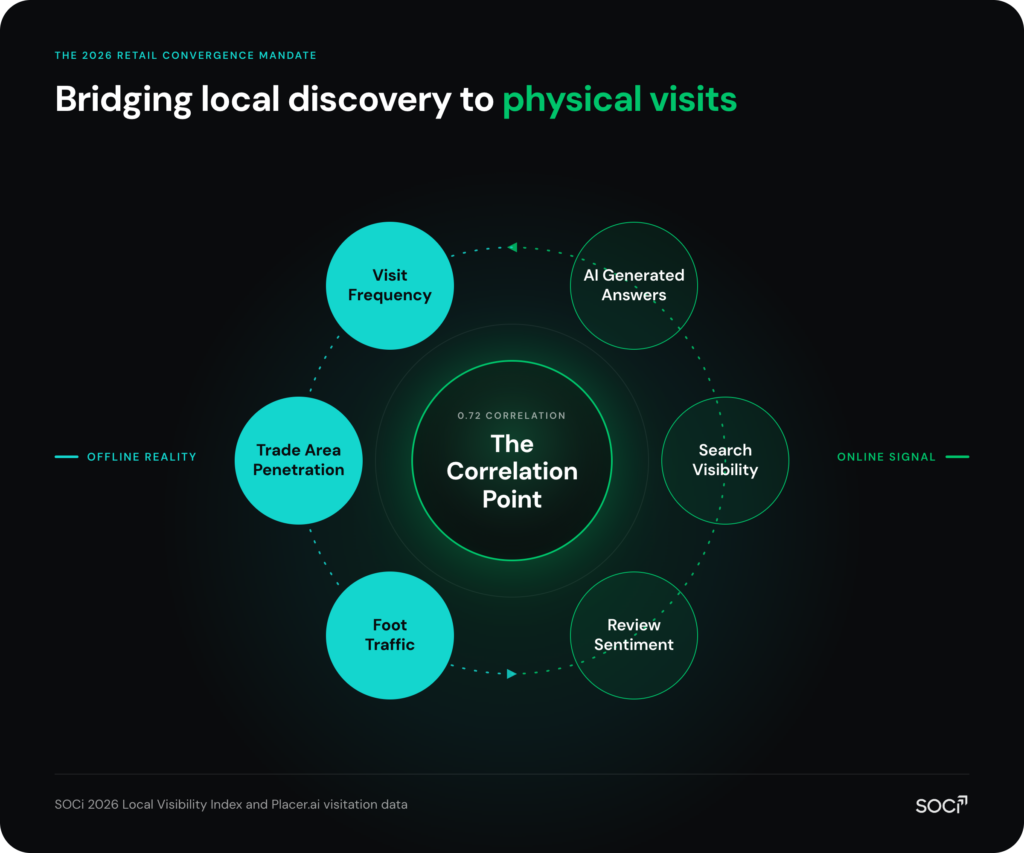
Retail foot traffic and local visibility are directly connected, and for the first time the relationship can be quantified. By comparing year-over-year visitation data from Placer.ai with year-over-year scores from SOCi’s 2026 Local Visibility Index, we identified a 0.72 correlation between growth or decline in store visits and growth or decline in local visibility. Retailers that gain ground in local search, social, and AI channels are more likely to see foot traffic increase. Retailers that lose visibility tend to lose visits.
For marketing leaders accountable for store performance, this closes a long-standing measurement gap. Local visibility is not a brand metric. It is a demand signal that shows up at the door, and it can now be benchmarked, managed, and tied to revenue.
Does Local Visibility Drive Retail Foot Traffic?
According to SOCi’s 2026 Local Visibility Index and Placer.ai visitation data, multi-location retailers show a 0.72 correlation between year-over-year change in local visibility scores and year-over-year change in retail foot traffic.
The Local Visibility Index (LVI) is SOCi’s annual benchmark report that measures how multi-location brands across 42 industries perform in local search, social, reputation, and AI visibility. SOCi research has previously shown that multi-location brands collectively leave $54 billion in potential revenue on the table each year by failing to act on local marketing priorities. The Placer.ai analysis extends that work by tying local marketing execution to physical visits, the outcome retail leaders are paid to grow.
What the SOCi and Placer.ai Data Shows
Placer.ai is a location analytics company that analyzes the visitation patterns of U.S. consumers using a panel of tens of millions of mobile devices. SOCi compared Placer.ai’s year-over-year foot traffic trends for multi-location retailers against those same brands’ year-over-year LVI scores.
The result: a 0.72 correlation between movement in foot traffic and movement in LVI score. Retailers active in local digital channels across search, social, and AI were more likely than their peers to see store visits grow.
For budget owners, that correlation changes the allocation conversation. Local visibility work has often been funded as hygiene, maintenance spend with no line of sight to revenue. Tied to store visits, it competes as a demand channel, with performance that can be benchmarked against paid media and measured store by store.
Not every brand fit the pattern, and the exceptions are instructive. Discount stores, which are traditionally less active in digital channels, still saw traffic increase year over year, a trend consistent with broader economic pressure pushing consumers toward value retailers. External factors will always influence visitation. The correlation holds across the retail set despite them.
What High-Visibility Retailers Do Differently
One example makes the mechanics concrete. A popular grocery chain saw growth in both foot traffic and LVI score. Its local marketing execution included:
- 100% of locations claimed and managed on Google, against an LVI benchmark of 90.2%
- 97.3% of locations managed on Yelp, against a benchmark of 85.0%
- 99.5% of locations managed on Facebook, against a benchmark of 57.4%
That comprehensive coverage on authoritative sites carried into AI: the chain was recommended more often in AI answers than the average retailer. Complete, accurate, actively managed local presence is what search engines and AI platforms reward, and visits follow.
In the webinar accompanying this research, SOCi CMO Monica Ho and Placer.ai CMO Ethan Chernofsky discuss the results in the context of a post-funnel purchase journey, where consumers validate as much as they discover. Retailers have to meet them across search, social, and AI platforms, answering the need for information as well as validation.
Three Priorities for Retail Marketing Leaders
Monica Ho outlined three priorities that separate retailers converting visibility into visits from those losing share.
1. Accuracy
Base-level accuracy of local information is the price of entry. If hours, locations, and services are wrong or missing, searchers and AI tools cannot route customers to your stores.
- Audit listing accuracy across Google, Yelp, and Facebook for every location, not a sample.
- Close coverage gaps first; unclaimed profiles forfeit both search placement and AI inclusion.
2. Differentiation
AI platforms summarize; they do not browse. The features that make your brand worth choosing must be explicit in your local content or they will not surface in AI recommendations.
- Publish location-level content that names your differentiators: services, inventory, community presence.
- Treat every local profile as a conversion asset, not a directory entry.
The grocery example above shows the payoff: differentiation signals concentrated on authoritative profiles translated into above-average AI recommendation rates, and AI recommendations are becoming a front door to the store.
3. Reputation
Ratings and reviews now function as a threshold for inclusion in AI recommendations, not just a consumer trust signal. Brands below the bar are filtered out before a customer ever sees them.
- Actively solicit and respond to reviews at the location level.
- Monitor rating distribution by store; one weak market can suppress visibility across a region. [Link to SOCi reputation management product page]
Measure Your Retail Foot Traffic Opportunity
The data is clear: local visibility is a leading indicator of retail foot traffic. The operational question is where your brand stands today, and which gaps are costing you visits right now.
- Download the 2026 Local Visibility Index for the full retail benchmarks.
- Run a free Local Visibility Audit to see how your locations perform across search, social, and AI.
For the full discussion between Monica Ho and Ethan Chernofsky, the webinar is available on demand from Placer.ai.
Related Articles