How to Choose the Right AI Agents for Multi-Location Marketing (Updated for 2026)
Share


According to SOCi’s 2026 Local Visibility Index, only 1.2% of business locations are recommended by ChatGPT, compared to 36% appearing in Google’s local 3-Pack. That gap is the real cost of choosing the wrong platform. Managing marketing across hundreds or thousands of locations, each running six or more channels, already strains most teams. Now every one of those channels also has to feed an AI system that decides whether a customer hears about a location at all.
Choosing a multi-location marketing platform used to mean picking software to manage. In 2026 it means choosing whether an Agentic Workforce, or a stack of disconnected tools, does that work for you. Here is what to evaluate, and what to watch for if the platform you are running today is not keeping up.
What Is an AI Agent for Multi-Location Marketing?
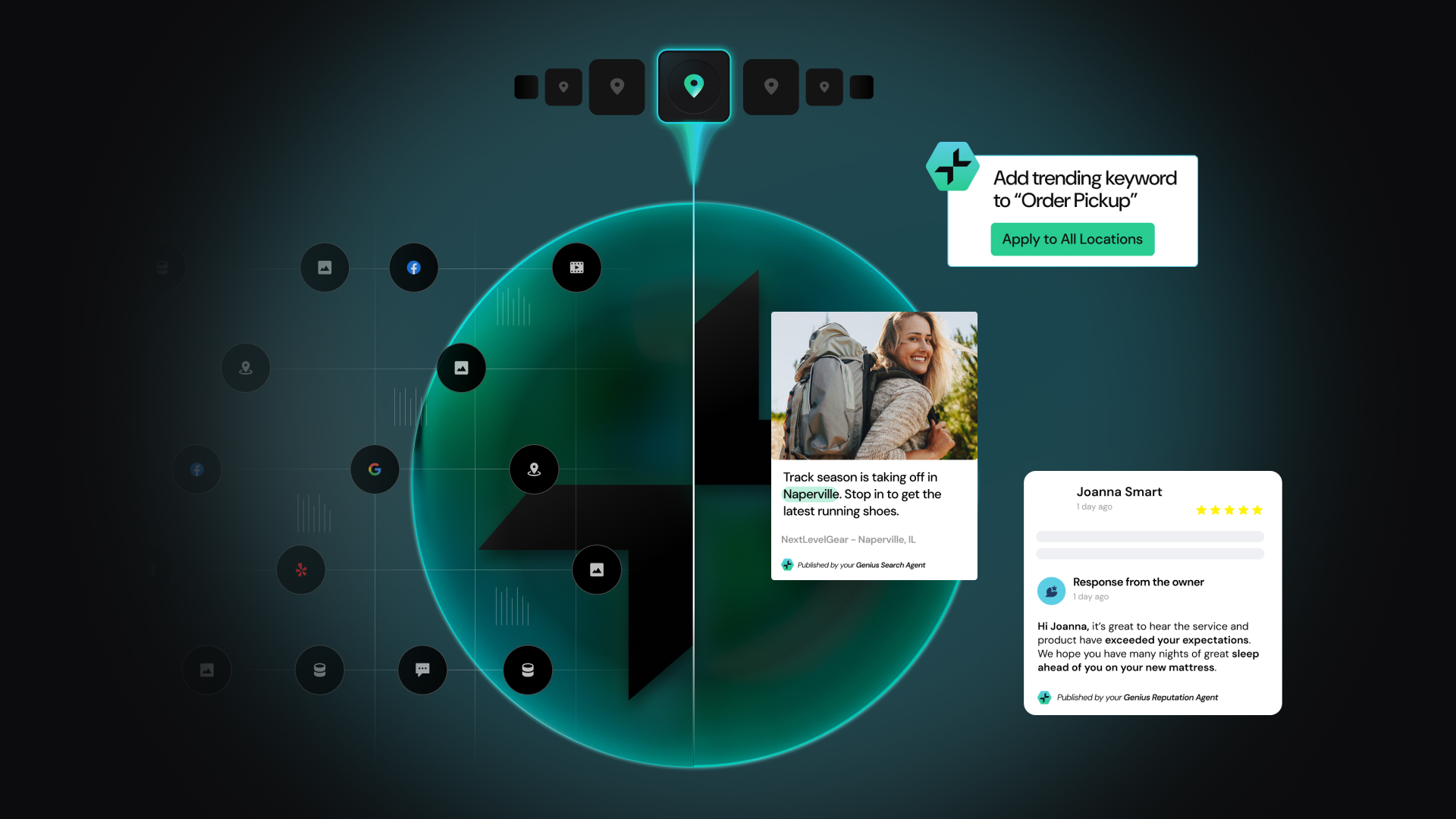
A Genius Agent is a brand-trained, autonomous digital worker assigned to one function, listings accuracy, review response, social publishing, and one location, that executes marketing tasks without a person initiating each one.
That is the line that separates this category from the software it replaced. Traditional platforms give a team dashboards and tools to operate. An Agentic Workforce does the work directly: it responds to a review, corrects a listing, or publishes a local post, and reports the outcome. The evaluation below applies to either model, but the gap between them is the first thing to test for.
1. Functionality: Does It Execute, or Does It Just Organize?
Local Search and Local Social, Consolidated
Fragmented tooling is still the norm. SOCi’s research with Forrester, The Localized Marketing Imperative, found many multi-location teams manage local search in one tool and local social in another, with no shared source of truth between them. SOCi’s own data found leaders who run both local search and social in one platform grow 3x faster than peers who don’t.
Consumers are already voting for consolidation with their own behavior. According to SOCi’s 2026 Local Discovery Index, 55% of consumers use social media to find a local business, 43% preview a business on social before a first visit, and 59% have become a customer from a social post or video.
When evaluating functionality, confirm the platform covers both sides under one login:
- Local search: reputation management, local SEO, local pages, local listings
- Local social: organic publishing, local paid social, local advertising
- A single, brand-level source of truth both sides read from and write to
Corporate and Local Usability, Together
A hybrid model, where corporate sets guardrails and individual locations act within them, consistently outperforms a model where one side owns everything. Confirm the platform gives corporate oversight into every location’s activity while still letting local teams, or their assigned agents, act without a bottleneck.
Execution, Not Just Automation Rules
Automation and agent are not the same claim. Automation runs a rule a person configured. An agent decides and acts inside boundaries the brand sets. Push past the feature list and ask:
- Does an agent respond to reviews directly, brand-voice-matched, or does it only draft one for a human to approve?
- Does listings accuracy get enforced continuously, or does it require someone to run an audit?
- Are local social posts generated and scheduled by an agent, or pulled from a static content library a person still has to populate?
2. Customer Support: Who Is Accountable When Something Breaks?
Functionality fails without support behind it. Before signing, get specific answers to:
- What does onboarding look like across corporate and every individual location?
- Is there a named customer success manager, or a shared support queue?
- What is the actual response time on a P1 issue, in writing?
Do not take a vendor’s word for it. Check independent, buyer-verified sources like G2. For reference, SOCi holds Leader status in G2’s Fall 2026 Grid Report for AI Agents for Business Operations, ranked #7 of 1,757 products, top 0.4% of the category. That is the kind of third-party benchmark to require from any platform under evaluation, not a claim to accept from a sales deck.
3. Reporting and Analytics: Can It Prove Revenue Impact?
Engagement and impressions are not proof of pipeline. Before comparing platforms, decide which outcomes actually matter to the business:
- Cost per lead or per conversion from social advertising
- Review response time and its effect on conversion rate, not just volume of responses
- Local page and listing visibility across the specific AI engines and search surfaces customers actually use
Score each platform’s reporting against that list, not against a generic dashboard demo. A platform that cannot tie a location’s activity to a location’s revenue is a reporting gap the buyer inherits.
4. Pricing: The Structure Matters More Than the Number
A platform covering both local search and local social will list a higher price than a single-purpose tool. Compare it against the cost of running two separate platforms plus the integration work to connect them, not against the single-purpose price alone.
Confirm the pricing structure directly: priced per account (per location) or per user login? For a multi-location brand, per-account pricing is materially more affordable once local team headcount is factored in. Weigh total cost against projected ROI, not sticker price against sticker price.
5. Proof: Does It Have a Real Agents Story?
A case study only counts as proof if it shows a specific agent doing specific work and driving a measurable outcome, not a generic engagement claim with no attribution to what caused it. Before trusting a proof point, check:
- Is the customer named, not anonymized, and verifiable?
- Does their location count and industry resemble the brand doing the evaluating?
- Is the result tied to a specific agent’s action, a Reputation Agent’s response rate, a Social Agent’s engagement lift, not a vague platform-wide number?
For example, outcomes for SOCi customers using Genius Local Search Agents include: Liberty Tax moved 90% of 2,200+ franchise locations into the Google local 3-pack (up from 60%) and saw a 55% lift in local visibility. Affordable Care attributed a 20% increase in patient leads directly to listings improvements. DICK’S Sporting Goods achieved 97% 3-pack inclusion across 700+ stores and a 74% increase in non-brand search rankings.
SOCi customers using Genius Social Agents impressive outcomes as well, such as: The Human Bean grew Instagram reach 270%, engagements 98%, and posts published 94% year over year. Smoothie King supports 1,200+ U.S. locations from one platform with a lean team. Scooter’s Coffee franchisees published brand-safe local content and outperformed local competitors. Another SOCi customer consolidated social and review work to one person.
Additionally, working with SOCi, Rita’s Italian Ice reached a 100% review response rate and cut time spent on reviews by 93% across 550+ locations. The Human Bean reached a 98% response rate with 75% less effort, responding within 24 to 48 hours. Scooter’s Coffee cut unresponded reviews by 75% and lifted positive sentiment 17%. Liberty Tax grew review volume 120% across 2,200+ locations.
Where to Start
SOCi runs the Genius Local Search Agent, Genius Social Agent, and Genius Reputation Agent on a single SOCi Platform, the shared source of truth the Agentic Workforce acts on for every location, every channel. The Platform is the foundation. The agents are the workforce doing the work on it.
Run the criteria above against what is in place today. Start with a free Local Visibility Snapshot to see where the current setup is losing visibility, in search and in AI answers, or request a demo to see the Agentic Workforce execute against real locations.
Related Articles