AI Visibility for Multi-Location Brands: The 3 Moves That Drive LLM Recommendations
Share


AI-driven discovery is reshaping how consumers choose where to eat, shop, bank, or book services. In this new world, page one doesn’t exist. Your brand is either recommended by AI or left out entirely.
Brand locations are recommended by AI platforms only 17.6% of the time, nearly six points below the 23.6% appearance rate in Google’s traditional 3-Pack. That gap is the headline finding of SOCi’s 2025 The Factors Driving AI Visibility Report, which analyzed a representative sample of roughly 3,000 multi-location brands and 350,000 individual locations across ChatGPT, Gemini, and Perplexity. Semrush projected in July 2025 that AI-driven search will overtake traditional organic search by early 2028, possibly sooner, which means the brands that close this gap now will shape how consumers discover local businesses for the next decade.
Most AI search guidance is written for single-location businesses, the independent coffee shop, the local plumber, the neighborhood retailer. The reality is different for multi-location brands. A brand with hundreds or thousands of locations generates its own data, reviews, content, and signals at every address, and AI does not average that performance across a network. It evaluates patterns. If even a handful of locations are out of sync, out of date, or underperforming, AI is more likely to recommend a competitor instead of drawing a distinction between your strong stores and your weak ones.
What Is AI Visibility for Multi-Location Brands?
AI visibility is a brand’s ability to appear as a trusted recommendation inside large language models such as ChatGPT, Gemini, and Perplexity when consumers search for nearby products or services. For multi-location brands, AI visibility depends on how consistently business data, customer experience, and local activity perform across every location, not just the top-performing stores.
SOCi’s 2025 AI Visibility report found that brands who dominate AI results share three characteristics: relevance to the specific query, authority relative to competing options, and precision in their underlying data. The three moves below are how multi-location brands execute against that framework at scale.
Move #1: Fix the Data That Feeds AI
If your data isn’t accurate everywhere, AI won’t recommend you anywhere.
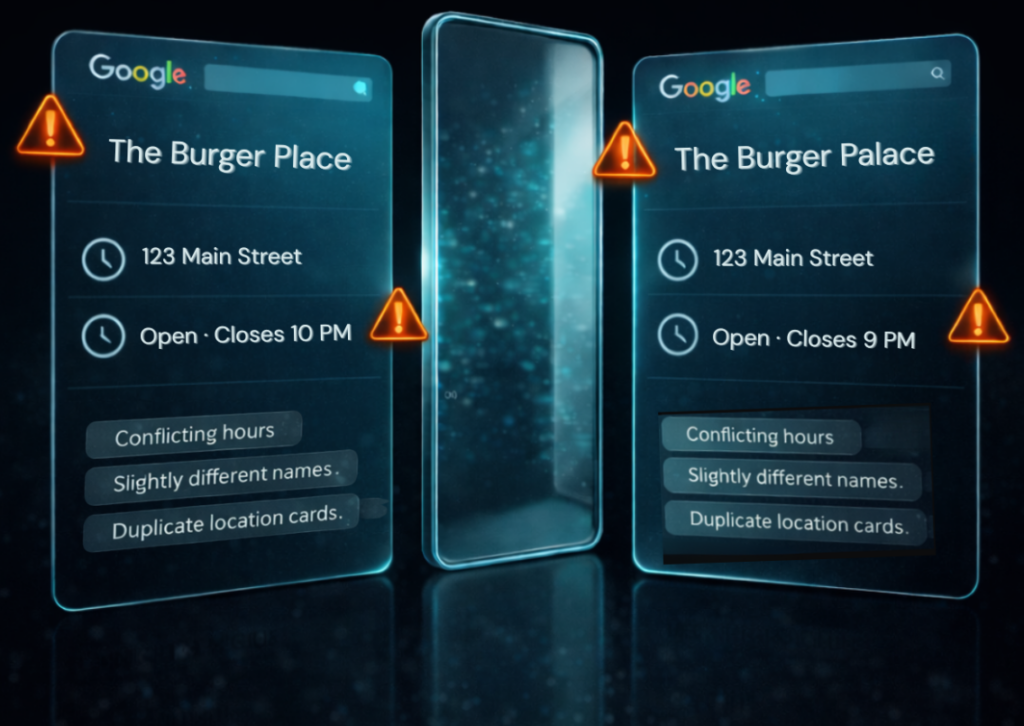
LLMs pull information from across the local ecosystem, including Google, Yelp, Facebook, business websites, and industry directories. They do not verify accuracy or reconcile conflicts between sources; every source is treated as equally plausible. That means every inconsistency chips away at trust, and the study shows how much that costs: ChatGPT’s location data is only 65.5% accurate and Perplexity’s is 69.8% accurate, compared to 99.2% accuracy for Gemini, which draws directly from Google Maps. ChatGPT and Perplexity don’t have Google Maps at their core, so they lean on a more fragmented set of directories and industry sites, some of which carry outdated or inconsistent information.
Common data failures for multi-location brands include mismatched business names, addresses, or phone numbers; outdated hours or holiday schedules; duplicate or abandoned listings; incomplete or missing attributes; social profiles that drift out of sync with listings; and local pages that contradict directory data. To an AI system, this doesn’t look like operational complexity. It looks like unreliability, and unreliable brands don’t get recommended.
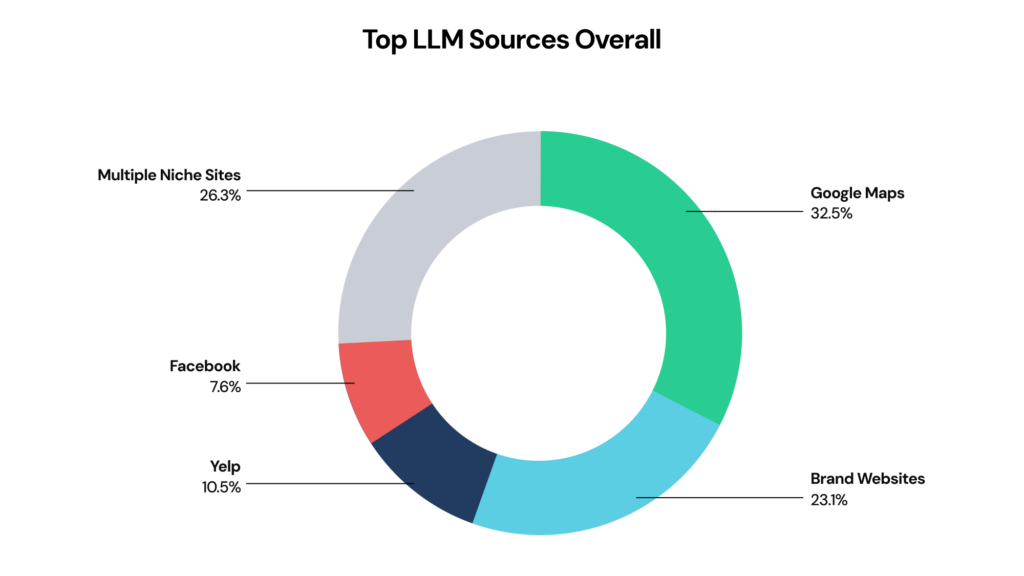
Where LLMs actually get their data: SOCi examined 2 million source URLs to determine what LLMs cite when answering local queries. The brand’s own website appears in 23.1% of LLM recommendations. Among third-party sources, Google Maps accounts for 32.5% of all local citations, followed by Yelp at 10.5%, Facebook at 7.6%, and multiple niche sites, 26.3%. The brand’s website, Google Maps, Yelp, and Facebook alone account for nearly three-quarters of what shapes AI’s understanding of your brand, which is why data consistency isn’t a technical detail, it’s a visibility requirement.
AI doesn’t fix your data. It reflects it. If your data is consistent, AI amplifies it. If it’s inconsistent, AI ignores it and recommends someone else.
What multi-location brands must do
- Standardize core details across every platform and every location.
- Remove outdated or duplicate listings.
- Sync local landing pages with directory data. A well-maintained set of local landing pages is a direct lever on AI visibility, not a nice-to-have.
- Ensure attributes, hours, categories, and naming conventions match everywhere.
- Use a system that maintains accuracy automatically. This is the specific job a Genius Local Search Agent handles across a multi-location footprint.
Source: SOCi’s 2025 AI Visibility Report
Move #2: Strengthen the Signals That Shape Customer Perception
If customer perception varies across locations, LLMs won’t risk recommending you.
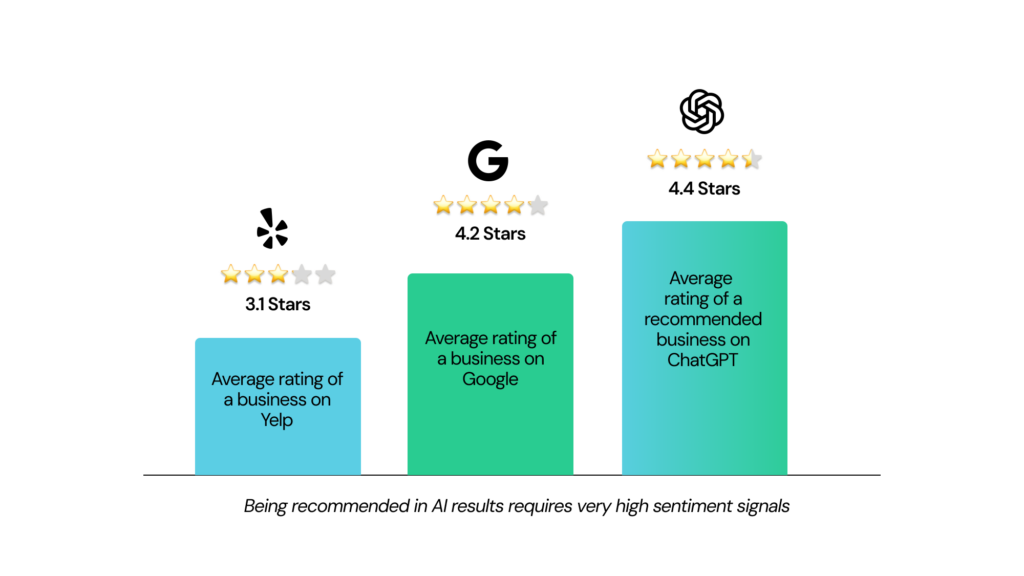
AI evaluates brands through the eyes of customers. Ratings, reviews, recency, response time, and feedback patterns all become signals that LLMs use to assess whether your brand is reliable across every location, not just your top-performing ones. And AI’s standard is higher than traditional search: the average business rating is 4.2 stars on Google and 3.1 stars on Yelp, but the average rating among businesses AI actually recommends is 4.3 stars on Perplexity and 4.4 stars on ChatGPT (Gemini follows Google). A 4.2 signals possible risk. A 4.4 signals reliably safe, and that half-star gap is the difference between being recommended and being passed over.
Source: SOCi’s 2025 AI Visibility Report
For a single-location business, one reputation defines the brand. For a multi-location brand, hundreds of reputations merge into a single trust profile, and one underperforming market can undermine confidence everywhere else in the network.
What multi-location brands must do
- Raise sentiment across the entire footprint, not just high-performing stores.
- Increase review volume and freshness at scale.
- Respond to reviews quickly and consistently. Managing volume and response at this scale is the core function of a Genius Reputation Agent.
- Identify and correct negative sentiment patterns by market.
- Reinforce experience quality through social engagement and content.
AI takeaway: AI rewards consistency, not isolated excellence.
Move #3: Increase Your Local Relevance Signals
If your brand isn’t active online, AI assumes it’s irrelevant.
AI visibility doesn’t come only from data accuracy or customer sentiment. It also depends on signals of ongoing activity, the digital equivalent of showing signs of life. LLMs rely on recency, relevance, and frequency signals, and AI interprets activity the same way a person would: if your local content is stale, your posts are outdated, your social pages go quiet, or your local pages never change, AI assumes the business may no longer be engaged or up to date.
This isn’t a soft correlation. SOCi’s 2025 AI Visibility report found a 0.72 correlation between local marketing performance in traditional channels, measured by the Local Visibility Index (LVI), and AI visibility. Brands that build complete online profiles, post consistently on social platforms, build local audiences, and respond to local reviews are measurably more likely to be surfaced in AI recommendations for their store and service locations. The work that improves traditional search rank is largely the same work that improves AI visibility, which means brands running one program aren’t choosing between the two.
What LLMs look for
- Fresh local content that signals your business is active.
- Search and social engagement that shows your brand is present and responsive.
- Local updates and offers that demonstrate relevance to a specific community.
- Timely Google and social updates that reflect store hours, events, and changes.
- Content that matches how people actually search (“best [category] near me,” “open now,” “kid-friendly [category]”).
- Consistency across locations so your network looks cohesive, not fragmented.
This isn’t generic content marketing. It’s proof of operational vitality, the signals that tell AI your locations are active, current, and relevant today.
AI Visibility Is Earned Across Your Entire Network
AI has raised the bar for multi-location brands. The brands that win deliver reliable data across every location, consistent experience signals in every market, and active, relevant engagement across search and social. These three layers shape how AI interprets your brand and heavily influence whether it surfaces your locations or a competitor’s.
Get those right, and your brand doesn’t just stay visible. It becomes the recommendation customers see first.
See how your brand performs in AI-driven local discovery. Run a free check to see your brand’s Local Visibility Scorecard or explore the Local Visibility Index.
Frequently Asked Questions About AI Visibility
How do LLMs decide which local brands to recommend?
LLMs evaluate business data accuracy, customer sentiment, review patterns, and signals of local activity across a brand’s entire footprint, then weigh those signals against competing options in the same category and market.
Why do single-location businesses appear more often in AI results?
Single-location businesses typically have simpler, more consistent data across fewer sources, which makes them easier for AI systems to verify and trust. Multi-location brands generate that same complexity at every address, which compounds the risk of inconsistency.
Does AI visibility replace local SEO?
No. AI visibility builds on local SEO, reputation management, and social activity, but it demands higher consistency and coordination across locations than traditional search ranking does.
How accurate is the location data AI platforms use?
It varies significantly by platform. According to SOCi’s 2025 AI Visibility Report, Gemini’s location data is 99.2% accurate because it draws on Google Maps, while ChatGPT is 65.5% accurate and Perplexity is 69.8% accurate.
Is there a measurable link between traditional local marketing and AI visibility?
Yes. SOCi’s 2025 AI Visibility Report found a 0.72 correlation between local marketing performance in traditional channels, as measured by the Local Visibility Index, and AI visibility.
Related Insights