AI Agents for Multi-Location Marketing: 5 Tasks You Can Fully Automate Today

Share


Summary
AI agents for marketing automation help multi-location brands automate local marketing with AI, improving visibility, reviews, and social at scale.
AI agents for marketing automation are already replacing manual local marketing workflows
Enterprise brands managing 50+ locations face a simple reality: manual local marketing does not scale. According to SOCi’s 2026 Local Visibility Index, business profile accuracy on AI platforms like ChatGPT is only 68.3%, highlighting a major gap in local data reliability, directly impacting visibility and conversion.
At the same time, customer expectations have accelerated. Consumers expect responses to reviews within 24 hours, accurate listings everywhere, and hyper-local social engagement. Most marketing teams cannot meet those expectations manually.
This is where AI agents for marketing automation change the equation.
Unlike traditional automation tools, AI agents act autonomously. They analyze context, make decisions, and execute tasks without constant human input. For multi-location brands, this means you can automate local marketing with AI across hundreds or thousands of locations simultaneously.
Below are five high-impact marketing tasks you can fully automate today.
What tasks can AI agents automate in multi-location marketing?
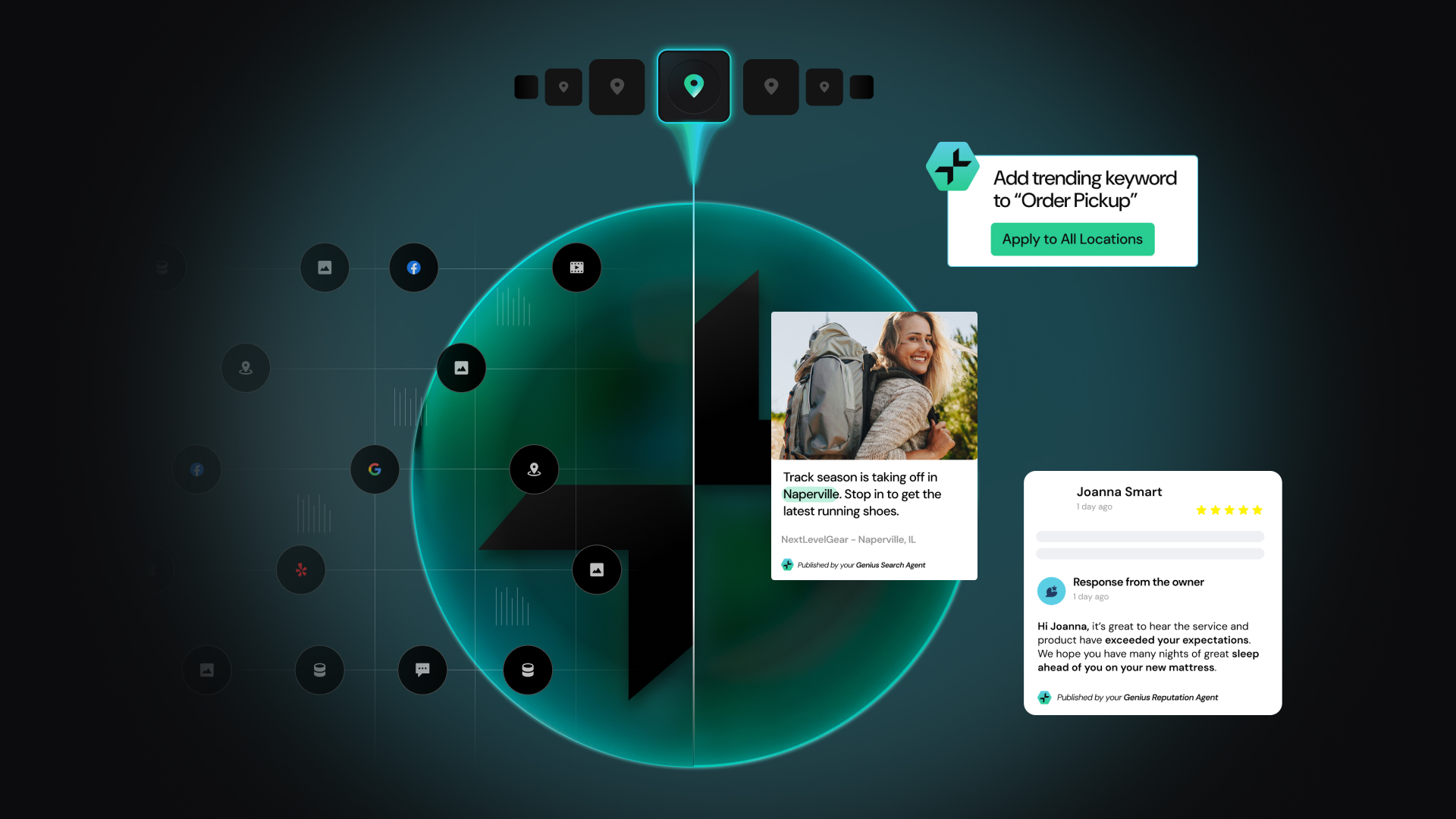
1. Review response automation AI at scale
Customer reviews are one of the most influential local ranking factors and conversion drivers. Yet responding to reviews across hundreds of locations is one of the most time-consuming tasks.
AI agents multi-location brands use today can:
- Generate personalized responses to every review
- Adjust tone based on sentiment (positive, neutral, negative)
- Reference location-specific details (staff names, services, events)
- Escalate critical reviews automatically
According to SOCi’s LVI, visibility in ChatGPT recommendations is 30x harder to achieve than ranking highly in Google search, fundamentally changing how visibility is earned.
Why this matters:
Speed and consistency directly impact both visibility and customer trust. AI agents ensure every review gets a timely, on-brand response without overloading local teams.
Where nuance matters:
Not all reviews should be fully automated. High-risk or legally sensitive responses may still require human review. The most effective approach combines autonomous review management with escalation rules.
2. Local listings management automation across every platform
Listings accuracy is the foundation of local discovery. If your hours, address, or services are wrong, nothing else matters.
Yet maintaining listings across Google, Apple Maps, Yelp, and emerging AI discovery platforms is complex and fragmented.
AI agents for marketing automation can:
- Detect inconsistencies across listings in real time
- Automatically update hours, services, and attributes
- Sync changes across platforms instantly
- Monitor AI-driven search engines for data discrepancies
Why this matters:
AI-driven discovery depends heavily on structured data accuracy. Local listings management automation directly improves how AI systems surface your brand.
Key insight:
This is no longer just about Google. AI agents must optimize for machine-readable accuracy across AI ecosystems, not just traditional search engines.
3. Local social media automation that still feels human
Local social media is critical for engagement, but it rarely gets the attention it deserves. Corporate teams cannot realistically create unique content for every location.
AI agents workforce marketing solutions can:
- Generate localized social posts tailored to each market
- Align messaging with brand voice using brand-trained AI agents
- Incorporate local events, promotions, and trends
- Schedule and publish content automatically
Example use case:
A franchise brand launches a national promotion. AI agents adapt the campaign into hundreds of localized posts, adjusting messaging based on region, audience behavior, and location-specific offers.
Why this matters:
Generic, duplicated content underperforms. AI agents enable true local relevance at scale, which drives higher engagement and reach.
Where caution is needed:
Over-automation can lead to content fatigue if not monitored. Brands should regularly review performance and refine prompts and guardrails.
4. Autonomous review and reputation monitoring
Beyond responding to reviews, brands need to understand trends across locations.
AI agents can automatically:
- Analyze sentiment trends across regions
- Identify recurring issues (e.g., staffing, cleanliness, service delays)
- Surface high-risk locations before issues escalate
- Generate executive summaries for leadership
AI systems consistently recommend businesses with 4.2–4.3 star ratings, making strong sentiment a baseline requirement for visibility.
Why this matters:
This transforms reviews from reactive tasks into strategic insight engines.
Key shift:
Instead of reading thousands of reviews manually, teams rely on AI agents to extract actionable intelligence in real time.
5. Franchise marketing automation with brand-trained AI agents
Franchise and multi-location brands struggle with balancing control and flexibility.
Corporate teams need brand consistency. Local operators need autonomy.
Brand-trained AI agents solve this by:
- Embedding brand guidelines into every output
- Allowing local customization within approved parameters
- Enforcing compliance automatically
- Scaling execution without increasing headcount
This creates a new model: agents workforce marketing, where AI agents act as an extension of your marketing team.
Why this matters:
It eliminates the traditional trade-off between control and scalability.
How do AI agents improve local visibility for multi-location brands?
AI agents improve local visibility by automating the core signals that search engines and AI platforms prioritize:
| Visibility Factor | How AI Agents Improve It |
| Listings accuracy | Real-time updates and synchronization |
| Review activity | Consistent, timely responses |
| Content relevance | Hyper-localized social content |
| Engagement signals | Increased interaction across channels |
| Data consistency | Structured, machine-readable data across platforms |
According to SOCi’s LVI, only 1.2% of locations are recommended by ChatGPT, compared to 35.9% appearing in Google’s 3-Pack, showing how dramatically AI compresses visibility.
Bottom line:
AI agents do not just save time. They directly influence how your brand appears in search, maps, and AI-generated recommendations.
What are the limitations of AI agents in marketing automation?
AI agents are powerful, but they are not a silver bullet. High-performing teams understand where human oversight is still essential.
1. Context sensitivity still matters
AI agents can misinterpret nuanced situations, especially in sensitive customer interactions.
2. Brand voice requires training
Without proper configuration, outputs can feel generic. Brand-trained AI agents are critical to maintaining consistency.
3. Governance and compliance are non-negotiable
Franchise systems require strict guardrails. AI agents must operate within clearly defined policies.
4. Over-automation risks diminishing authenticity
If every interaction feels automated, customers notice. The goal is scalable personalization, not robotic uniformity.
5. Data quality determines output quality
AI agents rely on accurate data. Poor inputs lead to poor outcomes.
Key takeaway:
The most effective strategy combines automation with intelligent oversight, not full detachment.
How do SOCi Genius Agents support marketing task automation AI?
SOCi’s Genius Agents are designed specifically for multi-location brands.
They go beyond basic automation by acting as autonomous, brand-trained AI agents that execute local marketing tasks across your entire footprint.
With SOCi Genius Agents, brands can:
- Automate review responses with location-specific personalization
- Maintain accurate listings across platforms
- Scale local social media content creation
- Monitor and analyze reputation trends
- Ensure brand compliance across all locations
Unlike generic AI tools, Genius Agents are built for the complexity of multi-location ecosystems, where scale, consistency, and localization must coexist.
Why AI agents are becoming the default for enterprise local marketing
The shift is already underway.
Marketing teams are moving from:
- Manual execution → Automated workflows
- Centralized bottlenecks → Distributed AI execution
- Reactive management → Proactive optimization
Across industries, fewer than half of top-performing brands in traditional search appear in AI recommendations, proving that existing strategies do not translate to AI visibility.
This is not a trend. It is a structural shift in how marketing gets done.
Frequently Asked Questions
What are AI agents for marketing automation?
AI agents for marketing automation are systems that autonomously execute marketing tasks such as review responses, listings updates, and content creation. They analyze context, make decisions, and act without constant human input. For multi-location brands, they enable scalable execution across hundreds of locations.
How can brands automate local marketing with AI?
Brands can automate local marketing with AI by deploying agents that manage reviews, listings, social media, and reputation insights. These agents operate across locations simultaneously while maintaining brand consistency. The result is faster execution and improved local visibility.
What is review response automation AI?
Review response automation AI uses AI agents to generate personalized replies to customer reviews. It adjusts tone based on sentiment and includes location-specific details. This improves response speed, consistency, and customer engagement.
Do AI agents work for franchise marketing automation?
Yes, AI agents are highly effective for franchise marketing automation. Brand-trained AI agents enforce corporate guidelines while allowing local customization. This ensures consistency without limiting local relevance.
How do AI agents improve local SEO and visibility?
AI agents improve local visibility by ensuring accurate listings, consistent review responses, and localized content. These factors directly influence how search engines and AI platforms rank and recommend businesses. Automation ensures these signals remain strong across all locations.
What are the risks of using AI agents in marketing?
The main risks include lack of context in sensitive situations, inconsistent brand voice without training, and over-automation. These risks can be mitigated with proper guardrails, escalation workflows, and ongoing optimization.
Ready to scale your local marketing with AI agents?
AI agents are no longer experimental. They are the fastest way to scale execution, improve visibility, and reduce operational strain across multi-location brands.
See how SOCi Genius Agents can automate your most time-consuming local marketing tasks. [Request a demo →]
Related Articles