How to Manage Social Media at Scale for Retail Brands
Share


Retail social media has a short shelf life. A promotion is only useful while it’s running. A new arrival is only interesting while it’s in stock. A weekend sale needs to reach the store’s neighborhood before Saturday, not the following Tuesday. For a retailer with a handful of stores, that timing pressure is manageable. For a retailer with hundreds of stores, each with its own inventory, promotions, and foot traffic patterns, it becomes close to impossible to manage by hand.
The stakes are concrete: 80% of shoppers search online before visiting a store, and when what they find there, hours, inventory, current promotions, is wrong, nearly half go elsewhere. Social media at scale for retail brands is not a branding exercise. It is one of the channels that decides whether a shopper walks in this weekend or chooses a competitor instead.
Most retail chains end up choosing between two flawed defaults: a national feed that promotes the brand broadly but never mentions what’s actually happening at a specific store this week, or a patchwork of local social pages that only stay active where a store manager happens to have the time and interest. Neither gets retail social right. It is a specific case of the broader multi-location social media management problem, with one constraint that makes retail harder than most: promotional windows measured in days, not months.
Why Retail Promotions Move Faster Than Manual Social Can Keep Up
A restaurant’s specials might run for a season. A retailer’s promotions often run for a weekend. That compressed timeline means the content gap that other industries can absorb becomes a lost sale in retail: a promotion that ends before the local post ever goes up, or new inventory that sells through before anyone in the neighborhood knows it’s on the shelf.
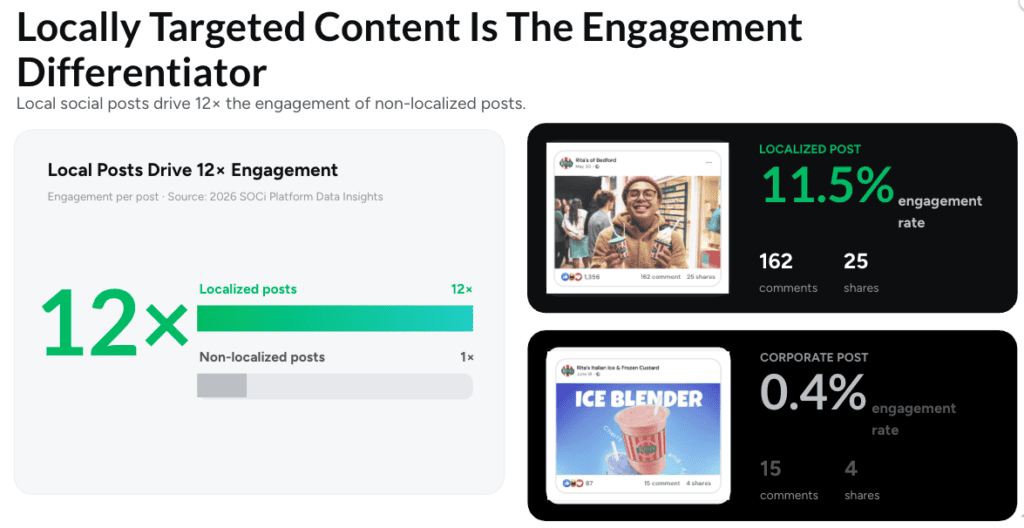
Store managers know this. They also know they don’t have the time to write a caption, source a product photo, and get it approved before the moment passes. So local promotion often doesn’t make it to social at all, and the brand’s national feed carries the weight instead: generic, and disconnected from what is actually happening at that store. The cost is measurable across the broader category. SOCi’s 2026 platform data shows localized social posts generate 12 times the engagement of non-localized posts, with a typical localized post reaching an 11.5% engagement rate against 0.4% for the national equivalent. A retail feed that never reflects the local store is leaving that engagement, and the visits behind it, on the table.
The Retail Content Mix That Actually Drives Store Visits
SOCi’s 2026 Local Discovery Index found that 73% of customers discover brands on social media, and 91% check reviews before making an in-store purchase decision. By the time a shopper is deciding whether to visit, social has usually already done part of the persuading.
A retail social presence that performs at the store level runs a mix like this:
- Time-sensitive local promotions: sales, clearance events, and limited windows tied to that specific store.
- Inventory and new arrival content reflecting what’s actually on the shelves at that location.
- Store experience content: the team, the space, what makes shopping there worth the trip.
- Reviews and local proof that build confidence before a customer ever walks in.
None of this works on a monthly cadence. Retail content needs to move at the speed of the sales floor, which is exactly what breaks most manual processes at scale.
Put Store Teams Back on the Floor
Managers should be spending most of their time helping a customer find the right size, running a great in-store event, or making the kind of impression that turns a one-time shopper into a regular. Retail is a service business wearing a product business’s clothes, and the in-person moment is still what closes the sale and builds the relationship.
Asking store staff to also be constant content creators pulls them away from exactly that. The stores that get the most value out of local social are the ones where the content shows up without taking a single hour off the floor.
Local Inventory, Local Voice, Same Brand
SOCi’s Genius Social Agent, part of the Genius Agent Workforce, is built to move at retail speed. It’s trained on brand guidelines and campaign priorities, and it understands what’s specific to each store: local promotions, timing windows, and store-level details. It generates and publishes content automatically, at the pace a sale or a new arrival actually requires, without a store team writing a single post.
SOCi is trusted by retail brands including Ace Hardware, Pet Supplies Plus, and DICK’S Sporting Goods to keep hundreds of store-level pages active and on brand. Using SOCi’s Community Calendar, Ace Hardware saw a 66% increase in the number of locations posting locally within two months, turning local relevance into something that scales rather than something that depends on which store happens to have a manager with extra time this week.
See Where Your Retail Locations Stand Today
Before changing the system, measure it. SOCi’s free Local Discovery Snapshot benchmarks your locations across search, social, and AI visibility against retail brands. For the full picture of how multi-location retail brands perform, download the 2026 Local Visibility Index.
Getting Started
Retail marketing teams making this shift typically start here:
- Look at how many store-level pages are actually active and reflect what’s currently in stock or on promotion.
- Define the brand and merchandising guardrails that every post needs to respect.
- Map out what “local relevance” should mean by store: inventory, promotions, events, and staff.
- Put a system in place that can publish at the speed retail actually moves, without relying on store staff to build it.
Frequently Asked Questions
Why is social media harder to scale for retail brands than for other multi-location businesses?
Retail promotions and inventory change quickly, often within a single weekend, which means content has to be produced and published fast to stay useful. At scale, across hundreds of stores with different promotions and stock levels, manual content creation can’t keep pace, so most retailers either default to generic national content or let local posting lapse entirely.
What kind of content should a retail store’s social media include?
A strong retail content mix includes time-sensitive local promotions, new arrival and inventory content specific to that store, content showing the in-store experience and team, and reviews or local proof points that build customer confidence before a visit.
Why shouldn’t store managers handle their own store’s social media?
Store managers and associates are focused on running the floor: helping customers, managing inventory, or running events. Time spent writing captions or sourcing photos is time away from those responsibilities, and the result is usually inconsistent or delayed posting that misses the promotional window it was meant to support.
How does SOCi’s Social Agent keep up with retail’s fast promotional cycles?
The Social Agent is trained on brand guidelines and campaign priorities and on details specific to each store, including local promotions and inventory. It generates and publishes content automatically at the pace those changes actually happen, without requiring a store team to build or approve individual posts. Brands using the Social Agent see an average 18% lift in engagement rate after deployment, based on organic Facebook post performance.
Can automated social media still reflect what’s happening at an individual store?
Yes. The goal isn’t a generic national feed pushed to every store. The Social Agent produces content that reflects what’s actually true at each specific location: current promotions, new inventory, store details, while staying inside the brand’s overall guidelines.