Your Next Customer Is Scrolling, Not Searching
July 29, 2026

Share



Search used to mean one thing: typing a question into a box and picking from ten blue links. That’s no longer how most people, especially younger consumers, find a place to eat, a product to buy, or a business to trust. They’re scrolling first.
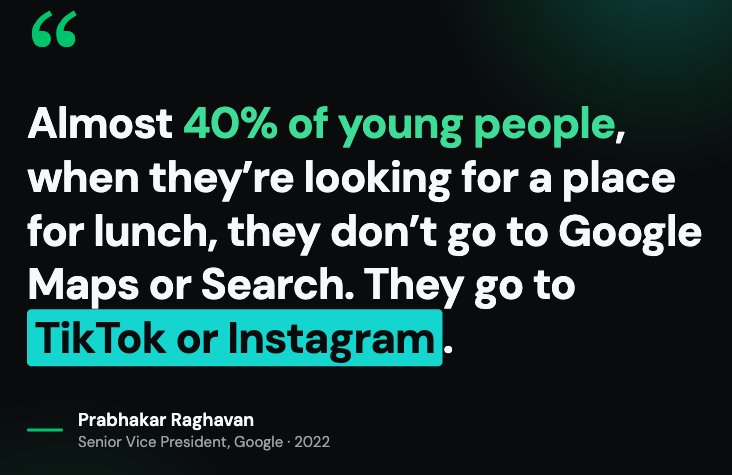
Even Google has acknowledged it’s losing discovery to social. Back in 2022, Prabhakar Raghavan, Google’s Senior Vice President, told an audience that “almost 40% of young people, when they’re looking for a place for lunch, they don’t go to Google Maps or Search. They go to TikTok or Instagram.” When the leader of search admits it’s losing discovery to social media, the shift isn’t coming. It already happened.
Google has kept adapting to that reality. This month, Google Search Console launched “platform properties,” a new reporting feature that lets brands track how their Instagram, TikTok, X, and YouTube content performs inside Google Search, including the keywords people use to find their account. That’s Google formally acknowledging that a brand’s search footprint no longer stops at its website.
Why People Search in the Feed Instead of the Search Bar
The average consumer now uses three different platforms before making a decision, and social has become where a lot of that early-stage discovery happens. Four things explain why:
- Visual and fast. A 15-second video answers a question immediately. No scrolling through paragraphs to find the point.
- Authentic. A real person describing a real experience reads as more trustworthy than an optimized web page.
- Personalized. The feed already knows what someone likes, so results feel relevant before they even ask.
- Built to explore. Search delivers an answer. Social is designed to deliver ideas, so people leave with more than they came for.
The Platforms Are Building Search Tools on Purpose
This isn’t an accident of user behavior. The platforms are actively building the infrastructure to be search engines.
Instagram now shows creators and brands what percentage of their video views came from “search” as a traffic source, a category that didn’t exist as a visible metric until recently. TikTok has gone further with Creator Search Insights and Keyword Insights, which surface the literal queries people are typing, and the numbers they report tell the story: 25% of TikTok users run a search within 30 seconds of opening the app. Location-based queries are climbing fast, too. Searches for “best tacos near me” are up 1,240%, “coffee shops to work from” is up 890%, and “date night restaurants” is up 540%.
What Changed in How Discovery Actually Works
According to an analysis by Search Engine Land’s Celeste Gonzalez, discovery has become fragmented rather than linear. Someone might find a restaurant on TikTok, verify it through Google reviews, cross-check it on Reddit, then book a table from the business’s website, in any order. There’s no fixed path anymore, just a set of surfaces a brand needs to show up on.
The same analysis found that roughly 50% of U.S. consumers used TikTok as a search engine in 2026, up from 41% in 2024. The content people search for most, in order, is tutorials, product reviews, personal stories, and influencer recommendations, not polished brand marketing.
That shift has made the old TikTok playbook (captions, hashtags, trending sounds, posting times, and hoping the For You feed notices you) incomplete. Discovery now also runs through TikTok’s own search function, location surfaces, reviews, comments, and AI systems layered into the app. The signals that actually influence ranking today include search-query relevance, how clearly a topic is spoken aloud, on-screen text, location context, and what people search for after they finish watching.
Five features are driving that shift in 2026: a Local Feed tab surfacing nearby content, a Local Explorer Program that rewards location-based reviews, a Visual Search bar that connects clips to broader topics without exact-match keywords, TikTok Shop matching queries to products, and AI features like Tako, TikTok’s search chatbot, plus AI-generated summaries on Places pages.
What Brands Should Actually Do About It
- Show the physical cues people search for. Feature menu items, signage, storefronts, and product displays. Mention the neighborhood or city naturally, tag locations, and time posts around local events.
- Treat the search bar as a research tool, not an afterthought. Search a seed topic and note the autocomplete suggestions. Cross-reference those against Google Search Console and Reddit, then work the resulting keywords into the first few seconds of video, the first text overlay, captions, and pinned comments.
- Measure the right thing. Track branded search lift and referral traffic tied specifically to social, and account for other noise, like PR pushes or seasonality, before crediting a single platform for a spike.
TikTok, Instagram, and the rest aren’t a supplementary channel anymore. They’re a discovery and search surface that deserves the same structured strategy brands have spent two decades building for Google.
Frequently Asked Questions
Is social media actually replacing Google search?
Not exactly. It’s fragmenting discovery across more surfaces rather than replacing any single one. A consumer might discover a business on TikTok, verify it on Google reviews, and cross-check it on Reddit, all before ever typing a query into Google. Search hasn’t disappeared, it’s just one stop among several.
Which platform functions the most like a search engine right now?
TikTok has moved the furthest, fastest. Roughly 50% of U.S. consumers used it as a search engine in 2026, up from 41% in 2024, and it now has dedicated search infrastructure, including Creator Search Insights, a Visual Search bar, and location-based discovery features.
Do hashtags and trending sounds still matter for TikTok SEO?
They still help, but they’re no longer sufficient on their own. Ranking now also depends on search-query relevance, how clearly a topic is spoken aloud, on-screen text, location context, and what people search for after watching a video.
How can a brand tell if its content is actually being found through search?
Instagram now reports what percentage of a video’s views came from “search” as a traffic source, and TikTok’s Creator Search Insights and Keyword Insights surface the literal queries driving discovery. Google Search Console’s new platform properties feature adds a similar view for how social content performs inside Google itself.
What’s the first step for a brand that hasn’t optimized for social search yet?
Treat the platform’s search bar as a keyword research tool. Search a seed topic relevant to the business, note what autocompletes and what related searches appear, then work those terms into the first few seconds of video, on-screen text, captions, and pinned comments.
Key Takeaways
- Social platforms have become genuine search engines, particularly for younger and location-based queries.
- Google itself is now tracking how social content performs inside traditional search, a sign the two are converging.
- Winning here means optimizing for search behavior on these platforms (keywords, location signals, on-screen text) rather than just posting for engagement.