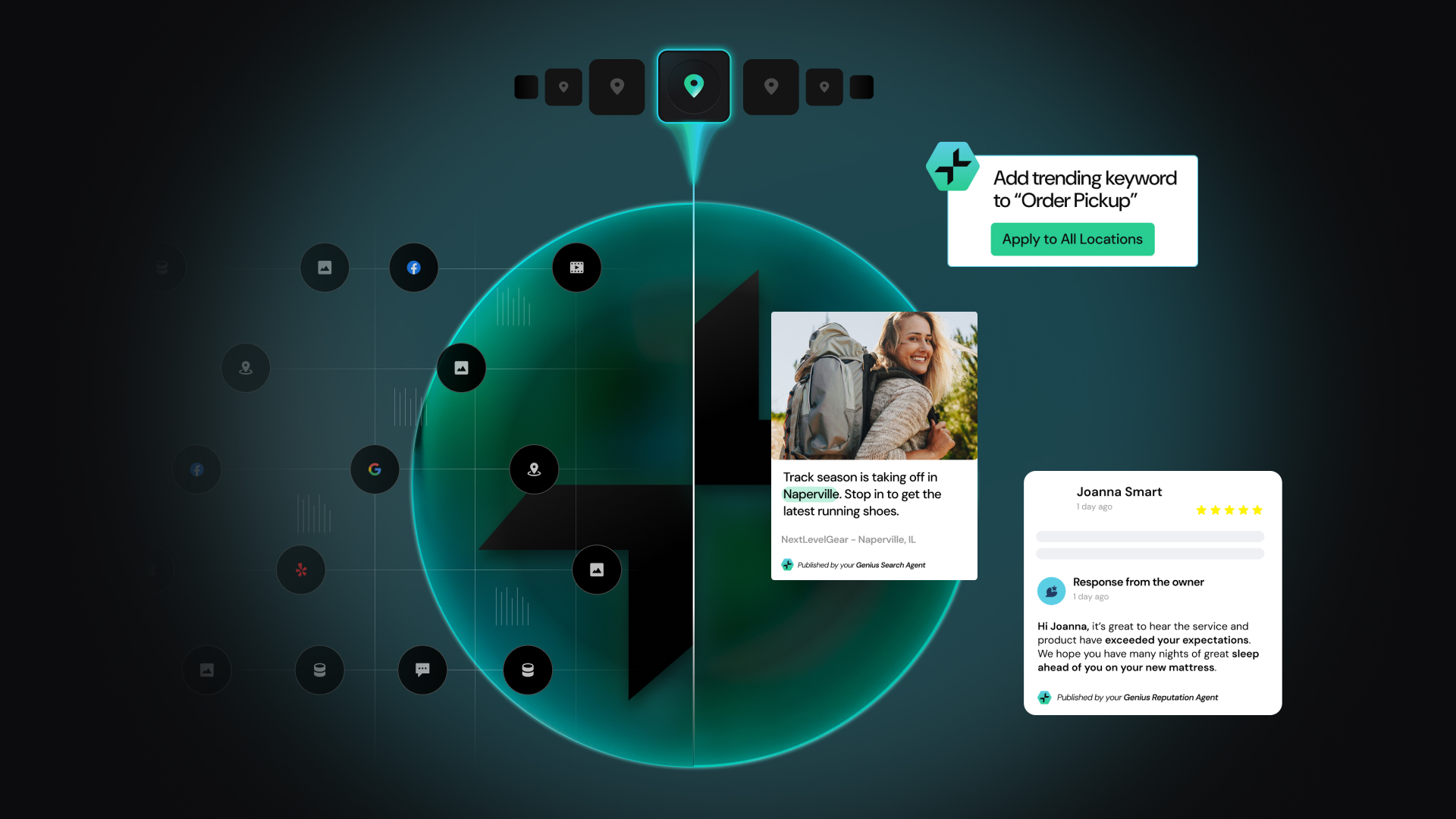
Healthcare Marketing Automation: Local Search for Every Location, Provider, and Patient

Share


Summary
- Healthcare marketing automation refers to the systems, workflows, and agents that execute local marketing across every location and provider without requiring manual work at each site.
- Healthcare local SEO carries a structural problem no other vertical has: every organization has two footprints to manage, one for locations and one for individual providers, and both rank independently.
- AI agents, specifically SOCi’s Genius Agents, execute location and provider-level work autonomously inside brand and privacy parameters, which removes the tradeoff between responsiveness and caution.
- Organizations that cannot automate local marketing lose patients at the highest-intent moment in the journey, when someone is searching for care nearby and choosing on rating and accuracy alone.
- According to SOCi’s 2026 Local Visibility Index, multi-location brands that deploy AI-driven local marketing outperform manually managed location sets in local search visibility by a significant margin.
Patients choose care locally and quickly. They search for a specialty near them, scan ratings, check whether the practice takes their insurance, and book. That sequence plays out on Google, maps, and healthcare directories, and it is decided by whether the location’s profile is accurate, whether the provider is listed correctly, and whether anyone has responded to the last twelve reviews.
Healthcare marketing automation is supposed to keep all of that current across every location and every provider. In practice, most organizations manage listings as a periodic cleanup project and reviews as a risk to be minimized rather than a channel to be operated. This post breaks down what healthcare local marketing actually requires, where automation falls short, and what AI agents make possible now.
What Is Healthcare Marketing Automation?
Healthcare marketing automation is the use of systems and AI-driven workflows to execute, monitor, and optimize local marketing across every location and provider without manual effort at each one. The goal is locally relevant, accurate, patient-appropriate output at every point of care, maintained at the pace credentialing and scheduling actually change.
It spans several operational domains:
- Listings and provider data accuracy: Keeping NAP data, hours, specialties, and accepted insurance consistent across every directory, map, and healthcare platform, for both locations and individual providers.
- Google Business Profile optimization: Publishing location-specific posts, maintaining service and accessibility attributes, keeping appointment links live, and managing photos and Q&A per site.
- Reputation management: Monitoring patient reviews across general and healthcare-specific platforms, responding in approved language that never acknowledges a care relationship, and flagging locations where service patterns are emerging.
- Local content publishing: Distributing genuinely localized content to social profiles, location pages, and directories within approved clinical and marketing boundaries.
- Performance monitoring by location and provider: Tracking local visibility, discovery, and engagement so declines surface before they show up in appointment volume.
Each of these requires site-level and provider-level specificity. A single system-wide post distributed to 250 profiles is not automation. It is mass production, and it does not improve healthcare local search ranking.
Why Healthcare Local SEO Is Structurally Harder Than It Looks
Healthcare local SEO is not one marketing program scaled. It is two overlapping footprints, locations and providers, competing in hundreds of independent local markets, on top of a data environment that changes with every credentialing event and schedule change.
The structural challenges compound quickly.
The provider footprint multiplies the problem. A system with 250 locations may have 1,200 providers, each with their own profiles across Google and healthcare directories, each affiliated with one or several locations. When a provider changes locations, retires, or joins, dozens of listings become wrong at once. Organizations that manage only location profiles are invisible for a large share of specialty search.
Provider data drift is continuous. Credentialing changes. Insurance networks change. Specialties get added. Practices are acquired. Every event creates inconsistency across surfaces, and inaccurate provider data is one of the most common reasons a patient calls, is told the provider is not available, and books elsewhere. SOCi’s Local Visibility Index shows inconsistency is one of the primary drivers of inaccurate AI mentions and weak brand visibility in AI platforms. Among the brand locations studied, 98% had a claimed Google profile, but only 80% had claimed Yelp profiles and only 53% were managing Facebook store pages. LLM citation accuracy for local brands sits at roughly 79%.
Review response is high volume and high sensitivity. An organization with 250 locations averaging 18 reviews per month generates 4,500 reviews monthly. Each response has to acknowledge the concern without confirming that the reviewer was a patient, without discussing any clinical detail, and while still sounding like a person who cares. At ten minutes per response including review, that is 750 person-hours a month. Most healthcare marketing teams answer a small fraction, and unanswered reviews suppress both rating and local ranking signals.
Caution has been mistaken for policy. Many organizations avoid responding to patient reviews at all, on the assumption that silence is the safe option. Silence is not neutral. It reduces review response rate, a confirmed local ranking factor, and it reads to the next prospective patient as indifference.
Local content cannot be templated away. Google’s local algorithm rewards relevance, recency, and specificity. A post about “quality care at [Practice Name]” delivers no ranking lift. Content that references the actual community, the services actually offered at that site, and what is actually happening there does.
Where Traditional Healthcare Marketing Tools Fall Short
The first generation of healthcare marketing tools solved data syndication without solving intelligence or responsiveness. They could push provider data to directories on a schedule. They could not produce locally distinct content or respond to thousands of specific reviews appropriately.
The gaps are predictable.
Rules-based automation breaks at the exception. Healthcare operations generate exceptions constantly: a location closes for a systems cutover, a provider goes on leave, a specialty clinic changes hours, an acquisition adds fourteen sites with inherited listing data. If-then logic cannot adapt. It queues the exception for a human.
Reporting without action creates false accountability. Many platforms produce location-level dashboards showing which sites are losing local visibility or slipping in rating. The dashboard names the problem. It does not fix it. Someone still has to diagnose, decide, and execute, site by site and provider by provider. At 250 locations and 1,200 providers, that workflow does not scale.
Data syndication is mistaken for local marketing. Accurate directory data is table stakes. It does not produce the content freshness, review responsiveness, or profile depth that local ranking rewards.
Integration gaps create data silos. Local marketing has to coordinate across Google Business Profile, healthcare directories, social platforms, review platforms, and location and provider pages, ideally reflecting real scheduling availability. Most point solutions cover one or two. Organizations end up with a fragmented stack and no single view of local performance.
How AI Agents Change Healthcare Marketing Automation
AI agents do not just automate tasks. They execute judgment at scale inside defined boundaries. That is the specific unlock in healthcare, because the highest-volume work, review response and provider data maintenance, requires reading a specific situation and answering it correctly, every time, thousands of times a month.
SOCi’s Genius Agents are that shift in practice. The Local Search Agent maintains location and provider profile accuracy across surfaces and publishes site-specific updates. The Social Agent produces locally calibrated content within approved boundaries. The Reputation Agent responds to patient reviews in approved language matched to the concern raised, without acknowledging a care relationship or engaging clinical detail. Marketing and compliance set the parameters. The agents operate inside them and escalate exceptions.
The operational change shows up in three dimensions.
Review response at healthcare volume, appropriately. Genius Agents respond across review platforms in brand-compliant language calibrated to each review, inside privacy boundaries defined by the organization. Response rate goes up, tone stays controlled, and the person-hour cost does not scale with volume.
Continuous monitoring without continuous staffing. Genius Agents watch listing and provider data accuracy, review streams, and ranking signals across every location and provider without anyone opening a dashboard. When an acquisition introduces bad data or a site’s visibility drops, the system acts. Organizations get the equivalent of a dedicated local marketer per location without headcount per location.
Closed-loop performance improvement. Rather than reporting and handing intervention back to a human, agents identify underperforming locations, diagnose likely causes from available signals, and execute corrective action inside defined parameters. Local visibility becomes an operating output rather than an annual listings cleanup.
What to Evaluate Before Choosing a Healthcare Marketing Automation Platform
Prioritize four criteria.
- Provider-level coverage, not just location-level. Ask how the platform manages individual provider profiles across Google and healthcare directories, and how it handles provider changes. Location-only coverage leaves specialty search uncontested.
- Review response quality within privacy boundaries. Pull sample responses from a vendor demo. Responses need to acknowledge the specific concern without confirming a care relationship or referencing clinical detail. Generic replies hurt more than silence, and inappropriate replies hurt considerably more.
- Google Business Profile depth, including healthcare attributes. GBP is the highest-leverage local surface in healthcare. The platform needs to handle posts, service and accessibility attributes, appointment links, Q&A, and photo management, not just hours and NAP.
- Ability to absorb organizational change. Acquisitions, provider transitions, and network changes are constant. The platform should correct new-site and new-provider data continuously rather than as a project per event.
According to SOCi’s Industry Research, brands that manage GBP optimization as an integrated, automated workflow rather than a periodic manual task see a 14% lift in visibility compared to those who do not.
The Healthcare Local Marketing Maturity Curve
Most organizations sit somewhere on a curve running from fully manual to fully agentic. Moving up requires operational redesign, and usually a rethink of the default posture toward patient reviews.
Stage 1: Site-dependent. Individual practices manage their own profiles unevenly, or not at all. Data accuracy is low and corporate has no visibility.
Stage 2: Periodic data syndication. A vendor pushes location and provider data to directories on a schedule. Accuracy improves between cycles and decays between them. Reviews go largely unanswered. Local relevance is minimal.
Stage 3: Platform-assisted management. A platform aggregates location and provider data, centralizes review monitoring, and enables bulk updates. Marketing manages exceptions. Performance improves, but it scales with headcount.
Stage 4: Agentic execution. Genius Agents execute location and provider-level work autonomously inside brand and privacy parameters. Marketing focuses on parameter design, exception review, and interpretation. Local search ranking improves as a byproduct of continuous operation.
Stage 4 is where Genius Agents operate. Most healthcare organizations are in Stage 2 or 3.
Frequently Asked Questions
What is healthcare marketing automation? Healthcare marketing automation is the use of software systems and AI-driven workflows to execute, monitor, and optimize local marketing across every location and provider without manual intervention at each site. It covers listings and provider data accuracy, Google Business Profile optimization, patient review response, local content publishing, and location-level performance monitoring.
How do AI agents respond to patient reviews appropriately? Genius Agents operate inside privacy and brand parameters set by the organization. Responses acknowledge the concern raised and direct the reviewer to an appropriate offline channel without confirming a care relationship or referencing clinical detail. Anything falling outside defined boundaries is escalated for human review.
Why do organizations need to manage provider profiles separately from location profiles? Patients search for specialties and for named providers, and provider profiles rank independently across Google and healthcare directories. A system with 250 locations and 1,200 providers has roughly five times more provider profiles than location profiles, and leaving them unmanaged forfeits a large share of high-intent specialty search.
Is not responding to patient reviews the safe option? Silence carries its own cost. Review response rate is a confirmed local ranking factor, and prospective patients read unanswered complaints as unchallenged. The workable approach is responding consistently within clearly defined privacy boundaries rather than avoiding the channel.
What is the Local Visibility Index and why does it matter for healthcare? The Local Visibility Index is SOCi’s annual research benchmarking local marketing performance across multi-location brands and industries. It reports on profile optimization rates, review response rates, local search visibility, and competitive performance by sector, which gives healthcare marketers external benchmarks for the internal business case.
Where should a healthcare organization start? Start with Google Business Profile completeness and accuracy at every location, including appointment links and service attributes. Extend that accuracy to provider profiles next, since provider data errors are the most common cause of a lost booking. Then focus on review response rate. Automating those three before expanding into local content produces the fastest measurable improvement.
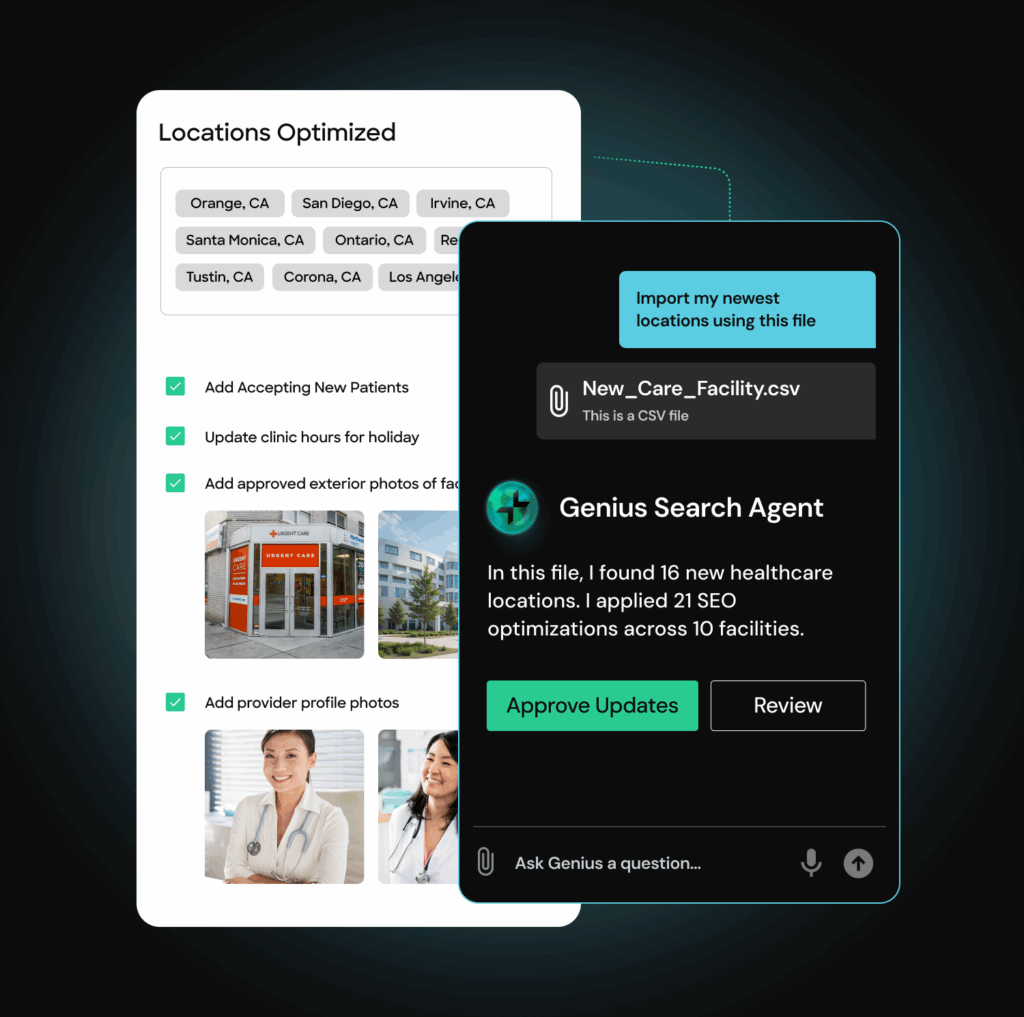
See Our Genius Agents In Action
See how SOCi Genius Agents automate local marketing across every location and provider in your organization.
Related Articles