Social Media: The Unsung Hero of Your Search Strategy

Share


For years, social media and search have been treated as separate budgets, separate teams, and separate strategies. That separation doesn’t reflect how Google, or AI platforms, actually work anymore. Social content is showing up inside search results, feeding the signals that decide who ranks, and increasingly, who gets recommended by AI at all.
Google Just Made the Connection Official
In August 2026, Google Search Console launched a new “platform properties” feature that lets brands track how their Instagram, TikTok, X, and YouTube content performs directly inside Google Search, including which keywords led people to find their account. Only one URL per network can be added right now, which limits how deep local brands can track this, but the direction is clear: Google now treats a brand’s social footprint as part of its search footprint, not something separate from it.

Social Content Is Already Ranking in Local Search Results
This isn’t theoretical. A recent SOCi example showed a junk removal service based in Seattle that had videos appear in local search results for cities more than 1,000 miles away, simply because the content itself is unique and well-optimized. Local, unique social content on Facebook, Instagram, YouTube, and other networks can rank in organic search for locations well outside a business’s immediate service area.
That cuts both ways. It’s an opportunity for service-area businesses to expand their reach: a business posting about a same-day job (say, a raccoon removal in Long Beach) and describing the work in the caption creates content that can surface for searches in that specific area, well beyond where the business is headquartered. It’s also a reminder that competitors doing this well are actively encroaching on markets a brand might assume belong to it by default.
The Data Behind Social as a Ranking Factor
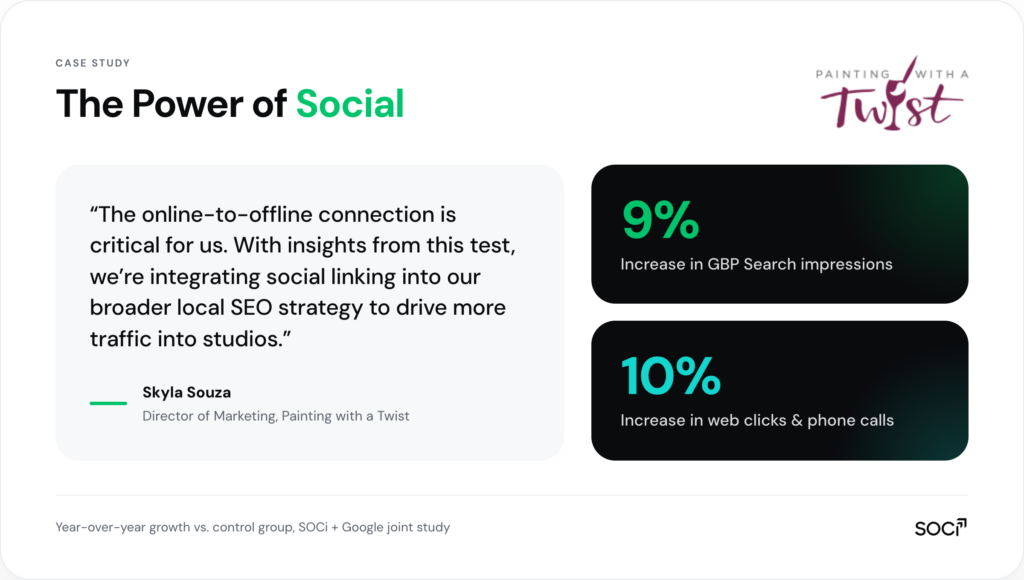
SOCi’s own research, done in partnership with Google, tested this directly by comparing a test group of locations that increased social posting activity against a control group that didn’t. The results were measurable within months:
- The test group’s search impression growth outpaced the control group by nearly 9% year-over-year by the third month.
- Web clicks and phone calls grew more than 10% faster than the control group, year-over-year.
- Overall website traffic rose 8%, with a 14% increase in Google-sourced users specifically.
What did the test group actually do differently? They simply posted more, and more consistently, across channels: 61% more Facebook posts, 59% more Instagram posts, and notably higher posting rates on LinkedIn, X, and TikTok than the control group. None of it required a fundamentally different content strategy, just more consistent execution across more channels.
Turning This Into a Strategy, Not a Side Project
- Add social media URLs to Google Business Profiles. Where a localized profile doesn’t exist for a given platform, linking to the brand-level URL is acceptable under Google’s guidelines.
- Keep every linked account active. An inactive or abandoned profile linked to a GBP does more harm than good.
- Create posts that inform, not just entertain. Content built to prompt engagement and answer real questions performs better across both social and search contexts.
- Localize whenever possible. Location-specific content is what showed up ranking outside a business’s home market in the first place.
The Same Signals Now Decide Who AI Recommends
The connection between social and search matters even more now that AI platforms have entered the picture. SOCi’s 2026 Local Visibility Index, which analyzed more than 350,000 locations across 2,751 multi-location brands, found that AI assistants are dramatically more selective than traditional search: ChatGPT recommends just 1.2% of brand locations it evaluates, compared to an average 35.9% appearance rate in Google’s local 3-pack, making AI visibility roughly 30 times more selective.
Locations that do get recommended by ChatGPT average a 4.3-star rating, which reflects how heavily AI platforms weigh reputation and sentiment when deciding who to surface. And strong traditional search performance doesn’t guarantee AI visibility either: in retail, the LVI found only 45% overlap between the brands most visible in traditional local search and those most frequently recommended by AI.
The consistent, localized, well-reviewed presence a brand builds through social doesn’t just support a search ranking anymore. It’s part of what determines whether an AI system considers a brand at all.
Frequently Asked Questions
Does posting on social media actually affect Google rankings?
Yes. In a joint study with Google, SOCi found that locations that increased social posting activity saw search impression growth outpace a control group by nearly 9% year-over-year within three months, along with more than 10% faster growth in web clicks and phone calls.
Can social content rank for locations outside a business’s home market?
Yes. Unique, localized social video and image content on platforms like Facebook, Instagram, and YouTube can rank in organic search results for cities well outside where a business is physically located, particularly for service-area businesses.
Does every location need a profile on every social platform?
No. Where a localized profile doesn’t exist for a given platform, linking to the brand-level URL on the Google Business Profile is acceptable under Google’s guidelines. The bigger requirement is keeping whatever is linked active.
How is AI search different from traditional search when it comes to social signals?
AI platforms are far more selective and weigh reputation and consistency more heavily. SOCi’s 2026 Local Visibility Index found ChatGPT recommends just 1.2% of brand locations it evaluates, compared to a 35.9% average appearance rate in Google’s local 3-pack, and locations it does recommend average a 4.3-star rating.
What’s the easiest way to start showing up in both search and AI recommendations?
Add social URLs to Google Business Profiles, keep linked accounts active, post content that’s localized and informative rather than purely promotional, and do it consistently. Those are the same fundamentals that drove the impression and traffic gains in SOCi’s study, and the same signals AI platforms weigh when deciding who to recommend.
Key Takeaways
- Google is now formally tracking social content’s performance inside search, confirming what local marketers have suspected for a while.
- Unique, localized social content can and does rank in organic search results, sometimes well outside a brand’s home market.
- Consistent social posting measurably improved search impressions, clicks, and traffic in SOCi and Google’s joint study.
- AI platforms weigh many of the same signals (reputation, consistency, local engagement) even more aggressively than traditional search, making social a factor in AI visibility too.