Multi-Location Social Media Management: How to Scale Without Going Generic
Share


Multi-location social media management breaks at the same point for nearly every brand. Corporate builds a content calendar, a brand voice, and an asset library. Then the network hits fifty, two hundred, or a thousand locations, and the math stops working. There are not enough hours or hands to make that content feel local at every address.
The stakes are higher than a quiet feed. According to SOCi’s 2026 Local Discovery Index, 78% of consumers use social networks to search for local businesses, second only to search engines at 84%. Whitespark’s 2026 Local Search Ranking Factors report added social signals as a local ranking factor for the first time, with a 5% direct influence on local search appearance and 9% on AI search appearance. A location that is silent or generic on social is leaving visibility, and the store visits that follow it, on the table.
Managing social media at scale means delivering one consistent brand voice across every location while keeping each location’s content relevant to its own market, without depending on local staff to produce it.
The specifics shift by industry: see how this plays out for restaurants, retail, healthcare, financial services, franchise brands, and property management companies.
Why Scale Breaks Most Social Strategies
A ten-location brand can run on a shared calendar and a coordinator who checks each page. A five-hundred-location brand cannot. The content volume, multiplied across every location every week, becomes a production problem long before it becomes a creative one. Brands respond in one of two ways, and both fail.
Centralize everything and go generic
One team, one calendar, one asset set pushed everywhere. It is efficient to manage, and it produces a feed that could belong to any location in the network. Customers in Tulsa see the exact same post as customers in Tampa, with nothing about their neighborhood, their weather, their local team, or what is happening at that address today.
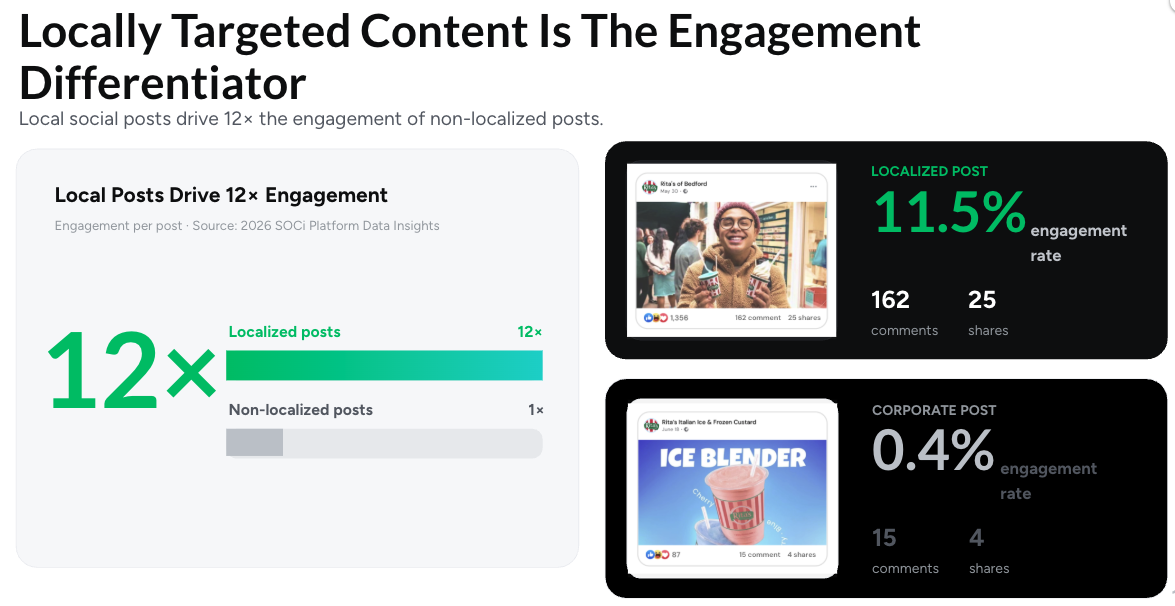
The cost shows up in the numbers. SOCi’s 2026 platform data shows localized social posts generate 12 times the engagement of non-localized posts, with a typical localized post reaching an 11.5% engagement rate against 0.4% for the corporate equivalent. Local ranking signals reward locations that look alive. An identical feed at every address does not.
Hand it to local managers and go inconsistent
Pushing posting to location managers solves relevance and creates a new problem. Some locations post daily. Others have not posted since a manager left three months ago. Brand guidelines get interpreted loosely, if at all. Visibility now varies by who is staffed at each location that week, which is not a strategy.
The gap this creates is measurable. According to SOCi’s 2026 Local Visibility Index, which analyzed roughly 350,000 locations across 2,751 brands, businesses appear in Google’s local 3-Pack 35.9% of the time on average, but only 1.2% are recommended by ChatGPT and 11.0% by Gemini. Social platforms such as Facebook rank among the top five sources AI tools cite when answering local queries. Locations with thin or generic social presence give those systems less to work with.
What a Strong Content Mix Looks Like at Scale
Social content is now a step in the path to a visit. In SOCi’s 2026 Local Discovery Index, 43% of consumers said they look up a business on social before visiting to understand what to expect, and 60% said they became a customer of a local business because of a social post or video. What each location posts is not a branding exercise; it is what a prospective customer sees before deciding whether to show up.
The brands that get multi-location social media management right are not choosing between corporate polish and local flavor. They run a deliberate mix, applied consistently at every location:
- Brand and campaign content that keeps every location aligned with what corporate marketing is pushing that month.
- Local relevance content tied to what is happening at that specific address: staff, weather, community events, and local news.
- Proof content, including reviews, testimonials, and user-generated posts, that builds trust location by location.
- People-first content that shows the team actually running that location, not a stock photo of the brand.
The mix matters more than any single post. A feed that is all campaign content reads as corporate. A feed that is all local content drifts off brand. At scale, that balance has to be built into the system rather than hoped for from every individual manager.
Posting Is Half the Job. Responding Is the Other Half.
Most conversations about social at scale stop at publishing. Customers do not. When someone asks a question in the comments or sends a DM, they expect an answer the same way they would at the front counter. SOCi’s 2026 Local Discovery Index found that 24% of consumers will not visit or use a business at all after a DM goes unanswered.
At five hundred locations, unanswered messages are not an edge case. They are a daily leak of customers who were ready to visit. Any system for multi-location social media management has to cover engagement at every location, at every hour, not just the content calendar. Responsiveness also signals an active, trustworthy business to the platforms themselves.
Give Local Teams Back Their Time
The manager running a location was not hired to be a content creator. Every hour spent finding a caption, resizing an image, or rereading posting guidelines is an hour not spent on the customer in front of them.
That trade-off is the real cost of manual social management at scale. The output is inconsistent, and local talent is spending time on content instead of on the in-person moments that build a customer relationship: a strong interaction at checkout, a well-run event, a helpful conversation. Those moments are why people choose one location over another, and they do not happen through a screen.
The fix is not asking managers to do more. It is removing the content burden from their plate entirely so that time flows back into the store, the branch, or the property.
Consistent Brand, Distinct Location
This is where most software falls short. Scheduling tools can push the same post to five hundred pages. They cannot make each of those posts feel like it belongs to that specific location.
SOCi’s Genius Social Agent, part of the Genius Agent Workforce, is designed to close that gap. It works from a brand’s guidelines, tone, and campaign calendar, and it also draws on what is true at each individual location: local weather, nearby events, store-specific details. The result is content that is on brand and local at the same time, generated and published without a local manager writing a caption. It also answers comments and DMs at every location, so no question waits on a manager’s shift. Consistency and relevance stop being a trade-off because one system delivers both at every address.
The performance difference is measurable. Localized posts created by the Social Agent drive two times the engagement and reach of non-agentic posts, and brands see an average 18% lift in engagement rate after deploying it, based on organic Facebook post performance.
How to Put Multi-Location Social Media Management Into Practice
Brands that fix their multi-location social presence tend to work in this order:
-
-
- Audit a sample of locations. Pull the last 30 days of posts from a representative set. Record posting frequency, brand compliance, and how many posts contain any location-specific detail. This is your baseline.
- Define the non-negotiables. Voice, visual identity, and compliance requirements that every location must meet, written so a system can enforce them.
- Decide what local relevance means. Which local inputs matter for your business (events, weather, staff, inventory, hours) and where that data lives.
- Put a system in place. Choose a platform that can execute the full content mix at every location without relying on local bandwidth, then measure posting consistency and local visibility against the baseline from step one.
-
Brands that get this sequence right end up with something more valuable than a big follower count: a social presence that customers in every market recognize as theirs, and locations that show up when those customers search.
See Where Your Locations Stand Today
Before changing the system, measure it. SOCi’s free Local Visibility Snapshot benchmarks your locations across search, social, and AI visibility against your industry. For the full picture of how multi-location brands perform across every channel, download the 2026 Local Visibility Index.
Take a deeper dive by industry: restaurants, retail, and franchise brands.
Frequently Asked Questions
What does managing social media at scale mean for a multi-location brand?
It means maintaining a consistent brand voice and posting cadence across every location while making each location’s content relevant to its own market. At scale, this cannot rely on a single corporate team or on individual local managers working alone. It requires a system that produces brand-consistent, locally relevant content at every address.
Why can’t a shared content calendar solve social media at scale?
A shared calendar keeps every location on brand, but it produces identical content everywhere, with no connection to what is happening at each location. Customers can tell the difference between a post written for their neighborhood and one written for the whole company, and local ranking signals increasingly reward the former.
Why shouldn’t local managers handle their own location’s social media?
Local managers are hired to run their location, not to produce content. Asking them to write captions, source images, and stay current on brand guidelines pulls time away from customers and staff, and it produces inconsistent results across the network because output depends on each manager’s bandwidth.
Does localized social content actually perform better than corporate content?
Yes. SOCi’s 2026 platform data shows localized posts generate 12 times the engagement of non-localized posts, and 60% of consumers in SOCi’s 2026 Local Discovery Index said a social post or video led them to become a customer of a local business. Localization is the difference between content that fills a feed and content that drives a visit.
How does SOCi’s Genius Social Agent create a different experience for each location?
The Genius Social Agent works from a brand’s guidelines, voice, and campaign calendar, and from details specific to each location, such as local events, weather, and store-level information. It uses those inputs to generate and publish content that stays on brand while reflecting what is true at that address, without requiring a local manager to write anything.
What is the first step for a multi-location brand with an inconsistent social presence?
Start with an audit of what is currently being posted across a representative sample of locations to identify where consistency and relevance are breaking down. Then define brand non-negotiables, decide what local relevance should include, and put a system in place that can execute that mix everywhere without depending on local staff.

You Don't Have An Army. But We Do.
Your agentic teammate for local social media strategy, publishing, and engagement. Working 24/7, across all of your channels and locations.
Related Articles