How to Manage Social Media at Scale for Franchise Brands
Share


Franchise social media management has a tension that corporate-owned networks do not. Corporate owns the brand. Franchisees own the day-to-day. Social sits in the middle, needing a national brand standard and hundreds of independent operators willing, and able, to execute it locally.
Most systems solve this badly. Corporate ships a monthly toolkit of approved assets, franchisees are expected to post them, and compliance gets checked after the fact, if at all. A handful of ambitious franchisees run strong local pages and the rest post sporadically or not at all. The result is a social presence customers see that has little to do with what corporate marketing built, and the cost is measurable. According to SOCi’s 2026 Local Discovery Index, 78% of consumers use social networks to search for local businesses, second only to search engines at 84%. Every franchisee who is not posting is invisible in the second-largest local search channel.
Franchise social media management means giving every franchisee, regardless of size, marketing background, or time, a way to show up consistently and locally without corporate losing control of the brand. It is a specific case of the broader multi-location social media management problem, with two constraints the general case does not have: voluntary adoption and a compliance layer.
Why Voluntary Adoption Fails the Franchisor
Franchisees didn’t sign up to run a marketing department. They signed up to run a location: staffing, operations, customers, the business fundamentals that pay the bills. Social media is often the first thing that slips when the business gets busy, which is exactly when local marketing matters most.
Corporate marketing teams feel this from the other side. They build campaigns, approve co-op spend, and produce toolkits, but they have no real way to guarantee any of it reaches a customer’s feed at the local level. Adoption depends entirely on whether a given franchisee has the time and inclination to post that week.
Push national content and lose the local edge
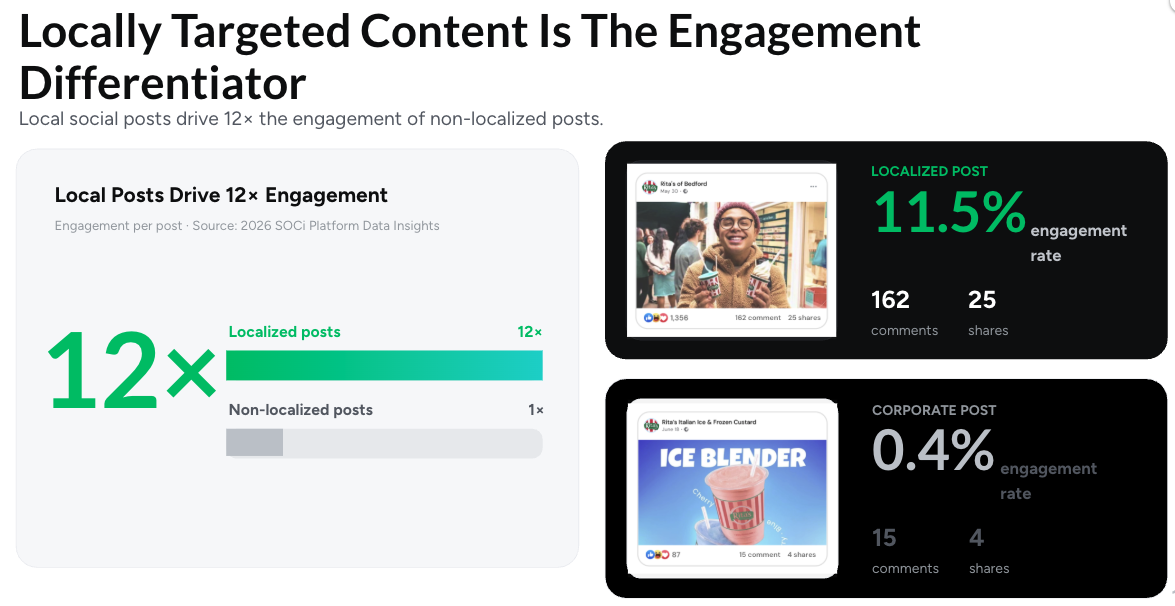
Auto-publishing the toolkit to every franchisee page fixes coverage and kills relevance. SOCi’s 2026 platform data shows localized social posts generate 12 times the engagement of non-localized posts, with a typical localized post reaching an 11.5% engagement rate against 0.4% for the national equivalent. A national post on a franchisee’s page is technically active and practically ignored.
Leave it to franchisees and lose consistency
Hand it to the operator and coverage becomes a function of individual bandwidth. Some locations post daily. Others went dark when the last manager left. Search and AI systems notice. Whitespark’s 2026 Local Search Ranking Factors report added social signals as a local ranking factor for the first time, with a 5% direct influence on local search appearance and 9% on AI search appearance. Dormant franchisee profiles drag down visibility for the brand, not just the location.
The visibility gap is already wide. According to SOCi’s 2026 Local Visibility Index, which analyzed roughly 350,000 locations across 2,751 brands, businesses appear in Google’s local 3-Pack 35.9% of the time on average, but only 1.2% are recommended by ChatGPT and 11.0% by Gemini. Social platforms such as Facebook rank among the top five sources AI tools cite for local answers. A franchise network with uneven social coverage is handing that ground to competitors location by location.
What Belongs in a Franchise Content Mix
The content itself has to earn a visit. In SOCi’s 2026 Local Discovery Index, 43% of consumers said they look up a business on social before visiting, and 60% said a social post or video led them to become a customer of a local business. For a franchisee, that is the difference between a full Saturday and a slow one.
A franchise system that shows up well on social runs four kinds of content at every location, in rotation:
- National brand and campaign content, approved and consistent across the system.
- Local relevance content specific to that franchisee’s market, staff, and community.
- Review and reputation content that reinforces trust in that specific location, not just the brand name.
- Franchisee personality content that shows the local owner and team, since franchise customers are often buying into the relationship as much as the brand.
The compliance layer matters more here than in most industries. Every one of these posts has to respect brand guidelines and, in regulated categories such as financial services, healthcare, and food, legal review, without requiring a franchisee to know the rulebook by heart. Compliance that depends on franchisee memory is not compliance.
Unanswered Messages Cost Franchisees Customers
Publishing is half the job. When a customer asks a question in the comments or sends a DM to a franchisee’s page, they expect an answer the same way they would at the counter. SOCi’s 2026 Local Discovery Index found that 24% of consumers will not visit or use a business at all after a DM goes unanswered.
In a franchise system, response coverage is as uneven as posting. The franchisee who is busiest on a Saturday afternoon is the one least able to answer the inbox, and that is when the questions arrive. Any approach to franchise social media management has to cover engagement at every location, at every hour, without adding to the operator’s workload.
Let Franchisees Run the Business
The strongest local franchise marketing has almost nothing to do with a franchisee’s caption-writing skills and everything to do with what happens in their store: how customers are greeted, how a local event is run, how a community partnership shows up in person. That is where franchisee time is worth the most.
When social execution depends on a franchisee’s spare hours, that time comes directly off the floor. Removing content creation from the franchisee’s plate is not just an efficiency win. It redirects the one resource a franchisee actually controls, their time, back toward the moments that build repeat customers in their market.
On Brand Everywhere, Local at Every Address
SOCi’s Genius Social Agent, part of the Genius Agent Workforce, is designed for this structure. It works from the franchisor’s brand guidelines and approved messaging, and it also draws on what is specific to each franchisee’s location: local market details, store-level information, and community context. It generates and publishes content that stays inside brand and compliance guardrails while reflecting what is true at that address, and it answers comments and DMs at every location, without a franchisee touching a content calendar or an inbox.
The performance difference is measurable. Localized posts created by the Social Agent drive two times the engagement and reach of non-agentic posts, and brands see an average 18% lift in engagement rate after deploying it, based on organic Facebook post performance.
That is the outcome franchise marketing teams have been trying to engineer manually for years: corporate does not have to choose between brand control and local relevance, and franchisees do not have to choose between marketing and running their business.
Where Franchise Brands Start
Franchise systems making this shift tend to follow the same path:
-
- Measure actual coverage. Across a representative sample of franchisees, record how many posted in the last 30 days, how much of that content was on brand, how much contained any local detail, and how many comments and DMs went unanswered. This is the baseline corporate has never had.
- Define the guardrails. Which brand and compliance rules are truly non-negotiable across the system, written so a system can enforce them rather than a franchisee remembering them.
- Define local relevance for a typical franchisee. Events, weather, staff, hours, community partnerships: which inputs matter and where the data lives.
- Deploy a system that executes automatically. At every location, regardless of franchisee bandwidth, then measure coverage and local visibility against the baseline.
SOCi is trusted by franchise brands including Jersey Mike’s and Liberty Tax to keep hundreds of locations visible and on brand without adding to what franchisees manage themselves.
See Where Your Franchise Network Stands
Before changing the system, measure it. SOCi’s free Local Discovery Snapshot benchmarks your locations across search, social, and AI visibility against your industry. For the full picture of how franchise and multi-location brands perform, download the 2026 Local Visibility Index.
Frequently Asked Questions
Why is social media harder to manage for franchise brands than for corporate-owned locations?
Franchise brands split control between corporate, which owns brand standards, and franchisees, who run operations and often have limited time or marketing experience. Corporate can build campaigns and toolkits but has no direct control over whether an individual franchisee posts them, which creates inconsistent coverage across the system.
What should a franchise social media content mix include?
National brand and campaign content, content relevant to each franchisee’s local market, review and reputation content specific to that location, and content that shows the franchisee and their team. All of it must stay inside brand and, where applicable, legal compliance guidelines.
Does localized content perform better than national content on franchisee pages?
Yes. SOCi’s 2026 platform data shows localized posts generate 12 times the engagement of non-localized posts, and 60% of consumers in SOCi’s 2026 Consumer Behavior Index said a social post or video led them to become a customer of a local business.
How can corporate keep franchisees compliant without slowing them down?
Remove the compliance burden from the franchisee entirely. A system trained on brand and legal guardrails generates content that is compliant by default, instead of relying on a franchisee to review a rulebook before every post.
How does SOCi’s Genius Social Agent work across a franchise network?
The Genius Social Agent works from the franchisor’s brand guidelines and approved messaging, plus details specific to each franchisee’s location, and generates and publishes content that satisfies both. It also responds to comments and DMs at each location. Franchisees do not need to write captions, source images, or check a compliance manual.
Does an automated social solution reduce franchisees’ local marketing control?
No. It removes the manual production work, not the local relevance. Franchisees still get a presence that reflects their market, staff, and community; they no longer have to build it themselves, which frees their time for running the location.

You Don't Have An Army. But We Do.
Meet your agentic teammate for local social media strategy, publishing, and engagement. Working 24/7, across all of your channels and locations.
Related Articles