Restaurant Marketing Automation: Solving Local Search for Every Location on the Menu

Share


Summary
- Restaurant marketing automation keeps every unit’s reviews, hours, menus, profiles, and local content current without relying on GMs or a large central team.
- Restaurants carry the highest review velocity of any local category, which makes reputation management the single largest unautomated cost in most multi-unit marketing budgets.
- Genius Agents answer reviews, keep hours and attributes accurate, and publish local content for every unit, inside the rules brand marketing sets.
- Restaurant groups that cannot automate at the unit level lose the decision that matters most, the hungry guest choosing between three nearby options in under a minute.
- SOCi’s 2026 Local Visibility Index showed that multi-location brands that deploy AI-driven local marketing outperform manually managed location sets in local search visibility by a significant margin.
Restaurant guests decide fast and locally. They search, scan star ratings, glance at a few photos, check whether the kitchen is still open, and pick. That whole sequence happens on Google, Yelp, and delivery marketplaces, not on the restaurant’s website. Which means the restaurant’s most important marketing surface is one it does not own and cannot fully control.
Restaurant marketing automation is supposed to keep those surfaces accurate, active, and responsive across every unit. In practice, most groups automate posting and leave the harder work, review response and unit-level relevance, to whoever has time. This post breaks down what restaurant local marketing actually requires, where automation falls short, and what AI agents make possible now.
What Is Restaurant Marketing Automation?
Restaurant marketing automation uses software, workflows, and AI agents to run local marketing for every unit in a restaurant group without manual effort at each one. The goal is locally relevant, brand-compliant output across every restaurant, kept current at the pace restaurant operations actually change.
| Area | What it means for a restaurant | What happens without it |
| Reviews and reputation | Monitoring and answering reviews on Google, Yelp, and delivery apps in brand voice; spotting units where service or food quality is slipping | Reviews go unanswered, or get the same canned reply; problems at a unit surface weeks later |
| Hours and menus | Keeping hours by daypart, seasonal changes, menus, and delivery availability consistent everywhere guests look | A guest drives over for a late dinner and finds the kitchen closed |
| Google Business Profile | Unit-specific posts, photos, Q&A, and dining attributes like outdoor seating, reservations, takeout, and delivery | Profiles look stale, so Google shows the competitor down the street |
| Local content and offers | Posts and limited-time offers tied to each neighborhood and market, not only the national calendar | The same LTO post appears on 180 profiles and does nothing for local ranking |
| Unit performance | Tracking each restaurant’s local ranking, discovery, and rating so a slipping unit is caught early | Same-store traffic drops before anyone knows why |
Each of these requires unit-level specificity. One national LTO post duplicated across 180 profiles is not automation. It is mass production, and it does not improve restaurant local search ranking.
Why Speed & Spread Make Restaurant Local SEO Difficult
Restaurant local SEO is not one brand campaign scaled. It is a set of independent local competitions, each decided by proximity, rating, recency, and photos, and each subject to daily operational change.
The structural challenges compound quickly.
Restaurant data changes constantly. Hours shift by daypart and by season. Patios open and close. Menus rotate. Delivery radius changes. GMs turn over at rates few other categories match, and each turnover risks a profile going unmanaged. Without continuous monitoring, every one of those changes creates an inconsistency that erodes ranking. SOCi’s Local Visibility Index shows inconsistency is one of the primary drivers of inaccurate AI mentions and weak brand visibility in AI platforms.
Reviews and listings are spread across platforms. Restaurant guests search on Google, but they also read Yelp and order through delivery apps, and each platform has its own listing and review stream. And while the Local Visibility index found that 98% of brand locations studied had claimed their Google profile, but only 80% had claimed Yelp and only 53% were actively managing Facebook pages. Those gaps now affect AI assistants as well: LLMs cite local brand information correctly only about 79% of the time, largely because of inconsistent listings.
Review velocity in restaurants is in a category of its own. A group with 150 restaurants averaging 45 reviews per month generates 6,750 reviews monthly. At five minutes per response, that is over 560 person-hours a month, and restaurant reviews rarely deserve a five-minute generic reply. They are specific: the wait, the order accuracy, a server by name. Unanswered reviews show measurable decline in local ranking signals, and in restaurants the star rating is the conversion mechanism itself.
Reputation risk moves faster than the org chart. One bad shift produces reviews within hours. Without automated monitoring, a unit-level service problem surfaces to corporate weeks later, after the rating has already dropped and the traffic has already moved to the restaurant next door.
Local content cannot be templated away. Google’s local algorithm rewards relevance, recency, and specificity. A post promoting a national LTO with no local context delivers no ranking lift. Content grounded in the actual neighborhood, the actual restaurant, and what is actually happening there does.
Operators do not have marketing capacity. A GM running a 60-hour week on labor, food cost, and staffing is not going to write local social content. Automation that depends on unit-level participation decays fast.
Five Myths That Keep Restaurant Groups Stuck
Myth 1: “Scheduling posts to every location is automation.” It’s distribution. Pushing one national LTO post to 180 profiles saves time, but Google’s local algorithm rewards content that’s relevant, recent, and specific to a place. A post with no local context gives Google no reason to rank that unit above the restaurant next door.
Myth 2: “A polite template reply is better than no reply.” Not when the guest wrote three detailed paragraphs. A generic apology under a specific complaint is a public signal that the brand isn’t listening, and it stays there for every future guest to read.
Myth 3: “Our GMs can manage their own profiles.” GMs are running 60-hour weeks focused on labor, food costs, and staffing. Local marketing falls to the bottom of the list, and with GM turnover as high as it is in restaurants, a profile can go unmanaged for months after someone leaves. Automation that depends on GM participation fades quickly.
Myth 4: “Once hours are set, they’re set.” Restaurant hours change by daypart and by season. Patios open and close, menus rotate, delivery zones shift, and a staffing gap can close a unit early on a Tuesday. Each change has to reach Google, Yelp, delivery apps, and every other listing, or guests get the wrong answer.
Myth 5: “We have a dashboard, so we’re on top of it.” A dashboard can show which units are losing visibility or slipping in rating. It can’t fix anything. Someone still has to diagnose each unit and act, and rules-based tools can’t handle the exceptions restaurants produce every day, like a delivery platform outage or a local event that doubles demand for one night. At 300 units, the queue never clears.
Where Traditional Restaurant Marketing Tools Fall Short
The first generation of restaurant marketing tools solved distribution without solving intelligence. They could push a promo to every unit profile simultaneously. They could not respond to 6,750 specific reviews with anything a guest would recognize as a real reply.
The gaps are predictable.
Rules-based automation breaks at the exception. Restaurants generate exceptions hourly: a unit closes early for a staffing gap, a delivery platform outage changes availability, a local event doubles demand for one night. If-then logic cannot adapt. It queues the exception for a human.
Reporting without action creates false accountability. Many platforms produce unit-level dashboards showing which restaurants are losing local visibility or slipping in rating. The dashboard names the problem. It does not fix it. Someone still has to diagnose, decide, and execute, unit by unit. At 300 units, that workflow does not scale.
Integration gaps create data silos. Restaurant local marketing has to coordinate across Google Business Profile, Yelp, delivery marketplaces, social platforms, review platforms, and local landing pages. Most point solutions cover one or two. Groups end up with a fragmented stack and no single view of unit performance.
Template review responses are worse than nothing. A guest who wrote three specific paragraphs about a bad experience and receives “We’re sorry to hear this, please contact us” has been told the brand is not listening, publicly, in a place every future guest can read.
How Genius Agents Handle Restaurant Marketing Automation
AI agents do not just automate tasks. They execute judgment at scale. In restaurants that distinction is the whole ballgame, because the highest-volume task, review response, is also the one that most requires reading and understanding a specific situation.
SOCi’s Genius Agents divide the work among three roles, with reviews leading:
The Reputation Agent answers guests. It reads every review across platforms and responds in brand voice to what the guest actually said, thanking the server they named, acknowledging the long wait, and addressing the order that came out wrong. It also watches for patterns across reviews and flags units where service or food quality is slipping. Response rates and response quality both go up without adding hours to anyone’s week.
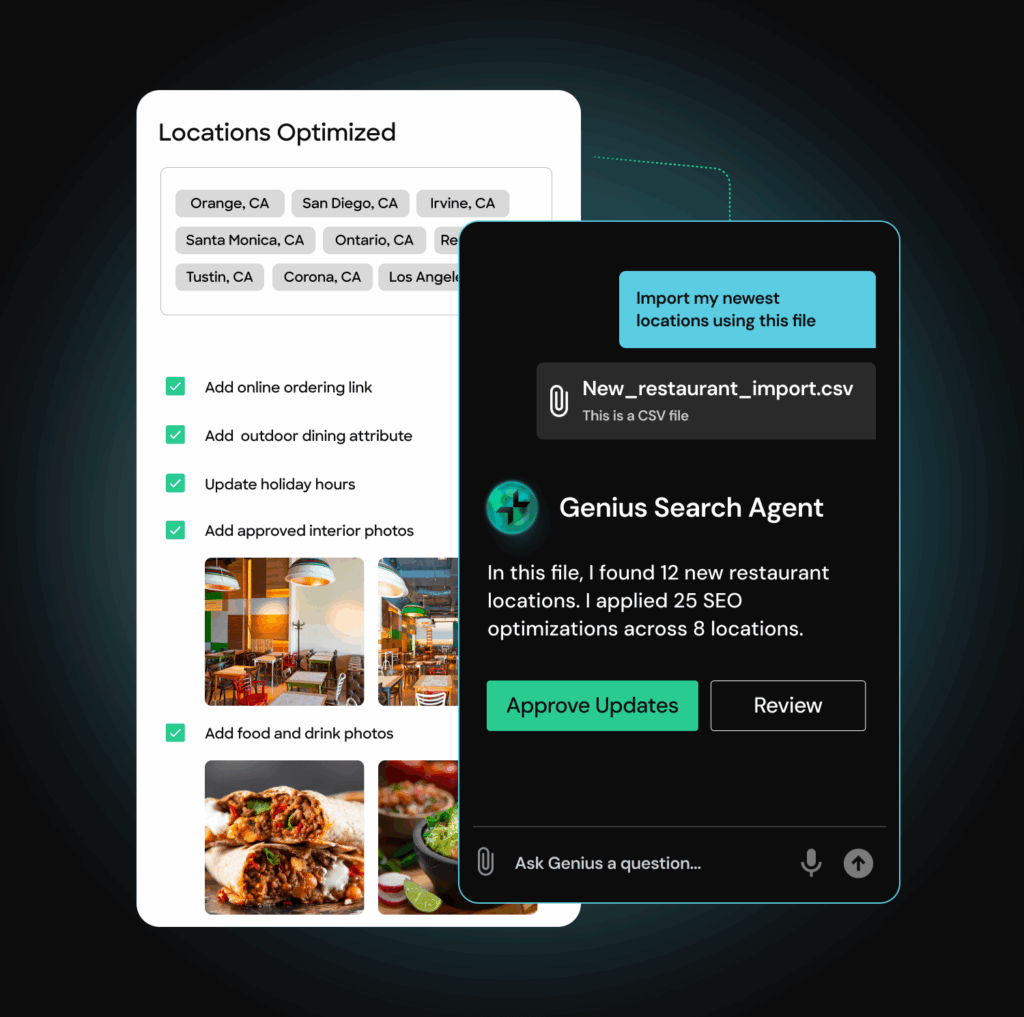
The Local Search Agent keeps every unit accurate. It maintains hours by daypart, seasonal changes, and dining and ordering attributes across every listing, and publishes location-specific updates to each Google Business Profile. When a unit’s hours drift or its visibility drops, the agent corrects it without anyone opening a dashboard.
The Social Agent makes each unit local. It creates social content tailored to each restaurant’s neighborhood and market, so a promotion reads as local instead of being the same national post everywhere.
Marketing stays in control. The team sets the brand voice and the rules, including which reviews should always go to a person, such as those mentioning food safety, allergies, or legal issues. The agents handle the rest and flag what needs human judgment. The agents also work in a continuous loop, identifying underperforming units, working out the likely cause, and acting within brand guidelines, so local visibility improves day to day instead of in quarterly pushes. It’s like having a local marketer at every restaurant, without adding a marketing role at every restaurant.
The operational change shows up in three dimensions.
Review response at restaurant volume, with actual specificity. Genius Agents respond to review streams across platforms in brand-compliant language matched to the content of each review. Response rate goes up, response quality goes up, and the person-hour cost does not.
Continuous monitoring without continuous staffing. Genius Agents watch listing accuracy, review sentiment, and ranking signals across every unit without anyone opening a dashboard. When hours drift, a rating slides, or a unit’s visibility drops, the system acts. Groups get the equivalent of a local marketer per restaurant without a marketing headcount per restaurant.
Closed-loop performance improvement. Rather than reporting and handing intervention back to a human, agents identify underperforming units, diagnose likely causes from available signals, and execute corrective action inside brand parameters. Local visibility becomes an operating output rather than a quarterly initiative.
What to Evaluate Before Choosing a Restaurant Marketing Automation Platform
Prioritize four criteria.
- Review response quality above everything else. Restaurants live and die on rating. Pull real sample responses from a vendor demo and read them as a guest would. If they could be pasted under any review, they are not going to help.
- Unit-level intelligence, not unit-level distribution. Ask exactly how the system generates content for an individual restaurant. Templates with variable insertion are not AI-driven local marketing.
- Google Business Profile depth, including restaurant attributes. GBP is the highest-leverage local surface for restaurants. The platform needs to handle posts, dining and ordering attributes, hours by daypart, Q&A, and photo management, not just hours and NAP.
- Coverage across the platforms guests actually use. Google alone is not the restaurant discovery set. Yelp and delivery marketplaces carry real weight, and coverage gaps show up directly in visibility.
According to SOCi’s Industry Research, brands that manage GBP optimization as an integrated, automated workflow rather than a periodic manual task see a 14% lift in visibility compared to those who do not.
Bring Your Own Reviews to the Demo
Most restaurant groups today push content from corporate, manage exceptions through a platform, or do some of both. Few have reached the point where unit-level work runs on its own. If you’re evaluating platforms to get there, the best test is simple: bring five of your own recent reviews, including a detailed complaint, and see what the platform does with them. Then check these four things:
- Review responses first. Read the responses the way a guest would. If a reply could be pasted under any review, it won’t help your rating.
- Unit-level content, not copy-and-paste. Ask exactly how the system writes content for a single restaurant. If the answer is a template with the city name filled in, it isn’t AI-driven local marketing.
- Restaurant-specific profile management. Google Business Profile is the most important local channel for restaurants. The platform should handle posts, dining and ordering attributes, hours by daypart, Q&A, and photos, not just the address and phone number.
- Coverage where guests actually look. Google alone isn’t where guests decide. Make sure the platform covers Yelp and the delivery apps your guests use, because gaps there show up directly in visibility.
The Stages of Restaurant Local Marketing Maturity
Most restaurant groups sit somewhere on a curve running from fully manual to fully agentic. Moving up requires operational redesign, not just a purchase.
Stage 1: Unit-dependent. GMs manage their own profiles and reviews when they have time, which is rarely. Brand consistency is low. Corporate has no unit-level visibility.
Stage 2: Centralized distribution. Corporate pushes national content and templated review replies to every unit. Consistency improves. Local relevance drops. Guests notice the templates.
Stage 3: Platform-assisted management. A platform aggregates unit data, centralizes review monitoring, and enables bulk updates. Marketing manages exceptions. Performance improves, but it scales with headcount.
Stage 4: Agentic execution. Genius Agents execute unit-level work autonomously inside brand parameters. Marketing focuses on strategy, exception review, and interpretation. Local search ranking and rating improve as a byproduct of continuous operation.
Stage 4 is where Genius Agents operate. Most restaurant groups are in Stage 2 or 3.
Frequently Asked Questions
What is restaurant marketing automation? Restaurant marketing automation is the use of software systems and AI-driven workflows to execute, monitor, and optimize local marketing for every unit in a restaurant group without manual intervention at each location. It covers listings and menu accuracy, Google Business Profile optimization, review response, local content and offers, and unit-level performance monitoring.
How do AI agents improve local SEO for restaurants? AI agents continuously monitor unit-level signals, generate locally relevant content for profiles and social platforms, respond to reviews with language specific to what each guest wrote, and correct listing and attribute inaccuracies in real time. Unlike rules-based automation, agents adapt to each restaurant’s conditions without proportional increases in staffing.
Why is review management the biggest local marketing cost for restaurant groups? Restaurants generate more reviews per location than nearly any other local category, and those reviews are specific enough that generic replies do damage. A 150-unit group averaging 45 reviews per restaurant per month faces 6,750 reviews monthly, which exceeds what any central marketing team can answer well by hand.
How does automation handle restaurant hours that change by daypart and season? Hours accuracy is a listings problem that repeats with every seasonal shift, patio opening, and staffing change. Genius Agents maintain hours and attribute accuracy continuously across the footprint, so a guest checking whether the kitchen is open gets the right answer without anyone updating profiles by hand.
What is the Local Visibility Index and why does it matter for restaurants? The Local Visibility Index is SOCi’s annual research benchmarking local marketing performance across multi-location brands and industries. It reports on profile optimization rates, review response rates, local search visibility, and competitive performance by sector, which gives restaurant marketers external benchmarks for the internal business case.
Where should a restaurant group start? Start with review response rate, a confirmed local ranking factor and the fastest lever on rating. Then verify Google Business Profile completeness and accuracy, including hours and ordering attributes, at every unit. Then confirm NAP consistency across major directories and marketplaces. Automating those three before expanding into local content produces the fastest measurable improvement.
Stop choosing which locations get attention
See how SOCi Genius Agents automate local marketing across every restaurant in your group.
Related Articles