What Are Conversational Surveys? How Multi-Location Brands Turn Feedback Into Recovery… and Reviews
Share


Key takeaways
- A conversational survey is a customer feedback exchange that adapts in real time to what the customer says, rather than presenting a fixed list of questions on a static form.
- Feedback is only worth what happens next, and its value decays by the hour. No team is staffed to close the loop on individual feedback across hundreds of locations, so the unhappy customer is gone before anyone reaches them.
- Recovery is the point. Just 1 in 25 dissatisfied customers leaves a public review, which means most unhappy customers say nothing at all… they simply stop coming back. A conversation that acts in the moment turns that customer into a retained one, and the one-star review never gets written.
- The same conversation produces reviews. A customer who has just described a good experience can post that experience publicly, in their own words, in a single tap, with no sentiment gating and nothing ghostwritten.
- Early deployments show 90% of customer issues closed out across 16,646 conversations, 45% fewer one-star reviews, 23% more five-star reviews, and average location Google ratings moving from 3.88 to 4.38.
- There is a second payoff. Consumer sentiment gates which locations AI assistants will recommend at all, so every recovered detractor and every earned five-star review also moves a location toward the range where it gets surfaced.
- SOCi’s Genius Reputation Agent runs both motions inside a single conversation: an unhappy customer is resolved in minutes, and a happy customer is converted into a public review in their own words.
The Tuesday afternoon every multi-location brand already recognizes
A one-star survey response lands at 2:14pm on a Tuesday afternoon.
Nobody chases it Wednesday. Nobody chases it Thursday.
By Friday that customer is gone, and the complaint is public and permanent.
That is two losses from one moment. A customer who will not come back, and a public record that discourages the next one. And it is the more visible half of the problem, because for every customer who posts, roughly 24 more leave quietly and never tell you why.
That sequence is not a customer service failure. It is the predictable output of a feedback program built for measurement in a market that now runs on response.
What is a conversational survey?
A conversational survey is a customer feedback exchange that adapts in real time to what the customer actually says. Instead of presenting a fixed list of rating-scale questions on a static form, it opens with a real question, follows the answer wherever it goes, and acts on the response while the customer is still engaged.
Three things separate it from a traditional survey:
- It adapts. The next question is determined by the last answer, not by branching logic someone had to build in advance.
- It resolves. When a customer describes a problem, the exchange can act on it in the moment with a resolution the brand has pre-approved, while the brand still has the customer’s attention.
- It amplifies. When a customer describes a good experience, the exchange can turn those words into a review the customer posts publicly, in a single tap.
That last pair is the structural change. A traditional survey ends in a dataset. A conversational survey ends in an outcome: a customer recovered, or a public review earned.
Why customer feedback loses its value by the hour
A score sitting in a dashboard is not the same as knowing a customer is about to leave. By the time a quarterly report shows a location trending down, the customers behind that number are already gone.
Feedback has a shelf life. Collected at the moment the experience is still fresh and acted on immediately, it saves a customer. Collected late, or acted on never, it is just data.
And this is not a caring problem. Every reputation lead reading this wants to chase that Tuesday response. Nobody is staffed to do it. Closing the loop on individual feedback across hundreds of locations is not a prioritization failure. It is an arithmetic one: the number of individual human follow-ups required exceeds the number of humans any brand will ever hire for the job.
The numbers make the gap concrete. Survey open rates hover near 1%. Two out of three completed surveys never receive a response at all. And just 1 in 25 dissatisfied customers leaves a public review (Source: Qualtrics, SOCi customer data, academosresearch.com).
The public record tells the same story. The average multi-location business responds to 46.9% of its Google reviews and just 3.1% of its Yelp reviews (Source: SOCi’s 2026 Local Visibility Index). That is the response rate on feedback a brand can see, posted publicly, where the cost of silence is visible to every future customer. Private survey feedback, where nobody is watching, fares worse.
Read that last statistic carefully, because it is the one that costs the most money. If only 1 in 25 unhappy customers says something publicly, then the review crisis every brand worries about is the small, visible edge of a much larger silent one. Most unhappy customers are not writing anything. They are just not coming back.
For a long time, that was a tolerable loss. Feedback was measurement. You collected it, scored it, reported it, and set a target for next quarter.
Measurement was never the point. Recovery was.
The unhappy customer: recovery in minutes, not a report next quarter
A static form takes the low score and files it. A conversational survey asks why, and the customer tells you: the wait was three times what they were told, nobody updated them, and they were late to their next meeting.
The Conversational Surveys Skill acts on that while the customer is still in the thread, in minutes, with a resolution the brand authorized in advance.
Three things happen at once that never happened before.
- The customer is recovered. A customer who was walking out the door stays. That is revenue, not sentiment.
- The one-star review never gets written. The complaint gets resolved privately, while it is still private. Nothing is suppressed and nothing is hidden… the issue is simply handled before frustration hardens into a permanent public post.
- The recovery itself becomes proof. Because that customer is now a satisfied one, the same conversation can end with them posting a review about how the problem was handled.
That is the shift worth sitting with. The customer most brands write off is the one with the most to say, and the one most likely to tell other people how a brand behaves when something goes wrong.
The happy customer: the review nobody ever asked them for
They already told you the visit was great, in writing, in the survey. Historically that is where the interaction ended, or it ended with a link to a blank text box on a third-party site that most people abandon.
Writing a review from scratch is real work. That is why satisfied customers, who vastly outnumber unhappy ones, are so underrepresented in public ratings. The feedback exists. It just never made it anywhere a future customer could see it.
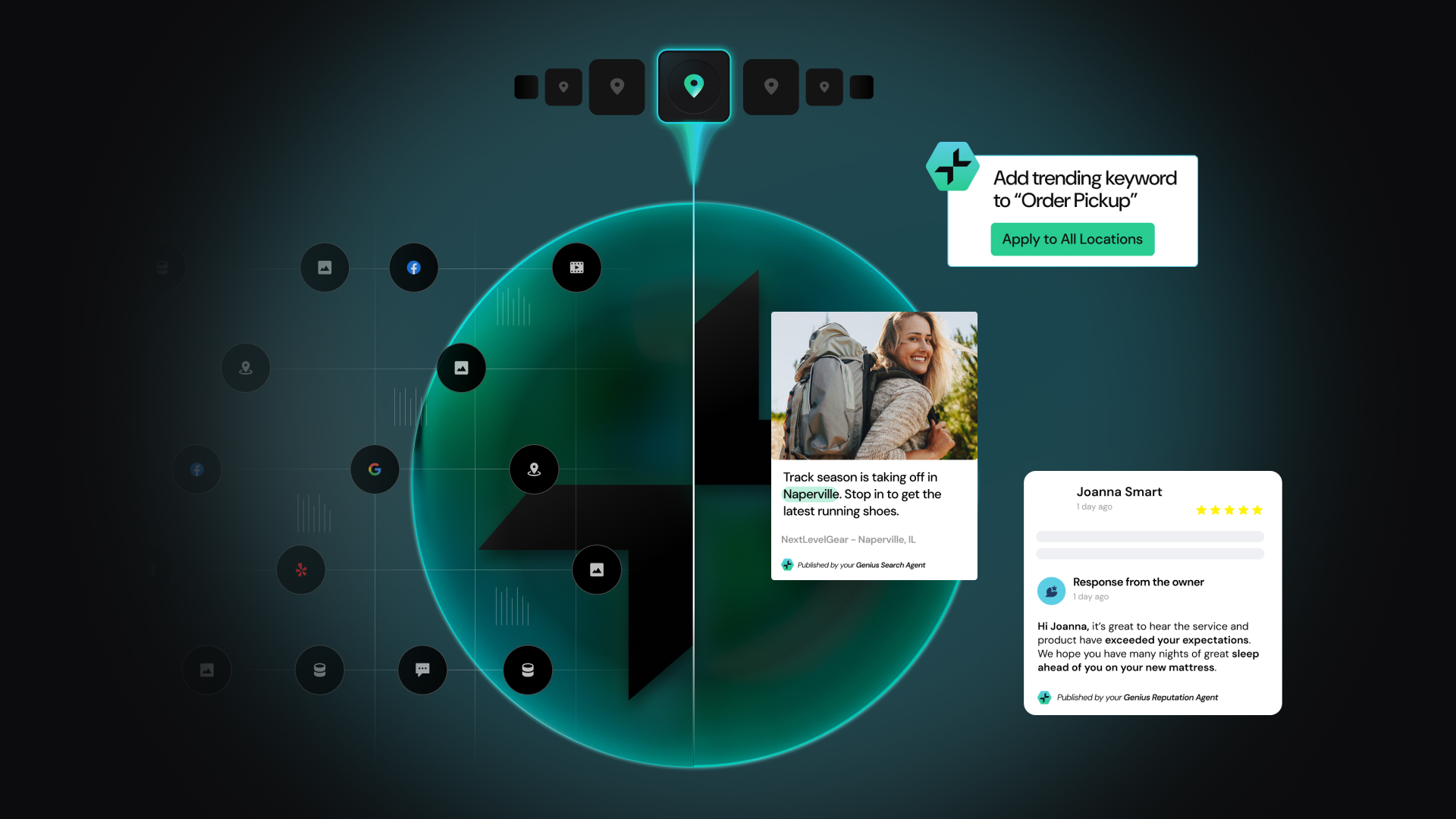
Instead, the Review Generation Skill compiles a draft from the customer’s own words, shows it back to them, and lets them post to Google or Facebook in one tap. Customers shown their own words are nearly twice as likely to post.
Nothing invented, nothing ghostwritten, and no respondent filtered out by sentiment.
How the Genius Reputation Agent runs the loop: reach, converse, resolve, amplify, analyze
Most platforms treat the feedback ask and the review ask as two products, two timings, and two workflows. SOCi treats them as one exchange.
The Genius Reputation Agent is the worker. Skills are the jobs it knows how to do. The Conversational Surveys Core Bundle gives every location an agent that runs the loop end to end:
- Reach. The agent analyzes open, click, and response data to pick the best time, channel, and message for each customer, replacing blind sends that go unopened.
- Converse. A real conversation in the brand’s voice replaces the static form, with every follow-up question adapting to the answer just given. The brand learns why, not just the score.
- Resolve. Whenever a customer expresses dissatisfaction, the system addresses it real-time within the conversation using pre-authorized solutions, retaining their focus.
- Amplify. When a customer signals a great experience, Review Generation drafts a review from quotes that customer already gave, then lets them post to Google or Facebook in one tap.
- Analyze. Every conversation flows into Voice of Customer, clustered into themes and sentiment, delivered to each location and rolled up to corporate. You fix the wait time in eleven stores instead of reading about it in eleven reviews.
Measured against static forms, SOCi customer data and industry benchmarks show 3.5x more survey responses, 3x more issues resolved, response coverage rising from an industry-typical 36% to nearly 100%, 25% more five-star reviews, and more than twice the conversations analyzed.
What’s in the Conversational Surveys Core Bundle
| Skill | What it does | What you get |
| Conversational Surveys | Replaces the static form with an adaptive conversation, delivered by email or SMS, that follows what the customer actually says | The reason behind the score, and the chance to act on it while the customer is still there |
| Review Generation | Asks every respondent for a review once the conversation wraps, regardless of their rating, and compiles a draft from their own words | A streamlined click to post to Google or Facebook, nothing invented, no respondent gated by sentiment |
| Voice of Customer | Brings first-party survey feedback and third-party review data into a single view | The themes driving your ratings, surfaced location by location |
Note: Review Generation is available only alongside Conversational Surveys, because the conversation is what produces the words a review is built from.
Compliant by default
Every respondent sees the same solicitation step, with no sentiment gating. Filtering so that only happy customers are invited to review violates the policies of every major review network, and the networks enforce it. Drafts are built only from the customer’s own words, with nothing ghostwritten. Yelp is automatically excluded in accordance with its partner policies, and every draft is written to stay within FTC guidance on solicited reviews.
What it is already delivering
In pilot with a multi-location brand, the Genius Reputation Agent delivered:
- 90% of customer issues closed out, across 16,646 customer responses
- 45% fewer one-star reviews
- 23% more five-star reviews
- Average location Google rating up from 3.88 to 4.38
“We’ve been using NPS surveys for years. We get the score back, and then… nothing. Our team is too lean to chase every unhappy comment, so we don’t. Conversational Surveys is a game changer.”
— Results from Pilot Brand
A move from 3.88 to 4.38 is not a reporting improvement. It is a half-star of public proof, built from customers who were already talking to the brand.
A second payoff: the reviews that feed AI search
There is a reason this matters more in 2026 than it would have in 2021.
Sixty percent of U.S. consumers now use generative AI tools to discover local businesses, and 52% have done so in the past 30 days, up six-fold from 2025 (Source: SOCi’s Local Discovery Index, September 2026). And AI assistants are far more selective than search engines about which businesses they will name.
SOCi’s 2026 Local Visibility Index analyzed more than 350,000 locations across 2,751 multi-location brands and found that ChatGPT recommends just 1.2% of brand locations, Gemini 11.0%, and Perplexity 7.4%, against a 35.9% average appearance rate in Google’s local 3-Pack. That makes AI recommendations 3 to 30 times more selective than traditional local search.
Sentiment is one of the first filters applied. Locations recommended by ChatGPT average 4.3 stars, compared with 4.1 on Perplexity and 3.9 on Gemini, and recommended businesses across platforms consistently maintain ratings above 4 stars.
The word that matters is filter. In traditional local search, a business with a 4.0-star rating can still rank well on proximity or category relevance. In an AI answer, that same location can be left out entirely. One national insurance brand in the study illustrates the pattern: with a 3.4-star average Google rating and a review response rate of 4.8%, it appeared in the Google 3-Pack only 3.6% of the time and registered close to zero appearances across ChatGPT, Gemini, and Perplexity.
Not ranked lower. Absent.
And AI assistants do not invent their recommendations. They synthesize them from sources consumers already trust:
| Source | Share of local citations |
| Google Maps | 32.5% |
| Multiple niche sites | 26.3% |
| Brand websites | 23.1% |
| Yelp | 10.5% |
| 7.6% |
Source: SOCi’s 2026 Local Visibility Index
Three of those five are places where reviews live. Which means the reviews your locations earn, or fail to earn, are a direct input to the answer. It also means strength in one channel no longer carries a brand: SOCi found only 45% overlap in retail between the most visible brands in traditional local search and those most frequently recommended by AI platforms.
None of this changes what a brand should do. It changes what the same work is now worth. Recovering a detractor and earning a five-star review were always good operations. They are now also the mechanism that decides whether a location appears in the answer at all.
What you need in place before launching conversational surveys
- A connected contact system. The agent reaches customers by email and SMS, so reach tracks the quality of your CRM data. Brands with significant walk-in or anonymous traffic should map coverage before setting targets.
- A decision on autonomy. You define up front what the agent can resolve on its own, from a pre-approved offer to an immediate escalation with full context.
- A single owner for feedback and reputation. The value of running one motion instead of two only materializes if one team owns the outcome.
The loop, and why it compounds
Feedback comes in. Recovery or amplification goes out. The customer stays, and the experience becomes public proof. Better proof brings in more customers, which produces more feedback.
Every survey response is either a customer saved or a review earned. Run as two separate programs, the unhappy customer is gone before anyone reaches them and the happy customer is never asked. Run as one conversation, both outcomes get captured while the customer is still paying attention.
An agentic workforce does that at every location at once, on the Tuesday afternoon when it matters, without anyone on your team having to find the time.
See how SOCi’s Genius Reputation Agent recovers unhappy customers in minutes and turns happy ones into public reviews. [Request a demo]
Frequently asked questions
What is a conversational survey?
A conversational survey is a customer feedback exchange that adapts in real time to what the customer says, rather than presenting a fixed list of questions on a static form. It opens with a real question, follows the customer’s actual answer instead of a predetermined question path, and acts on the response while the customer is still engaged, including resolving a complaint or producing a compliant review draft.
How is a conversational survey different from an NPS or CSAT survey?
An NPS or CSAT survey captures a score. A conversational survey captures the reason behind the score and acts on it in the moment. Most brands run both: rating-scale surveys for consistent trending, and conversational surveys on the one or two topics where a number alone never explains enough.
How does a conversational survey recover an unhappy customer?
When sentiment turns negative, the agent acts in-thread rather than filing the score. It can deliver a pre-approved resolution, while the customer is still engaged. In a pilot, 90% of customer issues were closed out across 16,646 conversations, and one-star reviews fell 45%.
Does resolving complaints privately suppress negative reviews?
No. Nothing is hidden or filtered, and every respondent is invited to review regardless of their score. The issue is simply addressed before frustration hardens into a permanent public post. The customer decides what to write, and many write about how the problem was handled.
Why do happy customers so rarely leave reviews?
Because writing one from a blank text box is real work. That is why public ratings underrepresent satisfied customers, who vastly outnumber unhappy ones. Showing a customer a draft built from words they already wrote removes the friction… customers shown their own words are nearly twice as likely to post.
Is it compliant to ask customers for reviews after a survey?
Yes, provided the ask is not gated by sentiment and the review is written in the customer’s own words. Filtering so that only satisfied customers are invited to review, often called review gating, violates the policies of every major review network.
How does the Review Generation Skill stay compliant?
It presents the solicitation step to every respondent regardless of their score, with no sentiment gating, and compiles each draft strictly from what that customer already wrote. Nothing is invented and nobody is filtered out for being unhappy. Requests route to Google and Facebook within each network’s rules, and Yelp is automatically excluded in accordance with its platform policies.
Why should surveys and reviews run as one program?
Because every survey response is either a customer saved or a review earned. Run separately, the unhappy customer is gone before anyone reaches them, and the happy customer is never asked. Run as one conversation, both outcomes get captured while the customer is still engaged.
What star rating do you need for AI to recommend your business?
There is no published cutoff, but the pattern is consistent. Locations recommended by ChatGPT average 4.3 stars, 4.1 on Perplexity, and 3.9 on Gemini, and recommended businesses across platforms consistently maintain ratings above 4 stars (Source: SOCi’s 2026 Local Visibility Index). AI platforms treat reviews as a filter rather than a ranking signal, so sentiment determines eligibility before relevance is ever considered.
How selective are AI assistants about local recommendations?
Extremely. SOCi’s 2026 Local Visibility Index found that ChatGPT recommends just 1.2% of brand locations, Gemini 11.0%, and Perplexity 7.4%, compared with a 35.9% average appearance rate in Google’s local 3-Pack. That makes AI recommendations 3 to 30 times more selective than traditional local search.
What do you need in place before launching conversational surveys?
A connected contact system, since the agent reaches customers by email and SMS and reach tracks the quality of your CRM data. You also decide up front what the agent can resolve on its own, from a pre-approved offer to an immediate escalation with full context.
Related Articles