Do Reviews Affect AI Recommendations for Local Brands?

Share


Short answer: yes. But not in the way most marketers expect.
If you run marketing for a multi-location brand, you have probably been asked some version of this question: do reviews affect whether our locations get recommended by ChatGPT, Gemini, and Perplexity? The answer matters because AI has changed what “visible” means. In traditional local search, a weak location can still land on page two. In AI-driven discovery, there is no page two. A location is either recommended or invisible.
SOCi’s 2026 research, the Local Visibility Index and the Local Discovery Index, gives us a clearer picture than we have had before, from both sides of the screen: how brands actually perform in AI recommendations, and how consumers behave once they see one. Here is what the data says about reviews and AI recommendations, and what to do about it.
Do AI platforms actually recommend locations with better reviews?
They do. SOCi’s 2026 Local Visibility Index (LVI) tested how often multi-location brands were recommended by ChatGPT, Gemini, and Perplexity. The method: each platform was asked to recommend 10 businesses for a given industry and market. If a location appeared in the first 5 results, it was considered likely to be recommended.
The first finding is how selective these platforms are. ChatGPT recommended just 1.2% of brand locations in the study, Perplexity 7.4%, and Gemini 11.0%. For comparison, those same brands appeared in the Google 3-Pack 35.9% of the time.
The second finding is about the locations that did make the cut. Their average star ratings were:
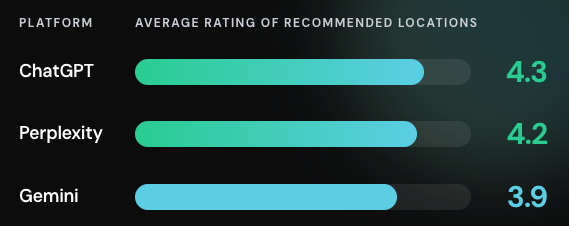
Source: SOCi’s 2026 Local Visibility Index
In practice, AI-recommended businesses sit at roughly 4.2 to 4.3 stars on the platforms that lean hardest on reviews. That is the cleanest single-number version of the inclusion bar.
Are reviews a ranking factor or a filter?
This is where the nuance lives. In traditional local search, ratings and review volume help determine where you rank. In AI recommendations, the LVI points to something different: reviews and ratings function less as a ranking factor and more as a filter for inclusion.
A business with merely “good” ratings may still rank in traditional search. It is less likely to be surfaced by AI.
Two details keep this from becoming a simple “get to 4.3 stars” rule:
- Gemini’s average is lower (3.9). Gemini is grounded in Google Maps, so it behaves differently from ChatGPT and Perplexity. Reviews matter, but the threshold is not identical across platforms.
- Ratings are a necessary signal, not a sufficient one. Being recommended also depends on accurate, complete profiles and on whether the platform can find consistent information about your location.
That second point is worth dwelling on. Profile accuracy on AI platforms was 68.3% for ChatGPT and 68.0% for Perplexity in the LVI. A great rating attached to a profile with the wrong hours or address is a weak asset.
Where do AI platforms get their review signals?
The LVI also looked at the sources LLMs cite for local queries:
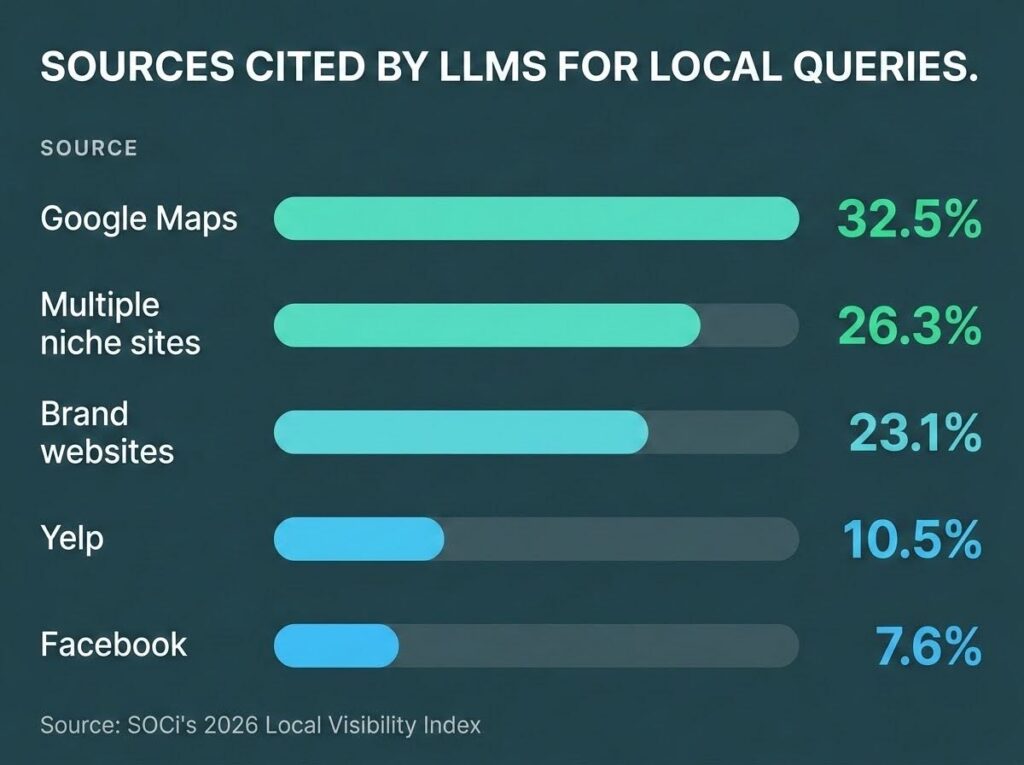
Reviews live across nearly all of these. Your Google Business Profile reviews feed the single largest source. Yelp, which many multi-location brands treat as an afterthought, still supplies 10.5% of what LLMs draw on, and the LVI notes it is a significant local content provider to Perplexity.
The takeaway: reputation is not a single-platform job. Strong reviews on Google and nothing anywhere else leaves gaps in what AI can verify about you.
What happens after an AI tool recommends you?
Here the consumer data matters. SOCi’s 2026 Local Discovery Index (LDI) surveyed more than 1,000 U.S. consumers, and it found that AI is a first impression, not a final decision.
81% of consumers take an additional verification step after an AI recommendation. Only 19% contact the business directly. When asked what they do next, the most common answer was to check reviews (33%), ahead of checking social (20%) and verifying via search (16%).
So reviews do double duty. They help determine whether AI recommends you, and they determine whether the person who sees that recommendation actually chooses you.
This is not a niche behavior either. The LDI found that 52% of consumers used an AI tool to research a local business in the last 30 days, up from 9% the year before. And 99% of consumers read reviews at least some of the time before visiting a business.
Does responding to reviews matter, or just the rating?
Both. The LDI found that 72% of consumers are more likely to choose a business that responds to its reviews. Responsiveness is a signal consumers can see, and the LVI’s playbook for Leaders treats review responses as a brand signal, not a support task.
Most brands have room to improve here. According to the LVI, only 46.9% of Google reviews receive a response, and the average response time is 4.3 days. More than half of consumer feedback goes unanswered.
Responding is also a chance to change the outcome. The LDI found that 87% of consumers say they would be likely to revise a negative review to a positive one if the business responds helpfully. A low rating is not always permanent.
What should multi-location brands do about it?
The LVI describes five behaviors that separate local visibility Leaders from Laggards. Three of them apply directly to reviews and AI:
- Win on reputation, not just reach. AI-recommended businesses consistently maintain ratings above 4 stars with strong review velocity and active response management.
- Treat accuracy as a strategic asset. Keep core business data complete and synchronized across Google Maps, Yelp, Facebook, and local pages, so your reviews attach to a profile AI can trust.
- Optimize traditional and AI channels together. AI amplifies the fundamentals. It does not replace them.
In practical terms:
- Audit rating distribution by location, not just the brand average. AI evaluates locations, so a strong brand rating can hide weak individual stores.
- Set a response standard and measure it: coverage and time to respond, location by location.
- Spread your reputation work beyond Google. Yelp and Facebook feed the sources AI uses.
- Fix profile accuracy first where it is weak. It is the cheapest unlock.
- Do not chase fake reviews or gating tactics. The goal is a genuine reputation, and consumers verify it anyway. (See why buying Google reviews backfires.)
The challenge at scale is doing this across hundreds or thousands of locations. SOCi’s Genius Reputation Agent handles this work for multi-location brands, monitoring reviews and responding in the brand’s voice at every location. A top 3 U.S. sandwich chain took its review response rate from 1% to over 40% and its average rating from 3.8 to above 4 stars within a year of deploying it (Source: SOCi platform metrics, September 2026).
The bottom line
Reviews affect whether your locations get recommended by ChatGPT, Gemini, and Perplexity, and they affect whether anyone acts on the recommendation. The LVI shows that recommended locations cluster around 4.2 to 4.3 stars on ChatGPT and Perplexity, while the LDI shows that consumers check reviews right after AI points them your way.
Reputation is the price of entry. The brands that treat it as a system, not a quarterly cleanup, are the ones AI can confidently recommend.
Key takeaways
- AI platforms are selective: ChatGPT recommended 1.2% of locations, Perplexity 7.4%, Gemini 11.0% (2026 LVI).
- Recommended locations average 4.2 to 4.3 stars on ChatGPT and Perplexity, and 3.9 on Gemini.
- 81% of consumers verify after an AI recommendation, and checking reviews is the most common next step (2026 LDI).
- 72% prefer businesses that respond to reviews, yet only 46.9% of Google reviews get a response (2026 LDI, 2026 LVI).
See where your locations stand. Get your AI Visibility Snapshot, explore the 2026 Local Visibility Index, or request a demo.
Related Articles