Generative AI for Marketing: Examples, Use Cases, and Strategy (2026 Guide)
Share


Summary
Generative AI for marketing refers to using artificial intelligence to create content, analyze data, and automate marketing workflows. In 2026, it is evolving beyond content generation into AI assistants and agents that help teams scale execution across channels. This guide covers use cases, benefits, risks, and how generative AI is reshaping modern marketing.
Generative AI for marketing is quickly becoming a core capability for modern marketing teams. It’s changing how teams create content, analyze customer data, and manage campaigns. What began as tools for generating text and images has evolved into systems that support decision-making, automate workflows, and help teams operate at scale.
What Is Generative AI in Marketing?
Generative AI refers to artificial intelligence systems that can create new content or insights based on patterns learned from large datasets. These systems use machine learning models to generate text, images, audio, code, and other outputs.
In marketing, generative AI is commonly used for:
writing marketing copy and blog content
generating social media posts
creating marketing images and creative assets
analyzing customer feedback and sentiment
generating insights from marketing data
Rather than replacing marketers, generative AI typically acts as an assistant that accelerates workflows and helps teams operate more efficiently.
Generative AI Adoption in Marketing
Generative AI adoption has accelerated rapidly across marketing teams in recent years.
Industry research shows that more than 75% of marketers now use AI tools in some part of their workflow, with over half using generative AI specifically for content creation.
Marketing teams are increasingly using AI for tasks such as:
-
generating marketing copy
-
analyzing customer reviews
-
creating personalized messaging
-
producing social media content
-
summarizing campaign performance
The result is a shift toward AI-assisted marketing operations, where human creativity and strategy are supported by automation.
Five Critical Generative AI Marketing Use Cases
As mentioned, generative AI has multiple uses, from idea and content generation to improving the customer experience (CX) and journey. Learn five valuable ways to incorporate generative AI into your marketing efforts.
1. Create Content
More than 75% of marketers have incorporated AI tools into their MarTech stacks to help create:
- Blog outlines and articles
- Social media posts or captions
- Emails
- Code snippets
- Internal reports or slide decks
- Transcripts
- Images
- Videos
- Meta descriptions
- Alt text
What generative AI can already do is impressive. One note-worthy example is Nestlé and its ad agency, Ogilvy Paris, using OpenAI’s DALL-E 2 to create a video from Johannes Vermeer’s famous “The Milk Maid” painting. They took the original artwork and made a larger one from it, all in Vermeer’s same style.
For more inspiration, read our article to see how well-known brands use AI.
Human oversight is still needed whenever creating content with generative AI. Sometimes “hallucinations” occur — when the AI technology produces false or incorrect information. We’ll touch more on these hallucinations later.
2. Upgrade Search Engine Optimization (SEO) to Search Everywhere Optimization
Search no longer lives solely within Google’s borders. The modern “search wheel” now includes:
- Traditional search engines like Google and Bing
- Voice and local search
- Community platforms such as Reddit and Quora
- Social platforms like TikTok, Instagram, and YouTube
- AI-driven search engines powered by large language models such as ChatGPT, Claude, and Gemini
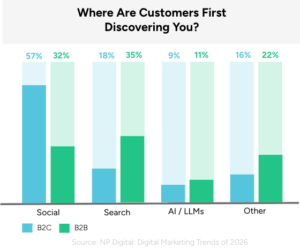
The takeaway is simple: search is now everywhere. Consumers no longer rely on a single platform. They look for answers wherever they trust the experience most.
Each of these channels operates differently, with its own formats, intent patterns, and ranking systems. A single, one-size-fits-all content strategy is no longer effective.
Generative AI helps brands adapt to this shift by making it possible to create, optimize, and scale content across all of these environments.
Winning in this environment requires brands to create content that is not just optimized for search engines, but for discovery across every platform where customers look for answers.
3. Analyze and Extract Data to Personalize the CX
Generative AI has the exceptional capability to analyze vast amounts of data and offer valuable recommendations. The technology can help you organize customer data, categorize it via sentiment analysis, and make personalized recommendations.
For instance, envision a large multi-location retail corporation, where each store receives a high volume of social media and website engagements and online reviews. With the help of AI, this multi-location enterprise could organize that data and track patterns, such as common unanswered questions or complaints about a specific product line.
These insights can help the retail brand modify its following product line or update the FAQ section of its website.
Generative AI can revolutionize your customer experience and journey by giving you once unobtainable data points and implementing them into your marketing efforts.
Success is no longer about ranking in one place. It is about being present, relevant, and trusted wherever customers search, whether that is Google, social platforms, or AI-generated answers.
4. Enhance Customer Support
Generative AI can enhance your customer support. Consider chatbots. They’re not new and have been around since the 1960s.
Now, generative AI’s growing data-analysis abilities can help you better train chatbots on your customer data. This data leads to more accurate and helpful responses. For instance, chatbots analyze conversation histories and behavioral patterns to provide tailored and personalized responses.
Furthermore, with generative AI, you can have more omnichannel support. You can use generative AI to respond to customers via:
- Website or app chatbots
- Social media platforms
- Telephone
Read our article on getting started with generative AI for more details on how to implement it.
5. AI Agents and Automation: The Next Phase of Generative AI in Marketing
Early AI tools focused primarily on producing content such as blog posts, images, or social captions. A newer generation of AI systems goes further by acting as autonomous agents that can complete tasks, analyze data, and execute marketing workflows. These systems allow marketing teams to automate repetitive work while maintaining human oversight and brand governance.
AI agents are systems that can take action on behalf of users, completing tasks such as responding to reviews, generating content, or analyzing performance data while operating within defined brand guidelines.
This shift from content generation to task execution is what defines the next phase of generative AI in marketing.
Key Takeaways
-
Generative AI is now core to modern marketing workflows
-
Marketers use AI for content, analytics, and automation
-
AI is reshaping how customers discover brands
-
AI visibility is becoming as important as traditional SEO
-
AI agents represent the next phase of marketing execution
Generative AI Marketing Risks
As advanced as generative AI is, it’s not perfect. Below are some of the most common risks to be aware of and ways to prevent them.
Content quality and accuracy
Sometimes, AI’s output isn’t always accurate and contains misleading information. We encourage human oversight and to regularly monitor AI-generated content to catch these hallucinations and ensure all information is correct.
You can also fine-tune your AI models based on user feedback to enhance the reliability and accuracy of AI systems.
Brand consistency
Organizations must ensure that AI-generated content aligns with brand guidelines and tone.
Governance and oversight
The majority of consumers care about privacy and transparency around AI. Our recent survey found that 76% of consumers believe a local business should clearly disclose the use of AI in customer service, advertising, and marketing.
Thus, we recommend being upfront about your AI usage and clearly explaining its uses in your privacy and security documentation.
Also, ensure your company complies with data protection regulations and laws, such as CCPA, GDPR, and the FTC.
AI Visibility and the Future of Digital Marketing
Generative AI is also transforming how customers discover brands online.
SOCi’s 2026 Local Visibility Index found that AI platforms like ChatGPT, Gemini, and Perplexity are significantly more selective when recommending businesses than traditional search engines.
For example:
-
Brands appeared in Gemini recommendations only 11% of the time
-
The same brands appeared 36% of the time in Google’s local 3-Pack
-
Brand locations were recommended by AI systems only 6.5% of the time
These findings highlight the growing importance of AI visibility, or how often a brand appears in AI-generated recommendations.
For marketers, this means generative AI is influencing not only marketing workflows but also how customers discover businesses online.
How SOCi Uses AI to Support Multi-Location Marketing
As you can tell, generative AI has tremendous benefits and many use cases for your marketing department and business.
If you’re a multi-location brand, SOCi integrates AI capabilities across its platform to help multi-location brands manage marketing at scale.
These AI capabilities support tasks such as:
-
generating social media content
-
responding to customer reviews
-
analyzing sentiment across locations
-
surfacing marketing insights
See how SOCi helps multi-location brands use generative AI to manage search, social, and reputation at scale. Request a demo to explore the platform in action.