What Are AI Agents? A Guide for Multi-Location Marketers in 2026
Share


AI agents are systems that use information and connected tools to carry out tasks toward a defined goal, within permissions people set. For multi-location marketers, they provide the capacity to execute local marketing across hundreds or thousands of locations. SOCi’s Genius Agents form an Agentic Workforce built for multi-location visibility, performing work across local search, social, and reviews. Marketers set the strategy and brand standards. Agents handle ongoing execution. The business case centers on more work completed, stronger local visibility, and more opportunities to turn discovery into customer action.
What Are AI Agents in Marketing?
AI agents perform marketing work by assessing information, choosing a next step, and taking action through connected systems. Their scope depends on the tasks, tools, and permissions they receive.
Consider a local customer asking about holiday hours. Answering well requires the correct location’s information, an appropriate response, and permission to send it. An agent configured for that workflow can carry out those steps and route questions outside its authority to a person.
For a multi-location brand, the value is execution capacity. Routine work gets done across more locations while the marketing team directs the priorities and handles decisions that need human judgment.
How Do AI Agents Differ From Automation and Generative AI?
These three technologies are frequently confused. Understanding how they differ is essential for deploying them effectively.
| Technology | Primary role | Local marketing example |
|---|---|---|
| Rule-based automation | Executes a predefined workflow when conditions are met | Sends a review notification to a location manager |
| Generative AI | Produces content from instructions and context | Drafts a response to a customer review |
| AI agent | Selects and carries out actions toward a goal using available information and tools | Evaluates a review, prepares a response, and publishes or routes it according to brand rules |
An agent may use generative AI to write and automation to move work between systems. What matters to the marketer is how much of the workflow it completes, how reliably it operates, and where human review belongs.
Why Multi-Location Brands Need More Marketing Capacity
Every location creates another set of marketing responsibilities. Business information changes. Reviews arrive. Social profiles need relevant content. Customers ask questions before deciding where to spend their money.
Corporate teams establish the strategy, but execution depends on whether that work happens consistently in each market. A strong national campaign cannot answer an unanswered local question or correct the wrong hours on a location’s listing.
The operational question is straightforward: Who is doing the work at every location?
An Agentic Workforce gives brands dedicated capacity for recurring local marketing. That creates room for the human team to focus on campaign strategy, customer insight, and growth opportunities while agents execute within the brand’s direction.
What Marketing Work Can AI Agents Perform?
Local Search: Keep Each Location Ready to Be Found
Customers need accurate information to choose a business and take the next step. Local search work includes maintaining listings, keeping business details current, and making location content useful.
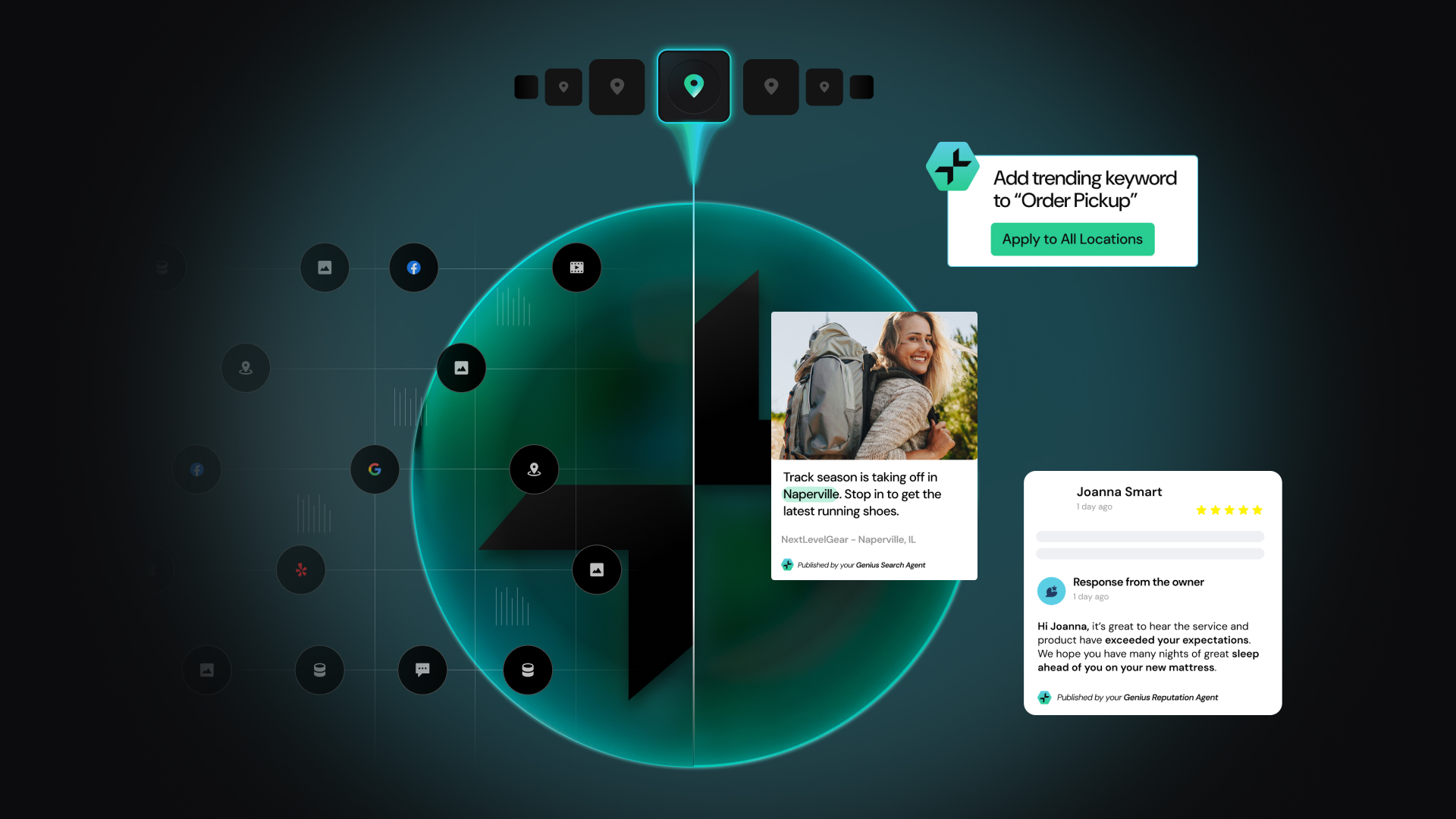
SOCi’s Genius Local Search Agent monitors location signals and executes local search optimizations. Brands choose automatic publishing, approval workflows, or a combination of both.
The business value is a more consistent local presence and less recurring maintenance for the team. Measure that value through listing accuracy, local visibility, and customer actions such as website clicks, calls, and requests for directions.
Social: Make Local Content and Customer Engagement Consistent
A corporate content calendar is a starting point. Each location also needs content that reflects its community and timely responses to local customers.
The Genius Social Agent creates localized content and handles community engagement within the workflows a brand establishes. This brings execution capacity to a channel that serves several business goals: discovery, customer care, and lead generation.
SOCi’s analysis of organic Facebook performance found that localized posts created by the Social Agent generated twice the engagement and reach of non-agentic posts. Customers also saw an average 18% lift in engagement rate after deploying the Social Agent.
Those are observed results from SOCi’s analysis, not a forecast for every brand. They show why the business case should evaluate the performance of the work alongside the time it saves.
Reputation: Keep Pace With Customer Feedback
Reviews give customers a view of the experience at a specific location. Responding consistently takes time, especially when review volume spans hundreds of locations.
The Genius Reputation Agent carries out review response work using brand guidance. Teams establish which responses can proceed automatically and which situations require attention.
The benefit is greater response coverage and more capacity to address customer feedback. Track response rate and response time, then assess whether the team is resolving the issues that reviews reveal.
For example, SOCi reports that Sport Clips deployed more than 3,400 Genius Agents across 1,800 locations to manage more than 7,000 monthly reviews without adding headcount. That is a concrete measure of capacity delivered.
What Is an Agentic Workforce?
An Agentic Workforce is a group of specialized AI agents assigned to carry out work under shared business direction. For local marketing, that means agents working from the brand’s knowledge and standards while addressing the needs of individual locations.
SOCi is the Agentic Workforce built for multi-location visibility. Its Genius Agents cover three core areas: local search, social, and reputation.
SOCi Genius provides the intelligence layer, and the SOCi Platform provides the foundation the workforce runs on. The agents perform the work. Marketers set priorities and retain control over brand standards and approvals.
This model connects enterprise direction with local execution. A location’s hours, services, and approved messaging should inform the work wherever customers encounter that business.
How Do AI Agents Support Local and AI Search Visibility?
The visibility goal is simple: make each location easy to discover, understand, and choose.
That requires ongoing attention to the information customers encounter across listings, local pages, social profiles, and reviews. AI search adds another reason to keep that information clear and consistent. Marketers should evaluate how their locations appear in answers from services such as ChatGPT, Gemini, and Perplexity alongside traditional search results.
Agents provide capacity to maintain the underlying local marketing work. They do not control which businesses a search engine or AI service recommends.
Measure visibility separately from execution. Track what changed at each location, whether its presence improved, and whether more customers took meaningful actions. This keeps the focus on business progress rather than activity alone.
What Does the Business Case Look Like?
Evaluate an Agentic Workforce against the work your business needs completed and the outcomes that work supports.
| Business objective | What to measure |
|---|---|
| Increase execution capacity | Hours spent on recurring work, completed tasks, and locations receiving consistent coverage |
| Improve local visibility | Listings accuracy, local rankings, and presence across relevant discovery channels |
| Strengthen customer engagement | Engagement rate, response coverage, and response time |
| Generate demand | Calls, website visits, inquiries, and other measurable customer actions |
| Support revenue growth | Qualified leads and attributable sales where reliable measurement exists |
Start with a baseline. Compare the same locations over a defined period and account for seasonality, promotions, and other changes. Treat engagement and direction requests as indicators of customer interest, then connect them to leads or sales where your measurement supports it.
Customer Example: Presidium
SOCi’s Genius Social Agent business case highlights Presidium’s 140% year-over-year increase in Instagram engagements and 95% increase in Instagram reach.
For marketing leaders, the value is the combination of execution at the local level and a measurable increase in audience interaction. These results illustrate one customer’s experience, rather than a guaranteed return.
Explore Presidium’s experience with SOCi Genius Agents.
What Should Marketers Evaluate Before Deploying AI Agents?
Ask providers to show the complete workflow, including the decisions people still make.
- Work completed. What does the agent execute, and what remains on your team’s task list?
- Brand knowledge. How does the agent use approved messaging and accurate location information?
- Local relevance. How does its work adapt to different locations, services, and markets?
- Control. Which actions can run automatically? What requires approval or escalation?
- Evidence. Can you see the actions taken and connect them to measurable results?
Deployment also needs an owner. Assign someone to maintain brand guidance, review exceptions, and assess performance. Clear responsibility makes it easier to expand the work agents handle with confidence.
From Software You Manage to Work That Gets Done
Multi-location marketing demands consistent execution wherever customers find your brand.
SOCi’s Genius Agents bring a brand-trained Agentic Workforce to local search, social, and reputation. Your team sets the direction. The workforce carries out the local marketing work that keeps your locations active, accurate, and ready for customers.
See what your team can accomplish with an Agentic Workforce. Explore SOCi Genius Agents.
Frequently Asked Questions
What is an AI marketing agent?
An AI marketing agent uses information and connected tools to complete tasks toward a marketing goal, within permissions set by people. Examples include responding to reviews, creating local social content, and executing local search updates.
What is the difference between an AI agent and an Agentic Workforce?
An AI agent handles a defined area of work. An Agentic Workforce brings specialized agents together under shared business direction. SOCi’s Genius Agents perform local marketing across search, social, and reputation.
Do AI agents replace marketing teams?
AI agents take on recurring execution. Marketing teams remain responsible for strategy, brand direction, and decisions that require business judgment. The opportunity is to expand the work a team can deliver across locations.
Can marketers approve an agent’s work before it goes live?
Approval options depend on the provider and workflow. SOCi’s Genius Local Search Agent supports automatic publishing, approval-based workflows, and hybrid approaches. Establish the appropriate controls for each type of work before deployment.
How should marketers measure AI agent ROI?
Compare the cost of deployment and ongoing oversight with measured capacity gains and incremental business results. Track time saved and execution coverage alongside visibility, customer actions, and attributable revenue. Avoid counting the same benefit twice.
Related Articles