The Local SEO Audit Checklist for Multi-Location Brands & Franchises
Share



Summary
A local SEO audit for a multi-location brand checks five things across every location at once: Google Business Profile accuracy, listing and citation consistency, local page quality, review coverage and response, and local search ranking performance. The full checklist is below.
What Is a Local SEO Audit, and Why Multi-Location Brands Need One
A local SEO audit is a systematic review of everything that determines whether a business shows up in local search results: Google Business Profile, listings and citations, on-page content, reviews, and rankings. For a single-location business, that review happens once, by hand.
For a multi-location SEO, the same audit has to happen at every location, on a recurring basis, and the risks of skipping it multiply with each new location. A single outdated phone number or an unclaimed listing might cost one store a little traffic. Across 200 locations, the same gap becomes a systemic visibility problem, and it’s often invisible until a competitor’s local pages start outranking yours market by market.
Step 1: Audit Every Google Business Profile
Google Business Profile (GBP) is the single highest-leverage asset in local SEO, and it’s also the one most likely to drift out of date across a large location count. For each location, check:
- Business name, address, and phone number (NAP): exact match to the storefront and website, no keyword stuffing in the business name field.
- Categories: primary category set correctly, secondary categories filled in where relevant.
- Hours: accurate standard hours plus holiday and special hours kept current.
- Photos: recent, location-specific photos rather than generic corporate stock imagery.
- Attributes and services: every available field filled in, since complete profiles convert at a meaningfully higher rate than incomplete ones.
- Q&A and posts: unanswered customer questions and any stale or missing Google Posts.
Step 2: Audit Listing and Citation Consistency (NAP)
Beyond Google, every location needs consistent NAP data across the directories, apps, and platforms that feed local search and AI-driven recommendations, including Apple Maps, Bing Places, Yelp, Facebook, and industry-specific directories. Inconsistent NAP data across these sources is one of the most common reasons a location underperforms in local search despite a strong Google Business Profile. Check for:
- Duplicate or outdated listings from a previous address, phone number, or ownership.
- Missing listings on directories that matter for your industry.
- Inconsistent suite numbers, phone formatting, or business name variants across platforms.
Step 3: Audit Local Pages
Each location should have a dedicated local landing page, not just a pin on a store locator map. Review each page for:
- A unique title tag and meta description referencing the specific city or neighborhood, not a templated duplicate across every location.
- Location-specific content: address, hours, directions, local promotions, and, where relevant, staff or location-specific details.
- Local schema markup (LocalBusiness structured data) so search engines and AI systems can parse the location’s name, address, hours, and reviews directly from the page.
- Mobile page speed, since the majority of local searches happen on a phone.
Step 4: Audit Reviews and Reputation
Review signals influence both local pack rankings and conversion rate, and they’re often the most neglected part of a multi-location audit because response happens (or doesn’t) at the individual location level. Check:
- Review volume and velocity per location compared to your category average and to nearby competitors.
- Average star rating per location, and whether any locations are dragging down the brand average.
- Response rate and response time across Google, Yelp, and Facebook.
- Whether negative reviews are being addressed promptly and whether any location has unresolved, publicly visible complaints.
Step 5: Audit Local Search Rankings and Competitors
Once the fundamentals are in order, benchmark actual visibility:
- Local pack (3-pack) presence for each location’s most important keywords.
- Organic ranking for location-specific and “near me” style queries.
- Share of voice against the two or three competitors that show up most often in the local pack for your target keywords.
- Whether your top-performing locations reveal a pattern (more reviews, more complete profiles, more local content) that underperforming locations could copy.
Step 6: Build a Reporting Cadence
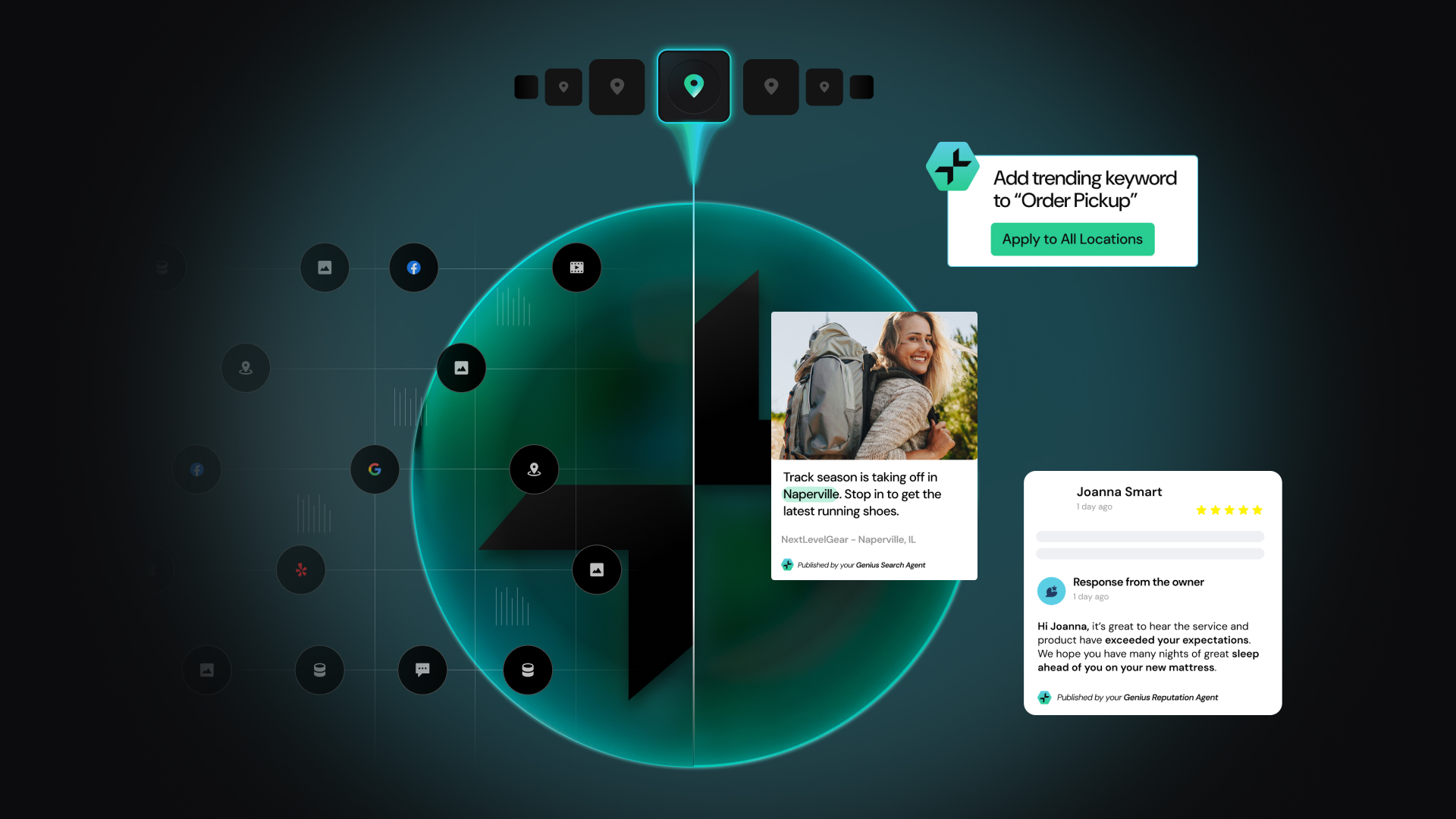
An audit is only useful if it’s repeated. Set a standing cadence, monthly for GBP and review health, quarterly for listings and local page content, so drift gets caught early instead of compounding across hundreds of locations. This is also where a centralized platform pays for itself: doing this manually across more than a handful of locations is not a sustainable process. SOCi’s Genius Search Agent and Genius Reputation Agent are built to run this kind of audit continuously across every location rather than as a one-time project.
The Full Local SEO Audit Checklist
- NAP accuracy on Google Business Profile
- GBP categories, hours, photos, attributes, and services complete
- GBP Q&A answered and Google Posts current
- NAP consistency across Bing, Apple Maps, Yelp, Facebook, and industry directories
- No duplicate or outdated listings
- Unique, location-specific title tags and meta descriptions on every local page
- LocalBusiness schema markup implemented
- Mobile page speed checked for local pages
- Review volume, rating, and response rate benchmarked per location
- Local pack and organic ranking benchmarked against nearby competitors
- Reporting cadence in place to repeat the audit on a schedule
Local SEO Audit FAQ
How often should a multi-location brand run a local SEO audit?
Review Google Business Profile and review health monthly. A full audit of listings, local pages, and rankings can run quarterly, since those elements tend to drift more slowly.
What’s the difference between a local SEO audit and a regular SEO audit?
A regular SEO audit looks at a single website. A local SEO audit for a multi-location brand has to check the same set of factors, Google Business Profile, listings, on-page content, reviews, and rankings, separately for every location, since each one competes in its own local market.
What’s the fastest way to audit hundreds of locations at once?
Manual audits don’t scale much past a handful of locations. Most multi-location brands use a centralized platform that pulls Google Business Profile, listings, and review data for every location into one dashboard, so gaps show up automatically instead of requiring a manual check per location.
Does a complete Google Business Profile actually affect rankings?
Yes. GBP completeness and accuracy are consistently cited as top local pack ranking factors, and incomplete profiles also convert at a lower rate even when they do rank.
Ready to Audit Every Location at Once?
If your audit uncovers the same issues across dozens or hundreds of locations, fixing them one by one is not scalable. SOCi uses Genius Agents to automate multi-location SEO across listings, pages, reviews, and AI visibility. Request a demo to see it run against your own locations.
Related Articles