Retail Marketing Automation: Why Store-Level Local Search Breaks, and How AI Agents Fix It

Share


Summary
- Retail marketing automation is how a chain keeps every store’s local presence (profile, hours, reviews, and local content) accurate and relevant without adding work for store teams, instead using systems and agents.
- In retail, the local search result is often the real storefront. Shoppers decide where to go based on a store’s profile, usually before they ever reach your website.
- Retail’s calendar raises the stakes. Holidays, promotions, and fulfillment changes hit hundreds of stores at once, usually when marketing has the least bandwidth.
- Genius Agents handle the store-level work (profile accuracy, local content, and review responses) within guidelines set by brand marketing.
- SOCi’s 2026 Local Visibility Index finds that brands using AI-driven local marketing see markedly stronger local search visibility than brands managing locations by hand.
Retail has the shortest distance between a local search and a transaction. Someone searches for a product near them, checks hours, and drives over. That path is measurable, high-intent, and almost entirely governed by signals living outside the retailer’s own website: Google Business Profile, maps, directories, and reviews.
The problem is that those signals are managed at the store level, and most retail marketing organizations are built at the brand level. Retail marketing automation promises to bridge that gap. In practice, it usually delivers distribution without local relevance.
This post breaks down what store-level automation actually requires, where the current generation of tools falls short, and what AI agents make possible now.
What Is Retail Marketing Automation at the Store Level?
Retail marketing automation is the combination of software, workflows, and AI agents that runs each store’s local marketing, including listings, Google Business Profile, reviews, and local content, without relying on store staff or a large central team. When it works, every store looks accurate, on-brand, and relevant to its own neighborhood, and it stays that way through every holiday, remodel, and promotion.
It spans several aspects of operations:
- Listings and citation accuracy: Keeping NAP data, hours, and holiday schedules consistent across every directory and map surface, including seasonal hour changes that hit the entire chain at once.
- Google Business Profile optimization: Publishing store-specific posts and product highlights, maintaining attributes like curbside pickup, in-store shopping, and buy online pick up in store, and managing photos and Q&A per store.
- Reputation management: Monitoring reviews across platforms, responding in brand voice, and flagging stores where service or staffing issues are surfacing in the review stream before they hit the P&L.
- Local content and promotion: Pushing genuinely localized promotional content to social profiles, store pages, and listing platforms, timed to regional demand rather than a single national calendar.
- Performance monitoring by store: Tracking local ranking, discovery, and engagement per store so declines are caught before a quarter of foot traffic is gone.
Each of these needs store-level specificity. A national promo posted identically to 900 profiles is mass production, not automation.
Retail local search ranking favors stores that look specific and current, not stores that look like copies of one another.
Why Store-Level Local SEO Is Harder in Retail
Retail local SEO is not one campaign scaled. It is hundreds of independent ranking environments, each with a different competitive set, different demand pattern, and different operating reality.
The structural challenges compound quickly.
Retail data changes faster than any other footprint. Hours shift for holidays, inventory events, and remodels. Stores relocate inside the same mall. Departments open and close. Fulfillment options change by market. Without continuous monitoring, each change creates a citation inconsistency that erodes ranking. SOCi’s Local Visibility Index shows inconsistency is one of the primary drivers of inaccurate AI mentions and weak brand visibility in AI platforms. Among the brand locations studied, 98% had a claimed Google profile, but only 80% had claimed Yelp profiles and only 53% were managing Facebook store pages. LLM citation accuracy for local brands sits at roughly 79% as a result.
Review volume in retail is relentless and staffing is not. A chain with 750 stores averaging 12 reviews per month generates 9,000 reviews monthly. At five minutes per response, that is 750 person-hours a month for review response alone. No retail marketing team is staffed for that. Stores that go unanswered show measurable decline in local ranking signals, and in retail those signals map directly to store visits.
Seasonal peaks arrive at the worst possible time. The weeks when local visibility matters most are the weeks marketing teams have the least capacity. Holiday hours, extended hours, and promotional posts all need to be live across every store simultaneously, and a store with wrong holiday hours in November is a lost shopper who does not come back in December.
Local content cannot be templated away. Google’s local algorithm rewards relevance, recency, and specificity. A post that says “shop your local [Brand Name]” delivers no ranking lift. Content that references the actual store, the actual market, and what is actually happening there does.
District and store managers are not marketers. Retail field leadership is measured on labor, shrink, and sales. Asking them to log in and publish local content adds a task to a role that already has too many. Automation that depends on store-level adoption decays within a quarter.
Retail’s Calendar Is the Real Stress Test
Any business with many locations has to keep its listings accurate. Retail’s difference is timing. The biggest changes hit the whole chain at once, and they arrive exactly when the stakes are highest.
- Holiday hours. Extended hours in November and December, early closings on Christmas Eve, and Thanksgiving closures all have to be live on every store profile, often in the same week. A store showing the wrong hours in peak season loses that shopper and possibly the next visit as well.
- Promotional events. Back-to-school, Black Friday, and clearance events are planned nationally, but demand varies by market. A single national message can’t reflect that stores in Phoenix and Minneapolis are selling different things in October.
- Weather and disruptions. A storm closes eleven stores in one region. A mall changes its entrance hours. A power outage closes a store for the afternoon. Each is a rare event for the store and a routine one for the chain.
- Fulfillment changes. Curbside pickup, same-day delivery, and pickup lockers roll out store by store. Each change is a profile attribute that determines whether the store appears for shoppers filtering by those options.
The weeks that matter most for local visibility are the same weeks retail marketing teams are busiest with campaigns. Manual processes break down right when they can least afford to.
Where Traditional Retail Marketing Tools Fail
Most existing retail marketing tools, though ahead of their time, only solved distribution without solving intelligence. They could push a promo to every store profile at once. They could not make that promo locally distinct, and so we tend to see the same gaps.
Rules-based automation breaks at the exception. Retail generates exceptions constantly: a store loses power, a mall changes access hours, a competitor opens two doors down, a regional weather event closes eleven locations. If-then logic cannot adapt. It queues the exception for a human.
Reporting without action creates false accountability. Many platforms produce store-level dashboards showing which stores are losing local search visibility. The dashboard names the problem. It does not resolve it. Someone still has to diagnose, decide, and execute, store by store. At 900 stores, that workflow does not scale.
Integration gaps create data silos. Store-level marketing has to coordinate across Google Business Profile, directories, social, review platforms, and store locator pages, and ideally reflect what is happening in merchandising and inventory. Most point solutions cover one or two surfaces. The result is a fragmented stack with no single view of store performance.
Promotional calendars override local reality. National calendar-driven automation pushes the same message everywhere regardless of local demand, weather, or competitive pressure. Efficient to operate, weak on relevance.
How AI Agents Change Retail Marketing Automation
AI agents do not just automate tasks. They execute judgment at scale. That matters in retail because the work is not only high volume, it is high variance. Every store needs a slightly different decision, and rules cannot express that.
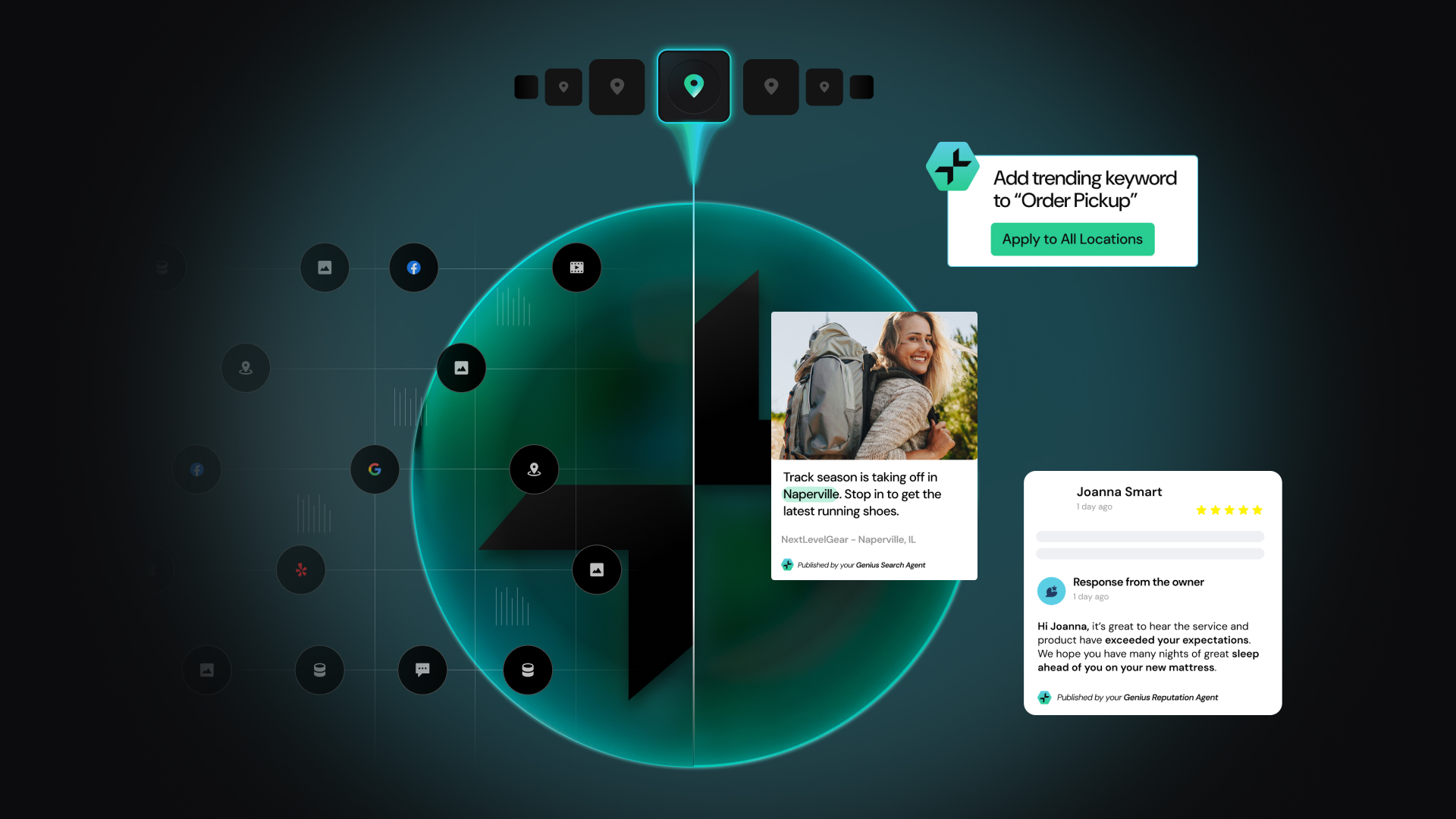
SOCi’s Genius Agents are that shift in practice. The Local Search Agent maintains profile and attribute accuracy across every store and publishes store-specific updates. The Social Agent produces content calibrated to each market rather than a single national message. The Reputation Agent responds to reviews with brand-compliant language matched to what the shopper actually wrote. Marketing sets the parameters and reviews exceptions. The agents do the work.
The operational change shows up in three dimensions.
Genuine store-level content at volume. Genius Agents generate profile posts, social content, and review responses grounded in real store-level inputs: the neighborhood, local competitive context, recent customer signals. Not a template with a store number appended. Content Google can distinguish as locally relevant, which is what lifts retail local search ranking.
Continuous monitoring without continuous staffing. Genius Agents watch listing accuracy, review streams, and ranking signals across every store without anyone opening a dashboard. When hours drift or a store’s visibility drops, the system acts. Retailers get the equivalent of a local marketer per store without adding a marketing headcount per store.
Closed-loop performance improvement. Rather than reporting and handing intervention back to a human, agents identify underperforming stores, diagnose likely causes from available signals, and execute corrective action inside brand parameters. Local visibility becomes an operating output, not a seasonal project.
What to Evaluate Before Choosing a Retail Marketing Automation Platform
Prioritize four criteria.
- Store-level intelligence, not store-level distribution. Ask exactly how the system generates content for an individual store. If the answer is templates with variable insertion, it is not AI-driven local marketing.
- Google Business Profile depth, including retail attributes. GBP is the highest-leverage local surface in retail. The platform needs to handle posts, product and service attributes, fulfillment options, Q&A, and photo management, not just hours and NAP.
- Review response quality. Pull sample responses from a vendor demo. Generic replies to a specific complaint about a specific store hurt more than silence. Responses need to reflect what the review actually said.
- Integration with the systems retail already runs. The platform should connect to your CRM and your store locator infrastructure. Isolated automation creates reconciliation work instead of removing it.
According to SOCi’s Industry Research, brands that manage GBP optimization as an integrated, automated workflow rather than a periodic manual task see a 14% lift in visibility compared to those who do not.
How Retail Local Marketing Maturity Matures
Most retailers sit somewhere on a curve running from fully manual to fully agentic. Moving up requires operational redesign, not just a purchase.
Stage 1: Store-dependent. Individual stores manage their own profiles and reviews, unevenly. Brand consistency is low. Corporate has no store-level visibility.
Stage 2: Centralized distribution. Corporate pushes national templates to every store profile. NAP consistency improves. Local relevance drops. Profile performance is mediocre because the content is generic.
Stage 3: Platform-assisted management. A platform aggregates store data, centralizes review monitoring, and enables bulk updates. Marketing manages exceptions. Performance improves, but it scales with headcount.
Stage 4: Agentic execution. Genius Agents execute store-level work autonomously inside brand parameters. Marketing focuses on strategy, exception review, and interpretation. Local search ranking improves as a byproduct of continuous operation.
Stage 4 is where Genius Agents operate. Most retail brands are in Stage 2 or 3.
A Store-Level Readiness Check
Most retail brands have moved past leaving each store to fend for itself, and many have a platform for bulk updates and review monitoring. Few have reached the point where store-level work runs on its own. Whether you’re reviewing your current setup or evaluating vendors, these questions show where the gaps are:
- If a store’s holiday hours were wrong right now, how long would it take you to find out? If the answer is “when a customer complains,” your listings aren’t being monitored continuously.
- Are your retail attributes complete on every profile? Check in-store shopping, curbside pickup, buy online, pick up in store, and delivery across the whole chain, not just a sample. Google Business Profile is the most influential local channel in retail, and attributes are often its most neglected part.
- With the store names removed, could you tell two of your stores’ posts apart? If not, your content is templated, and Google can tell too. When evaluating a vendor, ask exactly how it creates content for a single store. If the answer involves filling variables into a template, it isn’t AI-driven local marketing.
- Do your review responses address what the reviewer actually said? Pull 20 recent responses, or a vendor’s demo samples, and read them. A generic reply to a specific complaint can do more harm than no reply at all.
- Is your local marketing connected to the rest of your retail systems? Store-level automation should connect to your CRM and store locator so updates don’t have to be reconciled by hand.
Getting this right pays off in measurable ways. According to SOCi’s industry research, brands that treat Google Business Profile optimization as an integrated, automated workflow rather than a periodic manual task see a 14% lift in visibility.
Frequently Asked Questions
What is retail marketing automation? Retail marketing automation is the use of software systems and AI-driven workflows to execute, monitor, and optimize local marketing for every store in a chain without manual intervention at each storefront. It covers listings accuracy, Google Business Profile optimization, review response, local promotional content, and store-level performance monitoring.
How do AI agents improve local SEO for retail chains? AI agents continuously monitor store-level signals, generate locally relevant content for profiles and social platforms, respond to reviews with context-specific language, and correct listing and attribute inaccuracies in real time. Unlike rules-based automation, agents adapt to each store’s market conditions without proportional increases in staffing.
Why does Google Business Profile matter so much for retail? GBP is where high-intent local retail search resolves. Hours, location, fulfillment attributes, photos, posts, and reviews all influence whether a store surfaces for near-me and product-adjacent queries. Incomplete or stale profiles signal low relevance to Google’s local algorithm and suppress local search ranking directly.
How should retailers handle holiday and seasonal hours across hundreds of stores? Seasonal hours are a listings accuracy problem at scale, and manual entry across hundreds of profiles reliably produces errors during the highest-traffic weeks of the year. Genius Agents maintain hours and attribute accuracy continuously across the footprint, which removes the seasonal spike in manual work and the errors that come with it.
What is the Local Visibility Index and why does it matter for retail? The Local Visibility Index is SOCi’s annual research benchmarking local marketing performance across multi-location brands and industries. It reports on profile optimization rates, review response rates, local search visibility, and competitive performance by sector, which gives retail marketers external benchmarks for the internal business case.
Where should a retail brand start? Start with Google Business Profile completeness and accuracy at every store, including fulfillment attributes. Verify NAP consistency across major directories next. Then focus on review response rate, a confirmed local ranking factor. Automating those three before expanding into local content and social produces the fastest measurable improvement in store-level visibility.

Automate local marketing across every store in your chain.
See how SOCi Genius Agents can help automate retail marketing.
Related Articles