Property Management Marketing Automation: Winning Local Search Community by Community

Share


Summary
- Property management marketing automation refers to the systems, workflows, and agents that execute local marketing for every community in a portfolio without requiring manual work at each on-site office.
- A community’s marketing needs change as it moves through the portfolio: acquisition, lease-up, stabilization, renewals, and eventually repositioning or sale. Portfolio-wide automation that treats every property the same serves none of them well.
- Portfolios that cannot automate community-level marketing pay for it twice, in higher cost per lease and in ratings that suppress tour volume before a prospect ever calls.
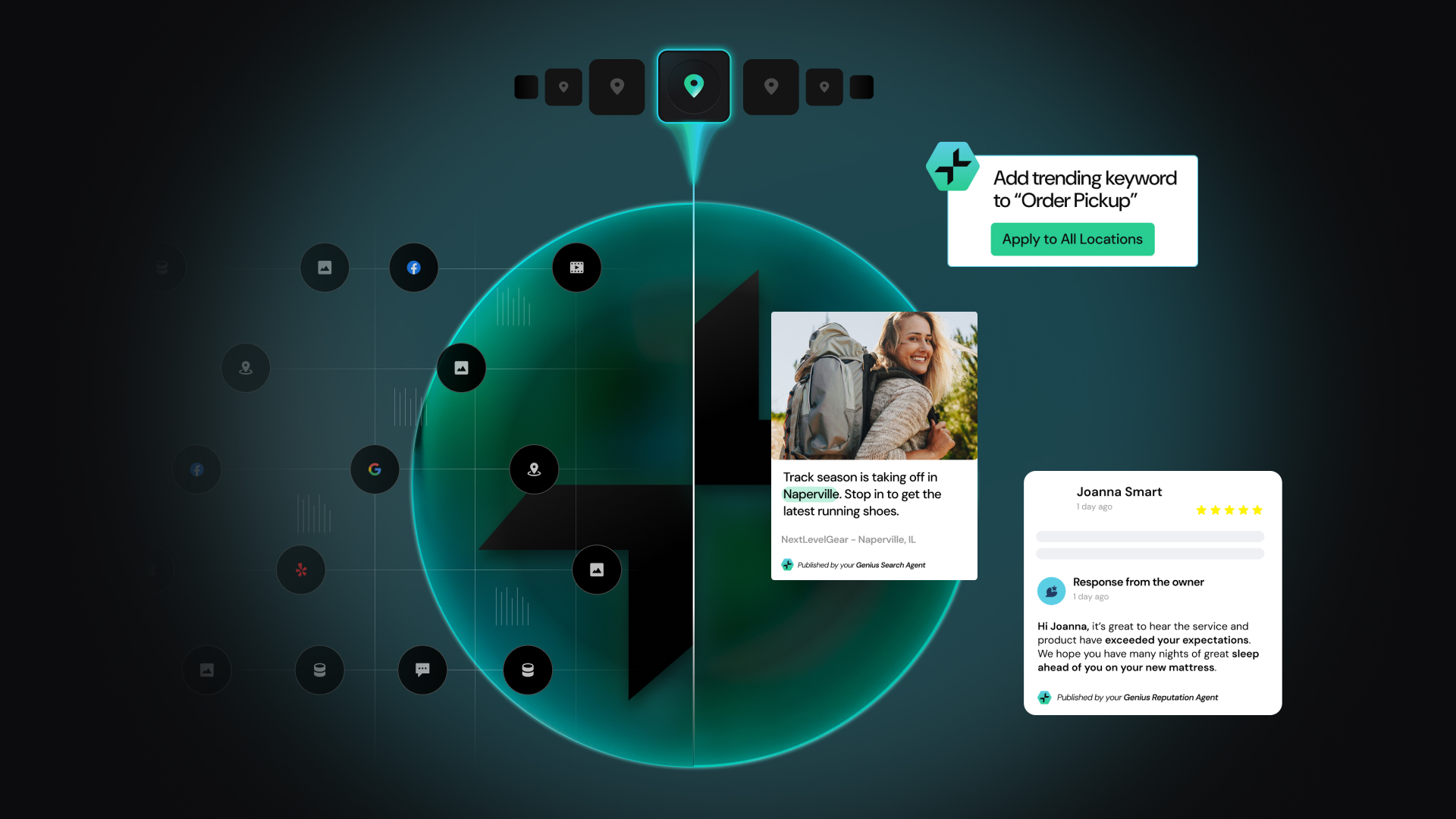
- AI agents, specifically SOCi’s Genius Agents, execute community-level work autonomously: profile accuracy, local content, and resident review response, all inside brand governance.
- According to SOCi’s 2026 Local Visibility Index, multi-location brands that deploy AI-driven local marketing outperform manually managed location sets in local search visibility by a significant margin.
Renters and commercial tenants search the way everyone else does. They search by neighborhood, read reviews, look at photos, and shortlist before they ever fill out a form. By the time a prospect reaches the leasing office, the local search work has already decided whether that community made the list.
What makes property management different from other multi-location businesses is that the locations themselves keep changing. Communities are bought, leased up, stabilized, rebranded, and sold, and each stage calls for different local marketing.
Property management marketing automation is supposed to keep every community visible, accurate, and well-reviewed in the markets where it competes. In practice, most portfolios run marketing centrally and execution on site, which means execution quality varies by whoever is at the desk that week. This post breaks down what community-level local marketing actually requires, where automation falls short, and what AI agents make possible now.
What Is Property Management Marketing Automation?
Property management marketing automation uses software, workflows, and AI agents to run local marketing for every community in a portfolio without manual work at each on-site office. The goal is locally relevant, brand-compliant output at every property, kept current through the constant change a portfolio generates.
It spans several operational domains:
- Listings and citation accuracy: Keeping NAP data, office hours, and community details consistent across every directory, map, and listing surface, and propagating changes the moment a property is acquired, rebranded, or repositioned.
- Google Business Profile optimization: Publishing community-specific posts, maintaining attributes and amenities, and managing photos and Q&A for every property.
- Reputation management: Monitoring resident and prospect reviews, responding in brand voice with appropriate care, and flagging communities where maintenance or service issues are surfacing publicly.
- Local content and lease-up support: Distributing genuinely localized content to social profiles, community pages, and listing platforms, tuned to occupancy needs rather than a single portfolio calendar.
- Performance monitoring by community: Tracking local visibility, discovery, and engagement per property so a declining community is identified before it shows up in traffic and occupancy.
Each of these requires community-level specificity. One portfolio-wide post duplicated across 140 profiles is not automation. It is mass production, and it does not improve local search visibility for any individual community.
What Property Management Marketing Automation Includes
Property management marketing automation uses software, workflows, and AI agents to run local marketing for every community in a portfolio without manual work at each on-site office. It covers listing and citation accuracy, Google Business Profile posts and amenities, resident and prospect review responses, local content that supports leasing, and tracking each community’s visibility so a decline is caught before it shows up in occupancy.
All of this has to happen at the community level. A single portfolio-wide post copied to 140 community profiles is easy to schedule, but it doesn’t make any one community more visible in its own submarket, where it competes against a different set of properties with its own rating, amenities, and occupancy pressure.
Stage 1: The Acquisition
A new community joins the portfolio, often as part of a group of properties. Along with the buildings comes their online footprint: listings, profiles, and citations across dozens of sites, managed to whatever standard the previous owner kept.
Where it breaks: That inherited data is almost always inconsistent: old phone numbers, outdated office hours, the former management company’s name, duplicate profiles. Cleaning it up is usually handled as a one-off project, which means it waits behind every other part of the transition. Meanwhile, prospects and AI assistants are reading the wrong information. SOCi’s Local Visibility Index found that while 98% of brand locations studied had claimed their Google profile, only 80% had claimed Yelp and just 53% were managing their Facebook pages, and that LLMs cite local brand information correctly only about 79% of the time as a result of inconsistencies like these.
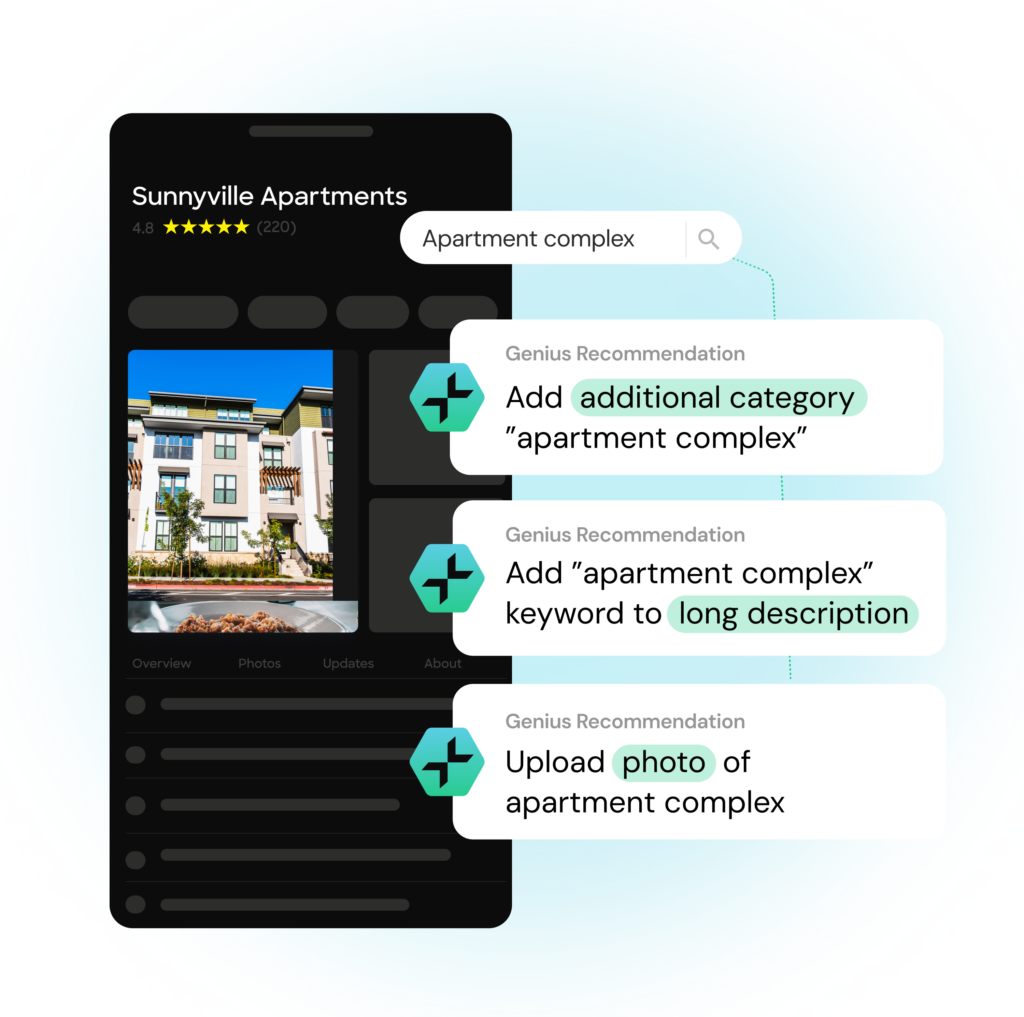
With Genius Agents: The Local Search Agent treats a newly acquired community like any other: it checks listings across the footprint, corrects what’s wrong, and keeps it accurate going forward. Data cleanup becomes part of normal operations instead of a separate project for every deal.
Stage 2: Lease-Up
A new or repositioned community in lease-up needs to be found, fast. Visibility and a steady flow of fresh, specific content matter more at this stage than at any other.
Where it breaks: Corporate content calendars aren’t built for one community’s urgency. The fallback is generic copy, such as “modern living at [Community Name],” that tells Google nothing about the location and gives prospects no reason to choose it over the property down the street. Google’s local algorithm rewards content that’s relevant, recent, and specific.
With Genius Agents: The Social Agent and Local Search Agent publish content built on what makes the community distinct: its neighborhood, nearby transit and employers, local competition, and what’s happening on site. Communities in lease-up can get more frequent posting than stabilized ones, instead of every property following the same schedule.
Stage 3: Stabilized
Once a community is stabilized, say at 96% occupancy, the priority shifts from being found to being trusted. Reviews do much of the leasing work at this stage, and they’re often the hardest part to manage.
Where it breaks: Resident reviews are fewer than in retail or restaurants, but they’re longer, more emotional, and often about maintenance requests, billing, or neighbors. A 120-community portfolio averaging 8 reviews per community each month receives 960 reviews a month. A careful reply takes closer to eight minutes than five, so that’s about 128 hours of work every month. On-site teams are stretched thin, and turnover is high. When a community manager leaves, the login, the habit of responding, and the history of what was already handled often leave too. Unanswered reviews weaken local signals, and prospects read the silence as an answer.
With Genius Agents: The Reputation Agent reads each resident and prospect review and responds in brand voice to the specific issue raised, acknowledging a slow maintenance request without overpromising or sharing a resident’s private details. Because the work doesn’t live with one person on site, it continues through staff changes. The agent also flags communities where maintenance or service complaints are starting to cluster, so operations can act before the rating drops.
Stage 4: Renewal Season
Keeping residents is usually cheaper than replacing them, and current residents are an audience too. They see the community’s profile, its posts, and how management responds when neighbors raise concerns in public.
Where it breaks: Local marketing is often switched off once a community is full, so profiles go stale and reviews pile up just as leases come up for renewal. A resident deciding whether to stay reads that silence the same way a prospect does.
With Genius Agents: The agents keep every stabilized community’s profile current and its reviews answered year-round, so the online presence residents see supports renewals instead of undermining them.
Stage 5: Rebrand, Renovation, or Sale
Eventually, many communities are repositioned: renamed, renovated, moved to a different brand, or sold. Each change affects every listing the community has.
Where it breaks: A rebrand makes existing citations wrong overnight. A renovation takes a building or leasing office offline for weeks. A new competitor delivers 300 units two blocks away. A storm closes the office for a week. Rules-based tools can’t handle these exceptions, so each one lands in someone’s queue, and old names and hours can linger online for months.
With Genius Agents: The Local Search Agent updates names, hours, and details across the footprint when the change happens, and keeps watching for old information that resurfaces. When a community’s visibility drops after a change, the agents look for the likely cause and correct it within brand guidelines.
Why Most Property Marketing Tools Miss the Lifecycle
Most portfolios run marketing strategy from corporate and leave execution to on-site teams, so quality depends on whoever is at the desk that week. The tools in between were built to distribute, not to adapt, and they share a few blind spots:
- Syndication isn’t local marketing. Getting a community listed everywhere is the baseline. It doesn’t deliver the fresh content, review responses, or profile depth that local ranking rewards.
- Reporting stops short of action. Community-level dashboards show which properties are slipping. Someone still has to diagnose and fix each one, and at 200 communities, that doesn’t scale.
- The stack is fragmented. Google Business Profile, listing sites, social, review platforms, and community websites each live in their own tool, with no single view of a community’s performance and no link to real availability.
- Every community is treated the same. Portfolio-wide automation gives a lease-up property and a full, stabilized property the same treatment, wasting effort on one and shortchanging the other.
SOCi’s Genius Agents address these gaps by making decisions specific to each community and acting on them.
How AI Agents Change Property Management Marketing Automation
AI agents do not just automate tasks. They execute judgment at scale. That distinction matters in property management because the highest-value work, responding to a frustrated resident or writing something genuinely local about a submarket, requires reading a specific situation and answering it well.
SOCi’s Genius Agents are that shift in practice. Marketing sets the parameters and reviews exceptions. The agents do the work.
The operational change shows up in three dimensions.
Genuine community-level content at volume. Genius Agents generate profile posts, social content, and review responses grounded in real property-level inputs: the neighborhood, the local competitive set, recent resident signals. Not a template with a community name inserted. Content Google can distinguish as locally relevant, which is what lifts local search visibility.
Continuous monitoring without continuous staffing. Genius Agents watch listing accuracy, review streams, and ranking signals across the full portfolio without anyone opening a dashboard. When an acquisition introduces bad data or a community’s rating starts sliding, the system acts. Portfolios get the equivalent of a dedicated local marketer per community without adding on-site marketing headcount.
Closed-loop performance improvement. Rather than reporting and handing intervention back to a human, agents identify underperforming communities, diagnose likely causes from available signals, and execute corrective action inside brand parameters. Local visibility becomes an operating output instead of a lease-up scramble.
What to Evaluate Before Choosing a Property Marketing Automation Platform
Most operators today push templates from corporate, manage exceptions through a platform, or both. Few have reached the point where community-level work runs on its own. When evaluating platforms to close that gap, give each vendor one realistic scenario: “We just acquired nine communities with inherited listing data. Walk us through the first 30 days.” Their answer will show you most of what you need to know. Listen for four things:
- How it absorbs portfolio change. New properties should be onboarded and their listings corrected as a routine process, not a manual project for every transaction.
- How it writes for one community. Ask what content for one of the nine acquired communities would look like in week two. If the answer is a template with the property name inserted, it isn’t AI-driven local marketing.
- How it handles a difficult resident review. Bring a real review about a maintenance delay and read the vendor’s response the way a prospect touring next week would. It should address the specific issue without overpromising.
- How deep its Google Business Profile support goes. Google Business Profile is the most influential local channel for most communities. The platform should manage posts, amenities and attributes, Q&A, and photos, not just the address and office hours.
Getting this right has a measurable payoff. SOCi’s industry research found that brands managing Google Business Profile optimization as an integrated, automated workflow, rather than an occasional manual task, see a 14% lift in visibility.
What Portfolio Local Marketing Maturity Looks Like
Most operators sit somewhere on a curve running from fully manual to fully agentic. Moving up requires operational redesign, not just a purchase.
Stage 1: Site-dependent. On-site teams manage their own profiles and reviews when time allows. Brand consistency is low. Corporate has no community-level visibility.
Stage 2: Centralized distribution. Corporate pushes portfolio templates to every community profile. NAP consistency improves. Local relevance drops. Profile performance is mediocre because the content is generic.
Stage 3: Platform-assisted management. A platform aggregates community data, centralizes review monitoring, and enables bulk updates. Marketing manages exceptions. Performance improves, but it scales with headcount.
Stage 4: Agentic execution. Genius Agents execute community-level work autonomously inside brand parameters. Marketing focuses on strategy, exception review, and interpretation. Local search visibility improves as a byproduct of continuous operation.
Stage 4 is where Genius Agents operate. Most portfolios are in Stage 2 or 3.
Frequently Asked Questions
What is property management marketing automation? Property management marketing automation is the use of software systems and AI-driven workflows to execute, monitor, and optimize local marketing for every community in a portfolio without manual intervention at each site. It covers listings accuracy, Google Business Profile optimization, resident review response, local content, and community-level performance monitoring.
How do AI agents improve local SEO for multifamily portfolios? AI agents continuously monitor community-level signals, generate locally relevant content for profiles and social platforms, respond to resident and prospect reviews with language specific to what was raised, and correct listing inaccuracies in real time. Unlike rules-based automation, agents adapt to each submarket without proportional increases in staffing.
Why do resident reviews matter so much for leasing performance? Prospects read reviews before they tour, and an unanswered negative review is read as confirmation. Review response rate is also a confirmed local ranking factor, so unanswered reviews reduce both conversion and visibility at the same time.
How does automation handle acquisitions and rebrands? Every acquisition brings inherited listing data of unknown quality across dozens of surfaces, and every rebrand invalidates existing citations. Genius Agents maintain listing accuracy continuously across the portfolio, which turns transaction-driven data cleanup into ongoing operation rather than a project per deal.
What is the Local Visibility Index and why does it matter for property management? The Local Visibility Index is SOCi’s annual research benchmarking local marketing performance across multi-location brands and industries. It reports on profile optimization rates, review response rates, local search visibility, and competitive performance by sector, which gives portfolio marketers external benchmarks for the internal business case.
Where should a property management company start? Start with Google Business Profile completeness and accuracy at every community. GBP is the primary local ranking signal for neighborhood and near-me search. Verify NAP consistency across major directories and listing platforms next. Then focus on review response rate. Automating those three before expanding into local content produces the fastest measurable improvement.
See Our Genius Agents in Action
See how SOCi Genius Agents automate local marketing across every community in your portfolio.
Related Articles