What Happens When AI Searches for You: A Meeting of 150 Marketing Leaders Discuss

Share


Recap of SOCi ReImagine 2026 (October 15 and 16, 2026). Customers are starting to hand their searching, comparing, and buying to AI agents. Here is what marketing leaders at ReImagine are doing about it as they plan for 2027.
The Short Answer
When AI searches for your customer, it researches, compares, and increasingly books on their behalf, often without the customer ever seeing your brand. The marketers at ReImagine agreed on three things: the fundamentals of local visibility still decide who gets recommended, accuracy and consistency across every location matter more than ever, and the work is too large for people alone. The leaders getting results are putting brand-trained agents on the routine work and keeping humans in charge of judgment.
More than 150 multi-location marketing leaders, plus partners from Google, Semrush, and Near Media, spent two days at SOCi ReImagine 2026 on one question: what happens when AI searches for you? The sessions covered consumer behavior, search, social, reputation, and the first real-world results from agentic marketing.
This recap pulls together the key points, the numbers speakers shared, and the quotes that stuck, so you can see how marketers are thinking as 2027 planning begins.
The numbers at a glance
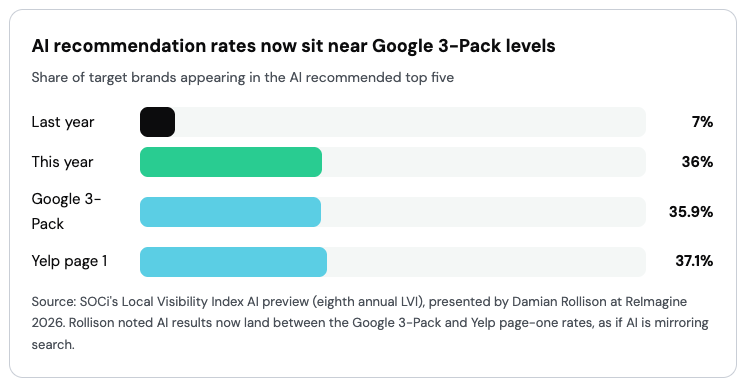
36%
of target brands now appear in the AI recommended top five for local searches
SOCi’s LVI AI preview, Damian Rollison
60%
of consumers now use AI tools at least monthly, up from 19% a year earlier
SOCi’s 2026 Local Discovery Index
81%
take another verification step after an AI recommendation
SOCi’s 2026 Local Discovery Index
5M
Meta Muse AI assistant downloads in just 22 days
Andrew Davis, opening keynote
What does it mean when customers task AI instead of asking it?
Opening keynote speaker Andrew Davis argued that consumer behavior has already shifted. People used to ask AI a question and then go do the work themselves. Now they hand the work over.
“As of September 8th, 2026 (thanks to Meta’s Muse), we no longer ask it, we have started to task it.”
— Andrew Davis, opening keynote
In his opening keynote, Davis had an AI assistant find his dentist, fill out the booking form, and confirm the appointment. In a second example, an agent spent about 47 minutes checking reviews, local press, and past receipts before choosing a hardware store for a purchase. Davis’s point for marketers: customers are telling their AI to act, and in many cases they never see your brand along the way.
The four levers for getting chosen
Davis gave marketers a framework for earning a place in an agent’s decision. He called it Pull, Preference, Proof, and Path.
Davis also flagged a practical Path problem: agents now phone businesses, and staff who do not realize they are speaking to an agent may hang up.
“How do we make it easier and faster for our customers’ agents to choose and buy from us?”
— Andrew Davis, closing his keynote with the question marketers should take home
Is AI replacing local SEO?
The short answer from the partner sessions was no. Local search consultant David Mihm of Near Media told the room not to chase the shiny object. Google still dominates the sources AI relies on, and he said google.com gets about 15 times more visits than ChatGPT.
“Good local SEO is still the winning visibility formula.”
— David Mihm, Near Media
Google’s Lisa Landsman said the same thing from the platform side: “Good SEO is still good SEO.” She pointed marketers to five habits for AI search success: publish unique, non-commodity content, make sure Google can access it, show local expertise, keep information consistent and fresh across platforms, and cultivate and respond to reviews.
That does not mean nothing is changing. Mihm expects unbranded click traffic to keep eroding as AI Overviews answer more questions on the results page, and he expects more “dark AI” conversions, where a customer researches in an AI tool and then arrives through a brand search or direct visit. His advice:
- Protect brand search. Brand queries are the best defense against interface changes.
- Build local pages that go beyond name, address, phone, and a map. Cover the themes your customers ask about.
- Invest in YouTube and PR. He called YouTube the number one cited domain in AI Overviews.
- Ask “How did you hear about us?” on every lead form, since analytics will undercount AI influence.
How often does AI recommend local businesses?
Damian Rollison, SOCi’s Senior Director of Market Insights, previewed new research from the eighth annual Local Visibility Index (LVI), focused on AI search. The full LVI publishes in January, with a preview report on the AI results in November. The numbers below are from that preview.
The method is simple. SOCi asked ChatGPT, Gemini, and Claude to recommend 10 local businesses of a given type in a given market, then checked where each brand’s locations landed. Positions 1 to 5 count as likely to be recommended, positions 6 to 10 are at risk, and anyone not on the list is invisible. The dataset covers about 3,000 brands across roughly 44 industries, with 8.5 million data points, 3 million local business results, and 1.4 million citations analyzed.
“No brand is all recommended or all not recommended.”
— Damian Rollison, SOCi. In the research, 89.7% of brands had a mix of strong and missing locations.
Visibility varies a lot by industry
Share of brands appearing in AI recommendations:
Retailabout 50%
Local services38 to 40%
Financial services ranked third. Food and beverage and property had the lowest rates. Rollison tied the spread to competition: a town may have only a few hardware stores, but many similar restaurants and apartment communities. Source: SOCi’s LVI AI preview.
Ratings are close to a gatekeeper, and review volume can offset a gap
Rating was the clearest driver in the data. Locations in the recommended group averaged a little over 4.3 stars on Gemini and just above 4.2 on ChatGPT. Locations in positions 6 to 10 hovered around 4 stars. Rollison summed it up as roughly a quarter of a star separating recommended businesses from those at risk.
“Rating really does drive AI visibility, almost more than any other factor.”
— Damian Rollison, SOCi
New this year is the effect of review volume. A location with a lower rating can still win if it has more reviews than a competitor sitting 0.2 stars above it. Recommended locations averaged about 150 to 190 reviews, compared with 90 to 135 for locations in positions 6 to 10.
Where does AI look, and where are brands missing?
Three sources showed up almost every time: Google Maps, your own website, and Yelp. Rollison said all three had breadth and depth above 90%, so any issue there should be fixed first. Yelp’s weight has grown since its relationship with ChatGPT and its frequent appearance in Claude citations.
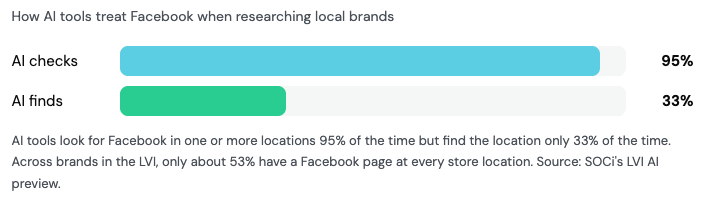
Facebook is the gap worth closing. AI tools look for Facebook in one or more locations 95% of the time but find the location only 33% of the time.
Accuracy is also improving, with gaps. Overall AI accuracy for local business details was about 67% last year. ChatGPT is now at about 85% and Claude at 88%, with Gemini the most accurate because accuracy is measured against Google Maps. Phone number, website, and hours of operation are the weakest fields, so keep those current everywhere AI draws from.
Three things you can do so AI recommends your business
- Fix the top three sources at every location: your website, your Yelp profile, and your Google Business Profile.
- Drive higher ratings and more reviews to become a candidate for AI recommendations.
- Optimize the citations specific to your brand. Industry lists help, but your own citation profile matters more.
He was direct about scale: this is a problem solved one location and one listing at a time, or by an agentic workforce doing that work for you.
Do consumers trust what AI tells them?
Kaci McBride of SOCi presented the 2026 Local Discovery Index and described consumer behavior as a verification loop, not a funnel. Consumers discover a business in one place, check it in another, and decide in a third, often within minutes. AI is now part of that loop, but it is not the end of it.
After an AI recommendation, most consumers keep checking
Verify elsewhere
81%
81%
Contact the business directly
19%
19%
Of the 81%, consumers check reviews first (33%), social (20%), search (16%), or multiple sources (12%). Source: SOCi’s 2026 Local Discovery Index.
Trust is the reason. The Index found that 67% of AI users have been given wrong information about a local business at least once, and 73% say their trust in AI has not increased over the past year. If your reviews, social presence, and listings do not agree with what the AI said, the customer moves on.
“This era of marketing isn’t about winning clicks or web traffic. In fact, we can hardly even track those anymore. It’s about finding consistency and trust within that loop.”
— Kaci McBride, SOCi
Social is a big part of that loop. The Index found that 59% of consumers have become a customer of a local business because of a social post or video, and Facebook leads the platforms consumers use to research local businesses at 73%.
What does AI search mean for the workload?
SOCi founder and CEO Afif Khoury put numbers on the problem. Customers now look for businesses across about 20 to 25 networks plus several AI platforms. He estimated about 100 tasks per location each month, which works out to 100,000 a month at 1,000 locations. Asking local managers to log into seven systems to cover it, he said, is “an unfair ask. It always has been.”
“None of you have an army. SOCi doesn’t have an army either, but we all now have an army.”
— Afif Khoury, founder and CEO, SOCi, on brand-trained agents
How did Liberty Tax scale AI visibility with a 9 person team?
Kyle Sawai, CMO of Liberty Tax, joined SOCi’s Monica Ho to show what that looks like in practice. The hardest part, he said, was taking control of listings back from individual franchisees. Once that was done, agents took over the volume work.
Reviews collected, with a marketing team of nine
First yearabout 16,000
This year60,000+
Source: Kyle Sawai, Liberty Tax, ReImagine 2026. Review response time was cut in half, with 4 and 5 star reviews answered within about two hours. Lower ratings get a personal response.
The context matters. Sawai said Liberty Tax’s biggest competitor outspends the brand 75 to 1, so local execution is how it competes. To measure success when clicks are harder to track, the team runs a location-level scorecard covering review response rates, social posting, and similar signals. His advice to peers on handing work to agents:
“You need to be comfortable with being uncomfortable.”
— Kyle Sawai, Liberty Tax
What did marketing leaders get right and wrong with AI?
The CMO panel, moderated by Brandon Rhoten of Dave’s Hot Chicken, started by asking each leader what AI projects went right, and wrong this past year.
What went wrong was just as useful as what went right:
- Franchisees went rogue with AI images. Lindsey McFadden of Stretch Zone showed examples of off-brand posts, including people with missing limbs. Her fix was a modified version of the brand guidelines written for AI.
- Hype outran value. One executive said franchisees are being sold “automation with a new user interface” as AI, and marketers need to coach them toward tools that work.
- Legal caught up. Christina Clarke of Sport Clips Haircuts said talent contracts now need to cover editing, modifying, and training AI on a person’s likeness.
- Budgeting is messy. Panelists described folding AI into existing vendor budgets, and Clarke called forecasting token usage a hard problem.
“Don’t confuse effort with results.”
— Lindsey McFadden, Stretch Zone
On people, the panelists expect flat headcount with changing roles. Rhoten runs a team of six, with nobody planning to hire next year. On decisions, the executives drew a line many in the room echoed:
“We want AI to advise on judgment, but we want human accountability on making that decision.”
One attendee takeaway, called out during the Day 1 wrap-up, summed up the mood: “No more AI slop.”
What do early adopters say to do first?
The Champions Panel brought three practitioners with lean teams and large footprints. Valvoline Express Care has 254 locations and a marketing team of one. Burn Boot Camp has 470 locations and a team of about 25. NACS is an association serving an industry of about 150,000 convenience stores. Their advice was practical.
“Until you trust the agent, you can’t just set it free.”
— Christina Scala, NACS
Lattimore added a segmentation lesson: Burn found that reactivated trials and former members convert at 4.7 times the rate of brand-new leads, so it stopped sending every segment the same message. Her bigger obstacle was not technology. It was getting local owners to follow the playbook and turn automations on.
In our prior session, Sport Clips’ Christina Clarke made the reputation case from a different angle: “I can’t outspend a bad experience.” Her team routes negative reviews to local team leaders on purpose, not because it distrusts the agent, but because someone needs to fix the root cause.
Mentions or citations: which one do you need?
Fernando Angulo of Semrush closed the research track with a framework for AI visibility, drawn from an analysis of 196 million prompts. His distinction is simple and worth remembering:
Angulo also said AI visibility is a company-wide effort, not only an SEO task. Customer success owns review platforms, social owns community threads, and PR sits near the top. He cited Semrush data showing that 25% of US desktop Google searches ended without a click, which is one more reason to measure presence and trust rather than traffic alone.
What Should Multi-Location Marketers Do First in 2027?
- Plan for customers who send an agent. Audit your brand against Pull, Preference, Proof, and Path.
- Keep doing the fundamentals. Your website, Yelp profile, and Google Business Profile ground most AI answers. Ratings and review volume decide who makes the list.
- Accuracy beats volume. Conflicting information across platforms is what AI and consumers punish first.
- Show up in the whole loop. Search, social, reviews, and AI each cover for the others’ weak spots.
- Start agents where the work is repetitive. Review responses, listings, and social posting came up again and again.
- Write the guardrails before you flip the switch. Approvals, escalation paths, AI-ready brand guidelines, and talent rights.
- Measure presence, not just clicks. Use location-level scorecards, brand search, and “How did you hear about us?”
FAQ
What happens when AI searches for you?
Your customer’s AI assistant researches, compares, and increasingly books on their behalf, so a consumer may never see your brand directly. Speakers at ReImagine said brands get chosen when they are recognized, clearly matched to a need, backed by fresh third-party evidence, and easy for an agent to transact with.
Is AI replacing local SEO?
No. David Mihm said good local SEO is still the winning visibility formula, and Google’s Lisa Landsman said good SEO is still good SEO. Profiles, reviews, and consistent listings feed AI answers.
How often does AI recommend local businesses?
SOCi’s Local Visibility Index AI preview found that target brands appeared in the AI recommended top five 36% of the time, up from 7% the year before. Rates vary by industry, with retail near 50% and food and beverage and property the lowest.
Do consumers trust AI recommendations for local businesses?
Not enough to stop checking. SOCi’s 2026 Local Discovery Index found that 81% of consumers take another verification step after an AI recommendation, and only 19% contact the business directly.
What did marketing leaders get wrong about AI this year?
Panelists cited off-brand franchisee AI images, tools sold as AI that were automation with a new interface, and gaps in legal review of likeness rights. Several graded their own progress between a C- and a B-.
How can a small team manage visibility across hundreds of locations?
By assigning routine work such as review responses and listing updates to brand-trained agents, with approvals and escalation rules set up front. Liberty Tax kept a nine-person team while growing from about 16,000 reviews in a year to more than 60,000.
See how your locations show up when AI does the searching
SOCi’s Local Visibility Index scores your brand across search, reputation, social, and AI. The AI preview report publishes in November, and the full 2027 LVI follows in January.
About SOCi
Making Every Location Visible
SOCi is redefining how multi-location enterprises achieve local and AI search visibility with the industry’s first agentic workforce. Built specifically for distributed brands, SOCi’s brand-trained agents are guided by a unified visibility engine that autonomously executes and optimizes local marketing work across AI search, GEO ecosystems, social, and reviews, ensuring every location is visible, discoverable, and growing in today’s geo-driven landscape. Trusted by leading brands like Ford, Ace Hardware, and Liberty Tax, and recognized by Fast Company as one of the World’s Most Innovative Companies, SOCi transforms marketing from software you manage into work that gets done, intelligently, consistently, and at scale.
Learn more at www.soci.ai or contact [email protected].
Related Articles